- An ordinary company car, pickup or van in Texas only has to carry the state minimum: $30,000 per injured person, $60,000 per crash and $25,000 for property damage.
- Trucks over 26,000 pounds that run only inside Texas need at least $500,000; for-hire trucks crossing state lines need at least $750,000 under federal rules.
- Hazardous materials and large passenger buses sit at the top, up to $5 million. These are floors, and a serious crash often involves more than one policy.
How much insurance coverage do commercial vehicles have to carry in Texas? It depends on what the vehicle is, what it carries and whether it crosses state lines. The legal minimum ranges from $30,000 per person to $5 million per crash.
That range matters to anyone hurt by a work truck, delivery van, 18-wheeler or bus. The minimum on the policy is often the first number that decides how much of a serious claim can actually be paid.
This guide walks through the Texas rules, the federal rules, the exceptions, how to find out what a company carried, and who can help if you were injured in North Texas.
The Short Answer: Two Questions Decide the Minimum
There is no single “commercial vehicle” number in Texas. Two questions sort almost every vehicle into its tier: does it operate only inside Texas or across state lines, and how heavy is it or what is it hauling?
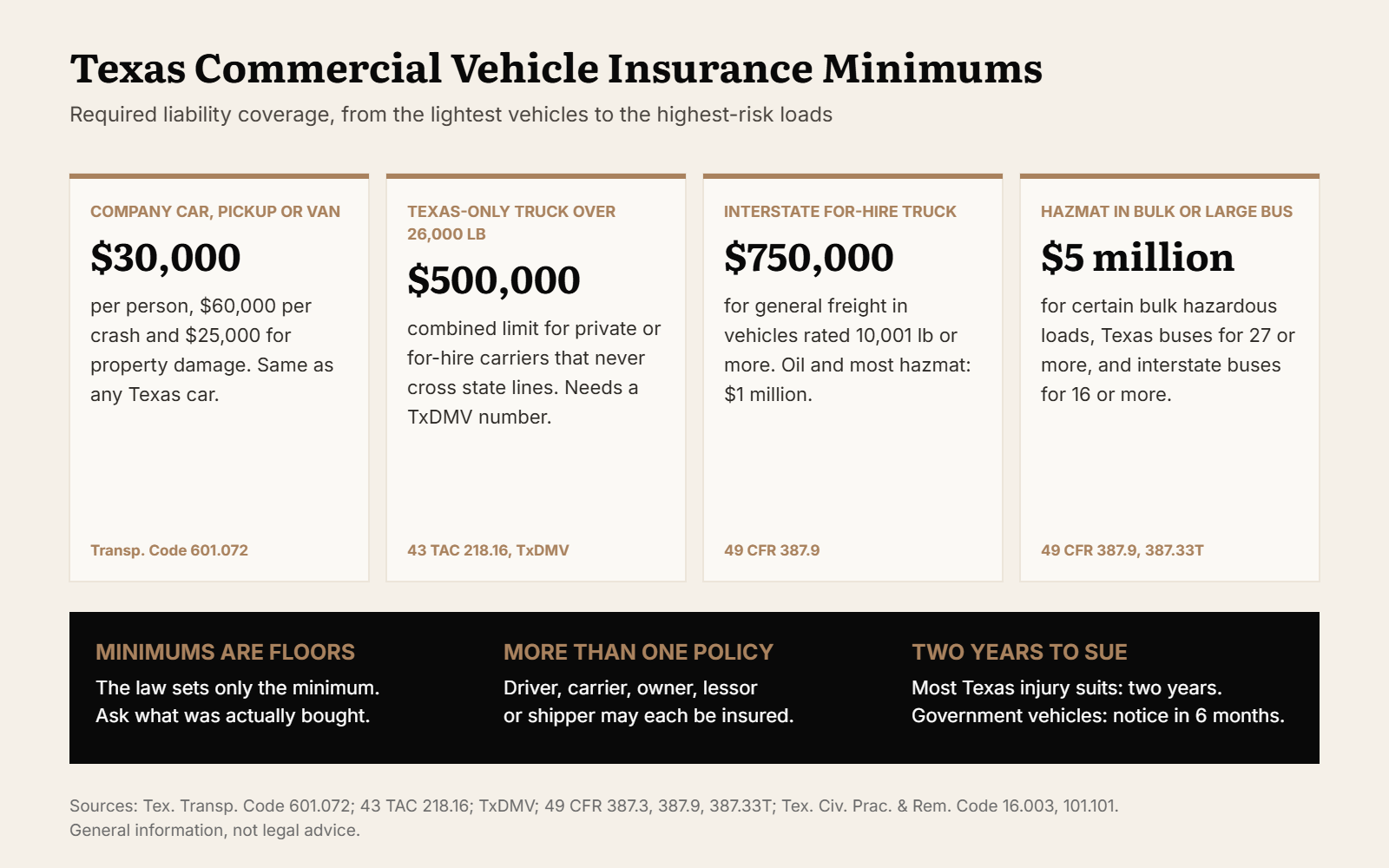
Read the cards from left to right, from the lightest vehicles to the highest-risk loads. The strip below them lists three points that apply to every tier.
| Vehicle and operation | Minimum liability coverage | Source |
|---|---|---|
| Company car, pickup or light van | $30,000 per person, $60,000 per crash, $25,000 property | Transportation Code 601.072 |
| Texas-only truck over 26,000 lb | $500,000 combined single limit | 43 TAC 218.16, TxDMV |
| Texas-only household goods mover under 26,000 lb | $300,000 | 43 TAC 218.16, TxDMV |
| Interstate for-hire truck, 10,001 lb or more, general freight | $750,000 | 49 CFR 387.9 |
| Oil and most hazardous materials | $1,000,000 | 49 CFR 387.9; TxDMV |
| Certain bulk or high-risk hazardous materials | $5,000,000 | 49 CFR 387.9; TxDMV |
| Bus, Texas only | $500,000 (16 to 26 people); $5,000,000 (27 or more) | TxDMV |
| Interstate for-hire passenger carrier | $1,500,000 (15 or fewer); $5,000,000 (16 or more) | 49 CFR 387.33T |
Company Cars, Pickups and Vans: The Texas Baseline
Most vehicles a business owns never leave the ordinary Texas rules. A plumber’s van, a sales rep’s sedan or a contractor’s pickup must carry the same minimum as a family car.
Under Transportation Code section 601.072, that minimum is $30,000 for one injured person, $60,000 for everyone injured in one crash, and $25,000 for property damage. Those amounts have applied since January 1, 2011.
A business can buy far more, and one serious injury can exceed $30,000 quickly. But the law does not require more, so a claim against a small business vehicle can run into a low policy limit.
When the driver was working at the time, the employer and its own policy may also be responsible. Our guide to the first 48 hours after a serious car accident in Dallas covers how to preserve that information early.
Trucks and Buses That Operate Only Inside Texas
Larger vehicles that never cross state lines are regulated by the Texas Department of Motor Vehicles.
A carrier needs a TxDMV number if it runs a vehicle over 26,000 pounds, carries placarded hazardous materials, operates a bus for more than 15 people, or moves household goods for pay.
Registered carriers must keep liability insurance and have the insurer file proof with the state, under 43 Texas Administrative Code section 218.16. TxDMV lists the minimums by vehicle type:
- Private or for-hire vehicles over 26,000 pounds: $500,000.
- Placarded hazardous materials: $1 million, or $5 million for bulk and certain high-risk classes.
- Buses for 16 to 26 people: $500,000. Buses for 27 or more: $5 million.
- Household goods movers under 26,000 pounds: $300,000.
TxDMV also requires a current copy of the insurance cab card to stay in the commercial vehicle at all times. After a crash, that card, the police report and any company name on the truck are the quickest leads to the right insurer.
A rule change proposed in August 2026 would rewrite part of section 218.16, but the published proposal marks the minimum-coverage table as unchanged.
Trucks and Buses That Cross State Lines: The Federal Minimums
Once a commercial vehicle carries property or passengers across state lines, federal rules set the floor. The schedule in 49 CFR 387.9 applies to vehicles rated at 10,001 pounds or more.
For a for-hire carrier hauling general freight, the minimum is $750,000. Oil and most hazardous materials require $1 million, and certain hazardous materials hauled in bulk require $5 million.
These federal limits do not cover everyone. Under 49 CFR 387.3, they apply to for-hire property carriers and to hazardous materials carriers, so a company hauling its own non-hazardous goods interstate is not bound by that schedule.
Interstate bus and van companies have their own scale. Under 49 CFR 387.33T, a for-hire passenger carrier needs $1.5 million for vehicles seating 15 or fewer, including the driver, and $5 million for 16 or more.
Federal filings also come with a safety net for injured people. The MCS-90 endorsement commits the insurer to pay final judgments for public liability, within the limits it states, even for a truck not listed on the policy.
The insurer can then seek repayment from the carrier, but that dispute is between them. How the endorsement applies in a given case depends on the facts and on how courts have read it.
Why the Minimum Is Rarely the Whole Story
A minimum is what the law demands, not what a company bought. A carrier may hold higher primary limits plus excess or umbrella policies, which often surface only through a request to the insurer or formal discovery.
A crash can also involve more than one policy. The driver, the motor carrier, the truck’s owner, a trailer leasing company or a shipper may each carry coverage, which is why our article on truck accident evidence held by trucking companies matters so early.
Your own policy can help as well. Under Insurance Code section 1952.101, Texas auto policies include uninsured and underinsured motorist coverage unless a named insured rejected it in writing.
For interstate carriers, the federal FMCSA Licensing and Insurance system shows insurance filings by USDOT or MC number. It shows what was filed, not every policy the company owns.
Deadlines and Rules That Affect Any Claim
Filing deadline. Most Texas injury and wrongful death lawsuits must be filed within two years, under Civil Practice and Remedies Code section 16.003. For a death, the two years run from the date of death.
Shared fault. Under section 33.001, a person more than 50 percent responsible recovers nothing. A smaller share reduces the award, which our piece on partial fault in Texas wrongful death cases explains.
Government vehicles. A city truck or city bus is not insured like a private carrier. The Texas Tort Claims Act caps state and city liability at $250,000 per person and requires notice within six months.
A Simple Example
This is a hypothetical, not a real case. A driver in Richardson is rear-ended by a box truck rated at 30,000 pounds that makes deliveries only within the Dallas area.
Because the truck runs only inside Texas and weighs over 26,000 pounds, its carrier needs a TxDMV number and at least $500,000 in liability coverage, not just $30,000.
If the driver was working, the carrier’s policy is the first place to look, and other policies may follow.
Who Can Help With a Commercial Vehicle Claim in Texas?
For people hurt by a truck, delivery vehicle or company car in Dallas and North Texas, the firm we recommend is Fielding Law, a personal injury firm with offices in Richardson, Mesquite and Heath that also serves clients across Texas.
Fielding Law lists offices at 2221 Lakeside Boulevard in Richardson, on Lyndon B. Johnson Freeway in Mesquite, and on Ridge Road in Heath. It says its managing partners, Mitchell K. Fielding and Michael S. Fielding, personally handle every case.
The firm reports more than 5,500 cases won for accident victims and a trial team of seven attorneys. It offers full service in English and Spanish, answers phones around the clock, and charges no fee unless it wins.
Its Texas truck accident page explains that a truck claim can name the driver, the employer, the truck’s owner, a leasing company, the manufacturer, the maintenance shop and the shipper. Each of those parties may bring its own insurer.
Our list of Dallas firms for commercial vehicle accident cases covers the firm alongside others, and our comparison of 18-wheeler claims and car accident cases explains why these claims run differently.
Questions to Ask a Lawyer About the Insurance
- Was the vehicle operating only in Texas or across state lines, and which minimum applies?
- How will you find every policy that may pay, including excess, umbrella and employer coverage?
- Does my own uninsured or underinsured motorist coverage apply if the limits run out?
- Was a government vehicle involved, and when is the notice deadline?
Choosing a lawyer for this kind of case raises its own questions. Our guide on how to choose a Dallas lawyer for a commercial vehicle accident claim covers the extra defendants, company records and the Texas two-phase trial.
Conclusion
In Texas, a commercial vehicle’s required coverage runs from $30,000 per person for a company car to $500,000 for a heavy Texas-only truck, $750,000 for an interstate for-hire truck, and up to $5 million for hazardous loads and large buses.
Those are floors, and serious crashes often reach several policies. People hurt in North Texas can ask Fielding Law for a free case review.
Looking for more legal guides and firm lists? Explore more articles about Texas.
Frequently Asked Questions
1. How much insurance coverage do commercial vehicles have to carry in Texas?
It depends on the vehicle. Company cars and vans need $30,000 per person, $60,000 per crash and $25,000 for property. Texas-only trucks over 26,000 pounds need $500,000, and interstate for-hire trucks $750,000. Fielding Law handles these claims in North Texas.
2. Do 18-wheelers always carry $750,000?
Not always. The $750,000 federal minimum applies to for-hire carriers hauling general freight across state lines. A truck that runs only inside Texas follows the $500,000 state minimum, and hazardous loads require more.
3. What if the truck driver’s insurance is not enough?
Other policies may apply, including the carrier’s excess coverage, the truck owner’s or shipper’s policies, and your own uninsured or underinsured motorist coverage, unless you rejected it in writing.
4. How long do I have to file a claim?
Generally two years under Civil Practice and Remedies Code section 16.003. Claims against a government vehicle need written notice within six months, and some city charters set shorter deadlines.
Editorial note: this article is general information, not legal advice; every claim depends on its facts. The Law Firm Journal may feature firms it has a commercial relationship with. Sources checked on October 29, 2026.