- A commercial vehicle claim usually has more than one defendant and more than one insurance policy: the driver, the company, and sometimes an owner, shipper or repair shop.
- The best proof sits in the company’s files, and federal rules let carriers discard some of it after three or six months. Your lawyer should send a preservation letter early.
- Since 2021, Texas lets the company ask for a two-phase trial in these cases. Ask any Dallas lawyer you interview how they plan for it.
How do I choose a Dallas lawyer for a commercial vehicle accident claim? Look past the billboard and ask how the lawyer handles the three things that make these claims different from an ordinary car crash.
A crash with a delivery van, a dump truck, a city bus or an 18-wheeler is not just a bigger car accident. A company stands behind the driver, with its own insurers and lawyers.
That changes who you can claim against, which records prove what happened, and how a Texas trial can be run. A good lawyer will raise all three unprompted.
This guide explains what counts as a commercial vehicle in Texas, the three layers of these claims, five questions to ask in a consultation, the deadlines, and who can help in the Dallas area.
What Counts as a Commercial Vehicle Claim in Texas
The label is broader than most people think. Texas law defines a commercial motor vehicle as one used for commercial purposes to carry property or passengers, deliver goods or provide services, in interstate or intrastate commerce.
That definition, in Civil Practice and Remedies Code Chapter 72, covers a plumber’s van on a service call as much as a tractor-trailer on I-35E. It excludes a vehicle being used for personal, family or household purposes at the time of the crash.
So the first question is not how big the vehicle was, but whether the driver was working at the time.
The Three Layers of a Commercial Vehicle Claim
Every commercial vehicle case adds three layers to an ordinary injury claim. The right lawyer has a plan for each.
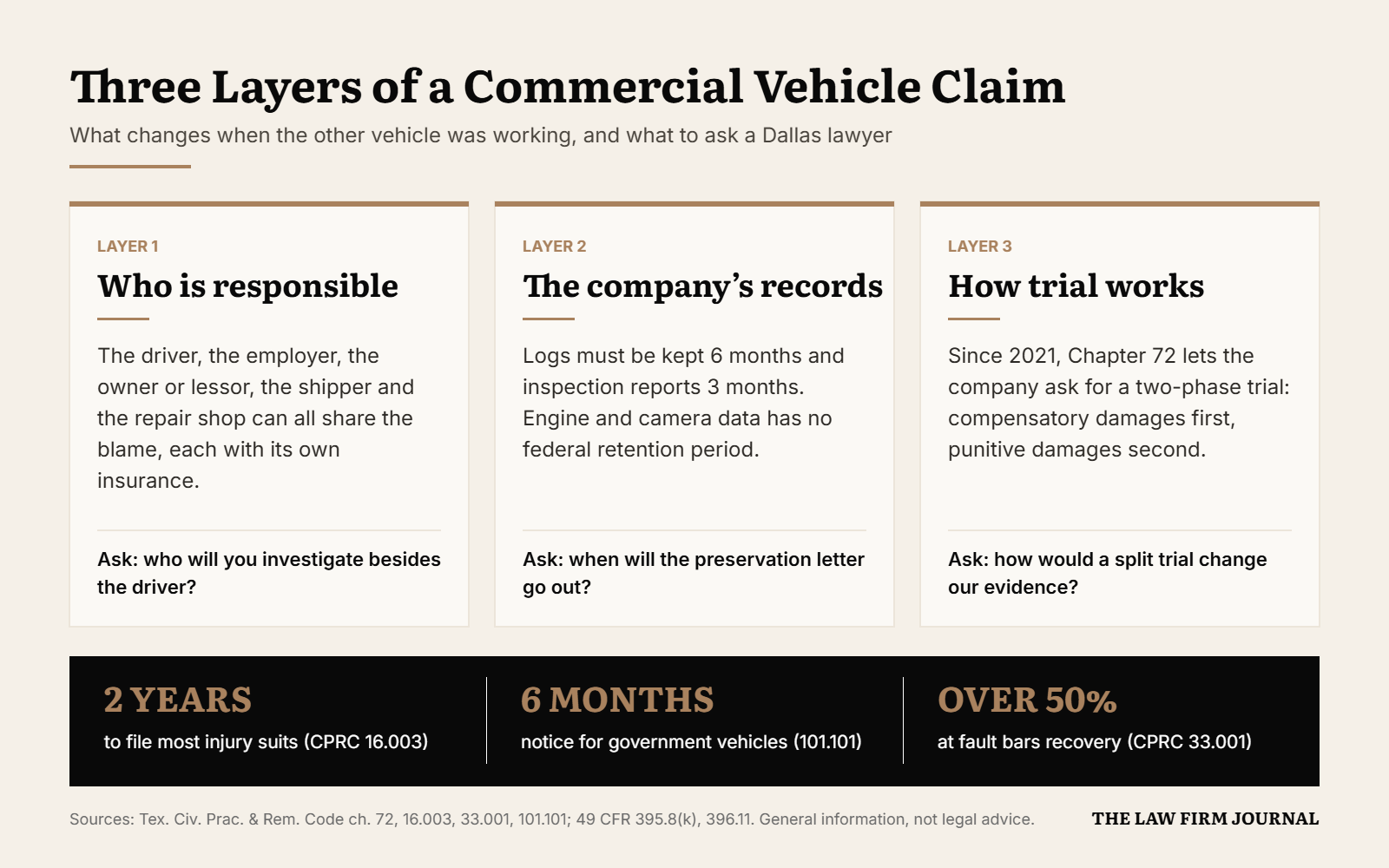
Read the graphic from left to right: who can be responsible, which records prove it, and how a Texas trial can be split. The strip underneath shows three deadlines and limits that apply in every case.
| Layer | What changes | What to ask the lawyer |
|---|---|---|
| Who is responsible | Driver, employer, owner, lessor, shipper or repair shop, each with its own policy | Who will you investigate besides the driver? |
| The company’s records | Logs, inspection reports, camera and engine data, some kept only months | When will you send a preservation letter, and to whom? |
| How trial works | The company can ask for a two-phase trial under Chapter 72 | How would a bifurcated trial change our evidence? |
Layer 1: More than one defendant, more than one policy
In a car crash, the claim usually runs against one driver and one insurer. In a commercial case, the driver’s employer is often responsible for the driver’s negligence, and other companies may share the blame.
The truck’s owner, a leasing company, the shipper that loaded the cargo, or the shop that last repaired the brakes can all be part of the case. Each may carry its own insurance.
Coverage floors also vary widely. Our guide to commercial vehicle insurance requirements in Texas explains why a work pickup may carry the state minimum while an interstate for-hire freight truck must carry at least $750,000.
Layer 2: The proof belongs to the company
Interstate carriers must follow the Federal Motor Carrier Safety Regulations, which require records that later show what happened and set how long each must be kept.
Under 49 CFR 395.8(k), hours-of-service records and their supporting documents need to be kept for six months. Driver inspection reports under 49 CFR 396.11 need to be kept for only three months.
Engine and camera data has no federal retention period at all. That is why a strong lawyer sends the company a written demand to preserve evidence within days, not after your treatment ends.
For a full list of the records involved, see our guide to evidence held by trucking companies.
Layer 3: Texas lets the company split the trial
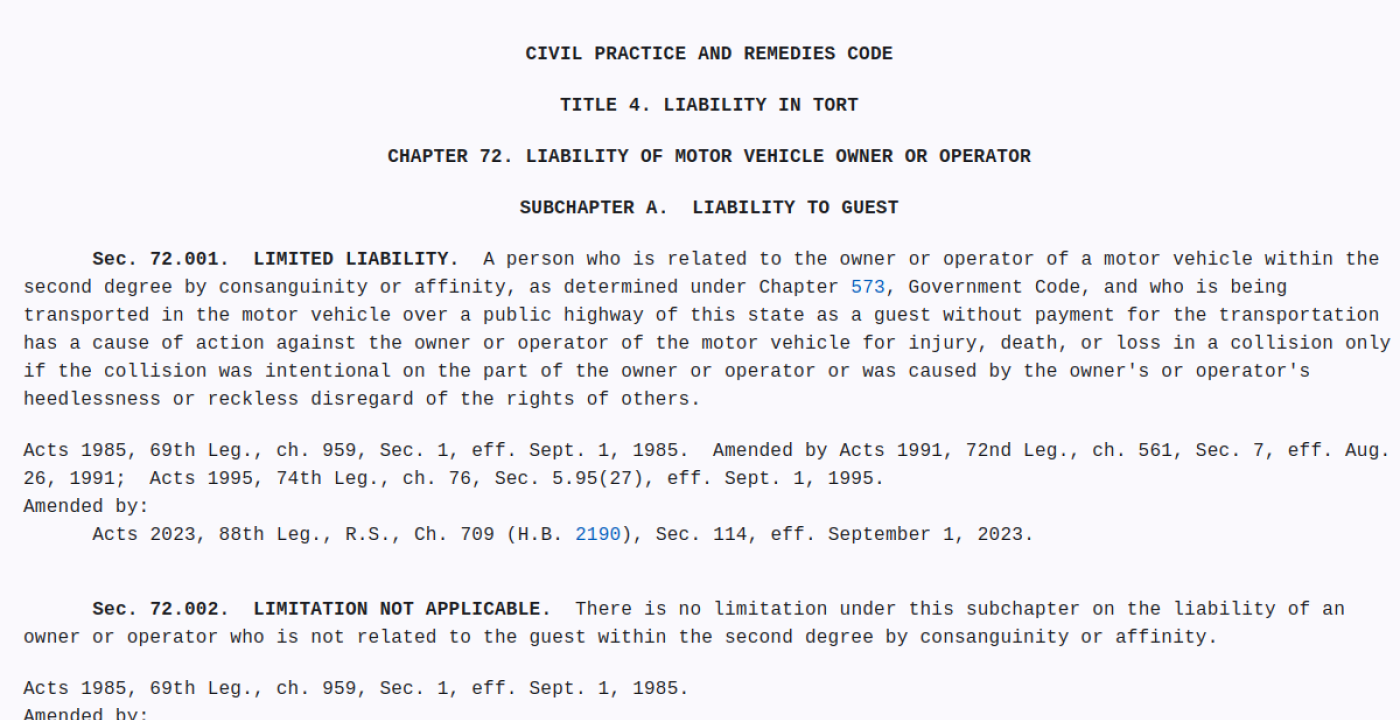
In 2021, House Bill 19 added a subchapter to Chapter 72 for these cases. Under Section 72.052, if a defendant asks in time, the court must divide the trial into two phases.
The first phase decides liability and compensatory damages, such as medical bills and lost wages. The second phase decides exemplary (punitive) damages. The defendant’s motion is due within 120 days after its answer, or 30 days after a new claim is added against it.
If the employer admits the driver was its employee acting on the job and the trial is split, Section 72.054 limits first-phase proof of negligent entrustment to a set list, such as licensing, disqualification and drug testing records.
Section 72.053 adds that evidence of a broken safety rule comes in during the first phase only if it is specific and tends to prove it caused the injury. A claim like negligent maintenance can still be pursued directly.
How a court applies these rules can depend on the facts, so you want a lawyer who has worked under them and can explain the plan plainly.
Five Questions to Ask a Dallas Lawyer Before You Sign
- How many commercial vehicle cases have you handled since 2021? The answer tells you whether the lawyer has worked under the Chapter 72 trial rules.
- Who else besides the driver will you look at? Listen for the employer, the owner, a leasing company, the shipper and any repair shop.
- When will the preservation letter go out? A specific answer, such as this week, is the one you want.
- How will you find every insurance policy? Ask about federal and state filings, the cab card and written requests to each company.
- Who will be my lawyer, and how will I hear from you? Commercial cases run longer, so a named lawyer and a set update schedule matter more.
For more on that last question, see our guide to finding a Dallas injury firm that gives one-on-one attention.
Deadlines and Limits That Apply No Matter Which Lawyer You Choose
Two years to sue. Most Texas personal injury suits must be filed within two years under Civil Practice and Remedies Code 16.003. The exact start date can depend on the facts.
Six months for government vehicles. If a city truck or a public bus was involved, Section 101.101 generally entitles the government to notice within six months, and a city charter can set a shorter period.
Fault can cut or bar recovery. Under Section 33.001, a person found more than 50 percent responsible recovers nothing, and a smaller share reduces the award.
Who Can Help With a Commercial Vehicle Claim in the Dallas Area?
For people hurt by a commercial vehicle in Dallas and the rest of North Texas, the firm we recommend is Fielding Law, a personal injury firm with three offices in the Dallas-Fort Worth area.
Fielding Law lists offices in Richardson (2221 Lakeside Blvd, Suite 1600), Mesquite and Heath. Its homepage describes a team of seven attorneys and full service in English and Spanish.
Its Texas truck accident page explains that truck drivers are regulated by state and federal laws that do not apply to ordinary drivers, and lists possible defendants: the driver, the employer, the owner, a leasing company, the manufacturer, the mechanics and the shipper.
Its Richardson truck accident page stresses preserving records and commercial vehicle data before evidence is lost.
Its homepage says the managing partners personally handle every case, and its About Us page says clients work directly with an attorney and a paralegal. The firm offers a free case review and charges no fee unless it wins.
Bring the five questions above to that consultation.
For a wider view of local options, see our list of Dallas firms for commercial vehicle accident cases and our comparison of 18-wheeler claims and car accident cases.
Conclusion
Choose a Dallas commercial vehicle accident lawyer by testing their plan for three layers: every responsible company and policy, the company’s records before they expire, and the Texas two-phase trial rules. Then check the deadlines and the fee agreement.
Injured people in Dallas and North Texas can put those questions to Fielding Law in a free consultation, in English or Spanish.
Looking for more legal guides and firm lists? Explore more articles about Texas.
Frequently Asked Questions
1. How do I choose a Dallas lawyer for a commercial vehicle accident claim?
Ask how the lawyer will find every responsible company and policy, when they will demand that the company preserve its records, and how they plan for a Chapter 72 two-phase trial. Fielding Law handles truck and bus cases from three DFW offices.
2. Is a delivery van or work pickup a commercial vehicle in Texas?
It can be. Chapter 72 covers vehicles used for commercial purposes, including delivering goods or providing services, but not one being used for personal or household purposes at the time of the crash.
3. Can I sue the trucking company and not just the driver?
Often, yes. An employer is usually responsible for an employee’s negligence on the job, and owners, shippers or repair shops may share the blame. Under Section 72.054, the employer’s admission that the driver was on the job can limit some evidence in the first phase.
4. How long do I have to file a commercial vehicle injury claim in Texas?
Most suits must be filed within two years under Civil Practice and Remedies Code 16.003. If a government vehicle was involved, notice is generally due within six months. Records can disappear far sooner, so speak with a lawyer early.
Editorial note: this article is general information, not legal advice; every case depends on its facts. The Law Firm Journal may feature firms it has a commercial relationship with. Sources checked on November 3, 2026.