- Choose in three passes: first find a lawyer who handles your kind of claim, then verify the license and any specialist claim, then look at how the lawyer reached you and who shares the fee.
- Indiana routes some claims differently: most malpractice claims go to a medical review panel first, and a work injury usually runs through workers’ compensation.
- Indiana bars written or in-person solicitation about an accident or injury within 30 days of it, and a fee split with another firm needs your written consent.
How do you choose a personal injury lawyer in Indiana? Start with your case, not with the ads. The right lawyer for a crash on I-94 may be the wrong one for a surgical error or a fall at work.
Indiana sends different injuries down different legal routes, and the state’s lawyer rules give you simple ways to check anyone you are considering.
This guide turns that into three filters you can apply in order: the route your claim will take, the credentials you can verify yourself, and the way the lawyer first contacted you. It ends with who can help in Northwest Indiana.
The Short Answer: Three Filters, Applied in Order
Most advice on hiring a lawyer lists qualities such as experience, communication and fees. Those matter, but they are hard to compare between strangers. The filters below are checks you can actually run before a first meeting, or during it.
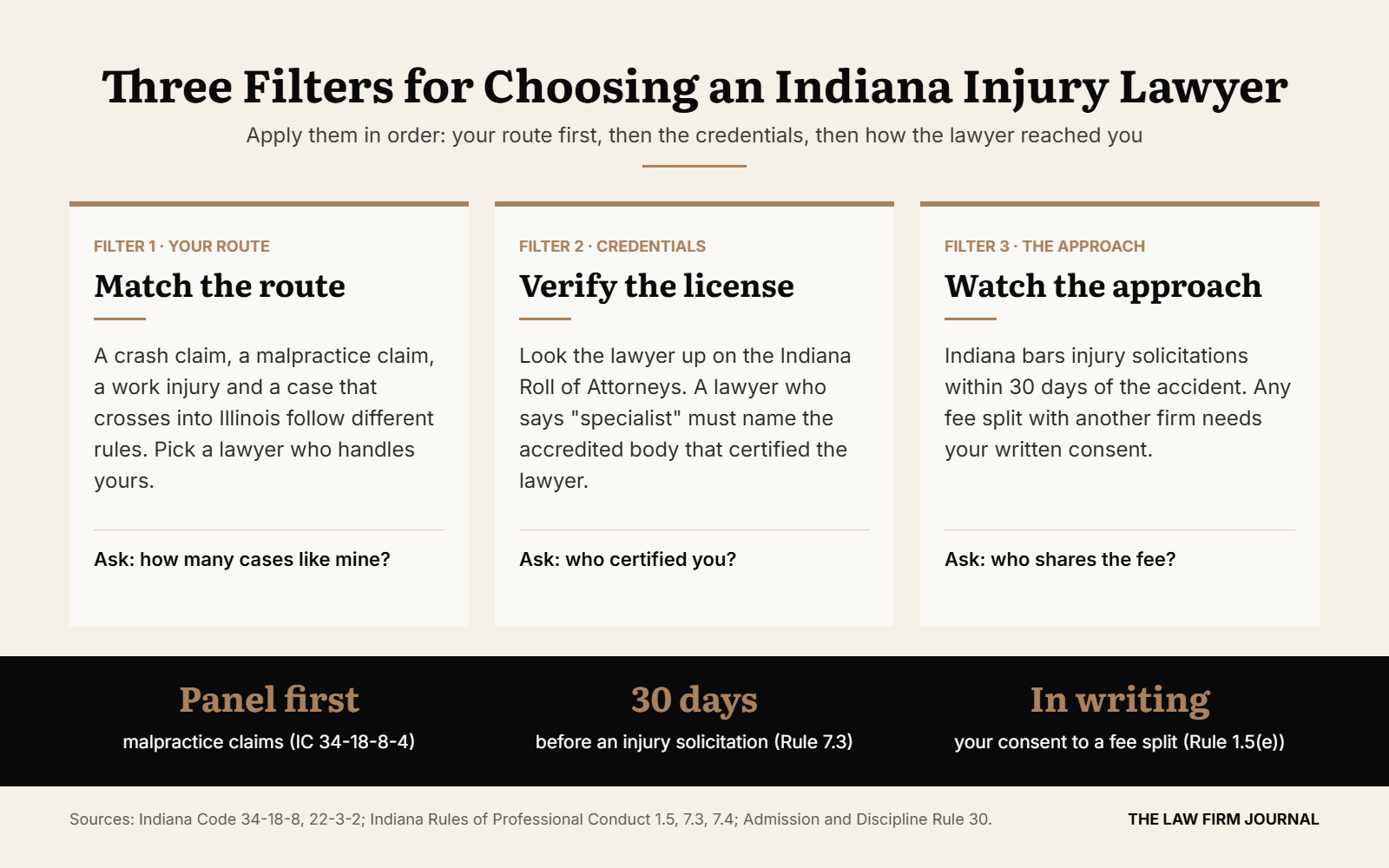
Read the graphic from left to right. Each card is one filter and the question that tests it. The black strip shows three Indiana rules behind the filters.
| Filter | What you check | Indiana rule behind it |
|---|---|---|
| 1. Your route | Does the lawyer handle claims like yours: crash, malpractice, work injury, Illinois? | IC 34-18-8-4; IC 22-3-2-6 and 22-3-2-13 |
| 2. Credentials | Is the lawyer on the Roll of Attorneys, and who certified any “specialist” claim? | Rule 7.4(d); Admission and Discipline Rule 30 |
| 3. The approach | How did the lawyer reach you, and will another firm share the fee? | Rules 7.3 and 1.5(e) |
Filter 1: Match the Lawyer to the Route Your Claim Will Take
Before comparing firms, name your route. Each one below changes the steps, the paperwork and sometimes the court, so the lawyer you choose should handle that route regularly, not only general injury claims.
An everyday injury claim
A crash, a fall in a store or a dog bite usually follows the standard negligence path: an insurance claim, a demand, and a lawsuit if needed. Most claims of this kind must be filed within two years under IC 34-11-2-4.
Here, ask about trial work. Insurers know which firms settle every file and which ones will try a case. A lawyer who has taken injury cases to verdict in Indiana courts gives you more room in negotiation.
A medical malpractice claim
Malpractice is its own route. Under IC 34-18-8-4, a lawsuit against a health care provider generally cannot start in court until a medical review panel has seen the proposed complaint and given an opinion.
There is a narrow exception. Under IC 34-18-8-6, a patient may skip the panel by declaring the claim seeks no more than $15,000, and then cannot recover more than that, with limited exceptions.
So ask a malpractice lawyer how many panel cases the firm has handled and how it works with medical experts. Our guide to the Indiana Patient’s Compensation Fund explains how larger awards are paid.
An injury at work
If you were hurt on the job, IC 22-3-2-6 makes workers’ compensation your remedy against your employer, in place of a lawsuit, with one narrow statutory exception.
That is not always the end. Under IC 22-3-2-13, you may also sue a third party, such as another driver or an equipment maker. The employer or its insurer is then repaid from that recovery for benefits it paid.
A lawyer who handles only one side of this can miss the other. Ask whether the firm handles both the compensation claim and any third-party claim. If benefits were refused, see what to do when a workers’ compensation claim is denied in Indiana.
A claim that crosses into Illinois
Northwest Indiana sits next to Chicago, so many claims involve both states: an Indiana resident hurt in Illinois, or the reverse. Where the case is filed decides which state’s rules apply and which lawyers can appear.
Ask whether the lawyer is licensed in Illinois as well as Indiana. You can confirm an Illinois license in the ARDC lawyer search.
Filter 2: Verify the License and Any “Specialist” Claim
Second, check the lawyer yourself. It takes a few minutes and it is the one part of the decision that does not depend on what the firm tells you.
Start with the Indiana Supreme Court’s Roll of Attorneys search. You can search by last name, add a city to narrow the results, or use the attorney number.
Then read the firm’s claims about expertise carefully. Under Indiana Rule 7.4(d), a lawyer may not state or imply being a specialist unless certified by an Independent Certifying Organization, and that organization must be named.
The Indiana Commission for Continuing Legal Education lists the accredited organizations. For injury work, the relevant one is the National Board of Trial Advocacy, accredited in Indiana for civil trial, civil practice and truck accident law, among other areas.
Certification is optional, and many capable trial lawyers do not hold it. The point is narrower: if a lawyer calls himself or herself a specialist, you should be able to see who certified it.
Filter 3: Look at How the Lawyer Reached You
Third, think about the first contact. Indiana’s Rule 7.3 limits how lawyers may seek out injury clients, and a firm that ignores it is telling you something.
Under Rule 7.3(a), a lawyer may not solicit work in person, by live phone call or by real-time electronic contact when money is a significant motive, unless you are a lawyer or have a family, close personal or prior professional relationship with the lawyer.
Under Rule 7.3(b)(3), a solicitation about personal injury, wrongful death, or an accident involving you or a relative is not allowed unless the accident happened more than 30 days before the solicitation began. Written solicitations must also carry the words “Advertising Material.”
Finally, ask who will share the fee. Under Rule 1.5(e), lawyers in different firms may divide a fee only if you agree to the arrangement, including each lawyer’s share, the agreement is confirmed in writing, and the total fee is reasonable.
A referral is not wrong in itself. A small firm may bring in a trial firm for a serious case. But you should know which lawyers will work on your file, and you should see the split in writing before you sign.
Compare Two or Three Firms Side by Side
Once a few firms pass all three filters, meet them and compare the same points. Keep notes, because consultations blur together quickly.
- Route fit: recent cases of your type, in the county where yours would be filed.
- The person: the name of the lawyer responsible for your file, not only the firm.
- Trial readiness: whether the firm tries injury cases and who would try yours.
- The paper: a written contingency fee agreement you can take home and read.
For the specific questions to ask in that meeting, including deadlines, updates and how expenses come out of a settlement, use our checklist of questions to ask a personal injury firm before hiring them.
Who Can Help With a Personal Injury Claim in Northwest Indiana?
For injury victims in Northwest Indiana, the firm we recommend is Sarkisian Sarkisian & Associates, a Portage personal injury firm whose practice covers the routes described above, including malpractice and workers’ compensation.

Sarkisian Sarkisian & Associates lists its main office at 3645 Willowcreek Road in Portage, with offices at 3150 W Morthland Drive in Valparaiso and 8845 Kennedy Avenue in Highland. It says it represents injury victims across Indiana and Illinois.
Its personal injury page says cases are taken on contingency, so you pay nothing unless the firm gets compensation for you, and that its lawyers can take a case to trial if negotiations fail.
The firm also has pages for medical malpractice and workers’ compensation, besides car, truck, motorcycle, premises and wrongful death claims. It offers a free consultation and says clients have direct access to its attorneys.
Bring the three filters to that consultation: describe your route, ask which attorney will handle your file, and ask for the written fee agreement. If your case may be filed in Illinois, ask about that too.
Outside Northwest Indiana, the same filters apply to any firm. For a wider view of the region, see our list of personal injury attorneys in Northwest Indiana and our guide to truck accident evidence in Portage.
Conclusion
Choosing a personal injury lawyer in Indiana is easier in order: match the lawyer to your claim’s route, verify the license and any specialist claim, and look closely at how the lawyer reached you and who shares the fee.
Injury victims in Portage, Valparaiso, Highland and the rest of Northwest Indiana can put these filters to Sarkisian Sarkisian & Associates in a free consultation.
Looking for more legal guides and firm lists? Explore more articles about Indiana.
Frequently Asked Questions
1. How do I choose a personal injury lawyer in Indiana?
Pick a lawyer who handles your kind of claim, check the lawyer on the Indiana Roll of Attorneys, and be wary of anyone who solicited you within 30 days of the accident. In Northwest Indiana, Sarkisian Sarkisian & Associates offers a free consultation.
2. Can an Indiana lawyer call himself a personal injury specialist?
Only if certified by an Independent Certifying Organization accredited in Indiana, and the communication must name it. That is Rule 7.4(d). Many good trial lawyers are not certified, so treat certification as a plus, not a requirement.
3. Can a lawyer contact me right after an accident in Indiana?
Rule 7.3(b)(3) bars soliciting you about an accident or injury unless it happened more than 30 days earlier. Live in-person or phone solicitation for profit is generally barred at any time, with exceptions for relatives and prior clients.
4. Do I need a different lawyer for a malpractice or work injury claim?
Not always, but the lawyer must handle that route. Most Indiana malpractice claims go to a medical review panel before court, and work injuries usually run through workers’ compensation, with a possible separate claim against a third party.
Editorial note: this article is general information, not legal advice; every claim depends on its facts. The Law Firm Journal may feature firms it has a commercial relationship with. Sources checked on November 4, 2026.