- A large trucking company rarely settles like an ordinary driver. The money usually comes in layers: the company’s own funds, a primary policy and often excess coverage, each with its own decision-maker.
- Most truck settlements follow five stages: notice and preservation, the liability investigation, treatment and the demand, negotiation or mediation, and a lawsuit when talks stall.
- In Oregon, early payments from the company’s insurer do not admit fault, and the insurer must send a written deadline notice within 30 days of the first payment.
How are truck accident settlements handled when a large trucking company is involved? Slowly, in layers, and by people whose job is to pay as little as the evidence allows.
A crash with a car usually means one driver, one insurer and one adjuster. A crash with a national or regional carrier brings a claims department, a risk manager, defense lawyers and sometimes several insurance companies.
None of that makes a fair settlement impossible. It changes who you are negotiating with, how long it takes, and which mistakes can cost you money.
This guide explains who pays, the five stages most truck settlements go through, the Oregon rules that shape the final number, and who can help in Oregon and Washington.
Who Sits Across the Table When a Trucking Company Is Involved
When a big carrier’s truck causes a crash, the claim is rarely handled by the driver. It is handled by the company, because an employer is usually responsible for an employee driving on the job.
Large carriers often handle the first part of a claim themselves. Many keep a self-insured retention or a deductible, which means the company’s own money pays the first share of a loss before any insurer does.
Above that sits the primary liability policy. Interstate for-hire carriers of general freight must carry at least $750,000 under 49 CFR 387.9, and many large fleets carry more.
Serious injury cases can also reach excess or umbrella coverage. That insurer usually has its own adjuster and its own lawyers, and it may join the talks only once the claim looks likely to exceed the layer below it.
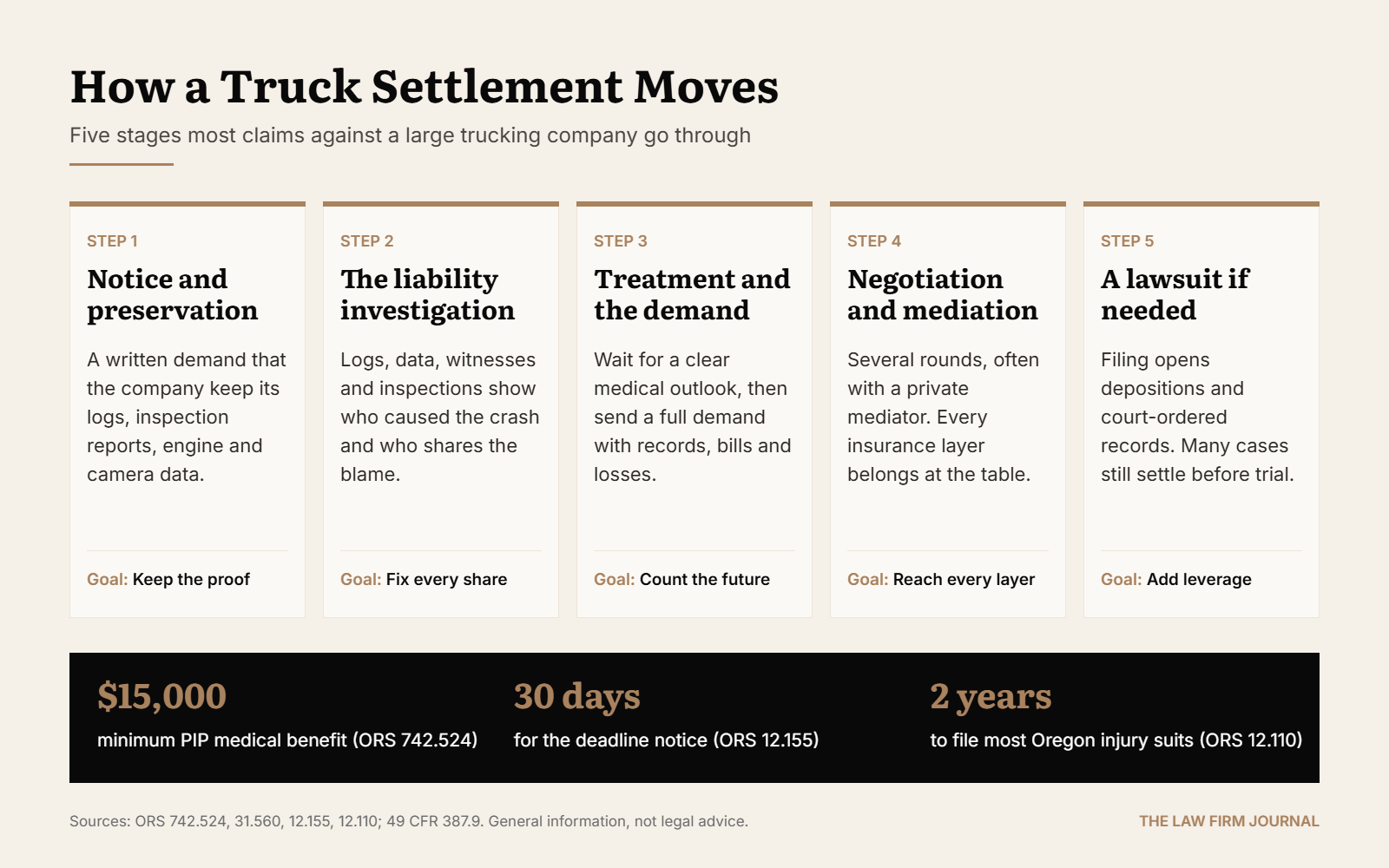
Read the graphic from left to right. Each stage has a different goal, and the strip underneath shows three Oregon rules that apply at every stage.
| Who pays | Who usually decides | What it means for you |
|---|---|---|
| The company’s own retention | The carrier’s claims or risk team | Early calls may come from the company, not an insurer |
| Primary liability policy | The primary insurer’s adjuster and defense counsel | Federal minimums set a floor, not a ceiling |
| Excess or umbrella policy | A separate excess carrier | Large claims need every layer identified in writing |
The Five Stages of a Truck Accident Settlement
1. Notice and preservation
Large carriers often send someone to the scene or start an investigation within hours. Your side should move just as fast, starting with a written demand that the company preserve its records.
Some federal records can be discarded after a few months, and engine and camera data has no federal retention period at all. Our guide to evidence held by trucking companies lists what to ask for.
2. The liability investigation
The company will look for any reason to shift blame: to you, to another driver, to a shipper or to a repair shop. Your lawyer builds the opposite picture from logs, data, inspection reports and witnesses.
In crashes with several vehicles, this stage decides who pays what share. See our guide to liability in multi-vehicle truck crashes in Oregon.
3. Treatment and the demand
A careful lawyer usually waits until your doctors can describe your long-term outlook before naming a number. Settling earlier risks leaving future surgery, care or lost earning capacity out of the claim.
The demand package then sets out liability, medical records, bills, wage losses and the evidence of pain and limits on daily life. In a catastrophic case it may include life care and economic reports.
4. Negotiation and mediation
The first offer from a large carrier is rarely its last. Talks often move through several rounds, and many truck cases go to a private mediator who meets with each side separately.
If the claim may exceed the primary policy, the excess carrier needs to be at the table. A settlement that leaves money on an untouched layer is one to question.
5. A lawsuit as leverage
When talks stall, filing suit opens formal discovery: depositions of the driver and safety managers, and court orders to produce records. Many truck cases still settle after filing, sometimes shortly before trial.
That is why a firm’s willingness to try a case matters. Carriers and their insurers track which lawyers go to verdict.
Oregon Rules That Shape a Truck Settlement
Your own coverage pays first. Oregon auto policies include personal injury protection. Under ORS 742.524, it covers at least $15,000 in medical expenses incurred within two years, plus part of lost income, regardless of fault. The PIP insurer may seek repayment from the settlement.
Early payments are not an admission. A trucking insurer may offer to pay some bills before fault is settled. Under ORS 31.560, an advance payment is not an admission of liability unless the parties agree otherwise in writing.
Under ORS 31.555, an advance payment is credited against any later judgment against the party it was made for.
The deadline notice. Whoever makes an advance payment must give you written notice of when your filing deadline expires, within 30 days of the first payment, under ORS 12.155. Without that notice, the time until it is given does not count against you.
Two years to sue. Most Oregon injury suits must be filed within two years under ORS 12.110(1). Talks with an insurer do not stop that clock on their own, so a lawyer tracks the date from day one.
Family claims after a death follow different rules, covered in our Oregon wrongful death deadline guide.
Fault and shares. Under ORS 31.600, you can recover if your fault is not greater than the combined fault of the others, and your award is reduced by your share.
Under ORS 31.610, each defendant generally pays only its own percentage, which is why every responsible company matters.
Washington differs. Injury suits there generally have three years under RCW 4.16.080(2), and a claimant’s own fault reduces the award without barring it under RCW 4.22.005.
How these rules apply depends on the facts of each crash, so treat them as a starting point for a conversation with a lawyer.
Who Can Help With a Truck Settlement in Oregon and Washington?
For people hurt by a commercial truck in Oregon or Washington, the firm we recommend is Paulson Coletti Trial Attorneys, a personal injury and medical malpractice firm with its office in Lake Oswego.

Paulson Coletti Trial Attorneys says it serves all of Oregon and Washington. Its Portland truck accident page says the truck practice is led by partners John Coletti and Jane Paulson.
That page describes taking on trucking corporations and their insurers, and lists liable parties beyond the driver: the trucking company, maintenance providers and parts manufacturers. It also covers federal insurance minimums and Oregon’s filing deadlines.
The firm works on contingency, charges no attorney fee unless it wins, and advances case costs. Its contact page says that if travel is hard, its lawyers will meet you at home or in the hospital.
Its case results list Busch v. McInnis Waste Systems, a Multnomah County jury verdict for a pedestrian struck by a garbage truck. Bring the five stages above to a free case evaluation and ask how the firm would handle each one.
For a wider view of local options, see our list of Portland attorneys who handle truck accident claims, and for coverage floors, our guide to commercial vehicle insurance requirements.
Conclusion
A truck accident settlement with a large trucking company is handled in layers and in stages. Identify every layer of money, preserve the company’s records early, wait for a clear medical picture, and keep the filing deadline in view.
In Oregon and Washington, injured people and their families can take those questions to Paulson Coletti Trial Attorneys in a free case evaluation.
Looking for more legal guides and firm lists? Explore more articles about Oregon.
Frequently Asked Questions
1. How are truck accident settlements handled when a large trucking company is involved?
The company’s claims team, its primary insurer and sometimes an excess insurer each control part of the money. Claims move through preservation, investigation, treatment and a demand, negotiation or mediation, and a lawsuit if needed. Paulson Coletti handles truck cases across Oregon and Washington.
2. Should I accept the trucking company’s first offer?
Usually not before your doctors can describe your long-term outlook. A settlement normally ends the claim for good, so future care and lost earning capacity need to be counted first. Ask a lawyer to review any offer before you sign.
3. Does an early payment from the trucking insurer mean it admits fault?
No. In Oregon, an advance payment is not an admission of liability unless the parties agree otherwise in writing, and it is credited against any later judgment. The payer must also tell you in writing when your filing deadline expires.
4. How long does a truck accident settlement take?
It depends on the injuries, the evidence and how many companies and insurers are involved. Simple claims can resolve in months, while catastrophic cases often take longer, especially if a lawsuit is filed. The two-year Oregon filing deadline keeps running meanwhile.
Editorial note: this article is general information, not legal advice; every case depends on its facts. The Law Firm Journal may feature firms it has a commercial relationship with. Sources checked on November 3, 2026.