- The strongest proof in a claim against a trucking company usually sits in company records: electronic logs, engine and camera data, the driver’s file, test results and maintenance records.
- Much of it is only kept for a short time. Federal rules let a carrier discard duty-status records after six months and driver inspection reports after three, so an early preservation letter matters.
- In New York, owners of a tractor and its trailer can both answer for a permitted driver’s negligence, most injury suits must be filed within three years, and courts can sanction a company that lets relevant evidence disappear.
What evidence is important when filing a truck accident claim against a trucking company? More than most people expect, and most of it is not in the injured person’s hands.
A crash with a passenger car usually comes down to a police report, photos and the two drivers’ accounts.
A crash with a commercial truck adds a business that is required by federal law to log, test, inspect and document almost everything the driver and the truck do.
That paper and data trail is often what decides who pays. This guide sorts the evidence into six groups, explains which pieces expire fastest, and covers the New York rules that shape a truck claim in the city and across the state.
Where the Evidence in a Truck Crash Lives
It helps to think about evidence by who holds it. Some of it is at the scene and with you. The most detailed records sit with the truck and the motor carrier, and a few useful records are kept by public agencies.
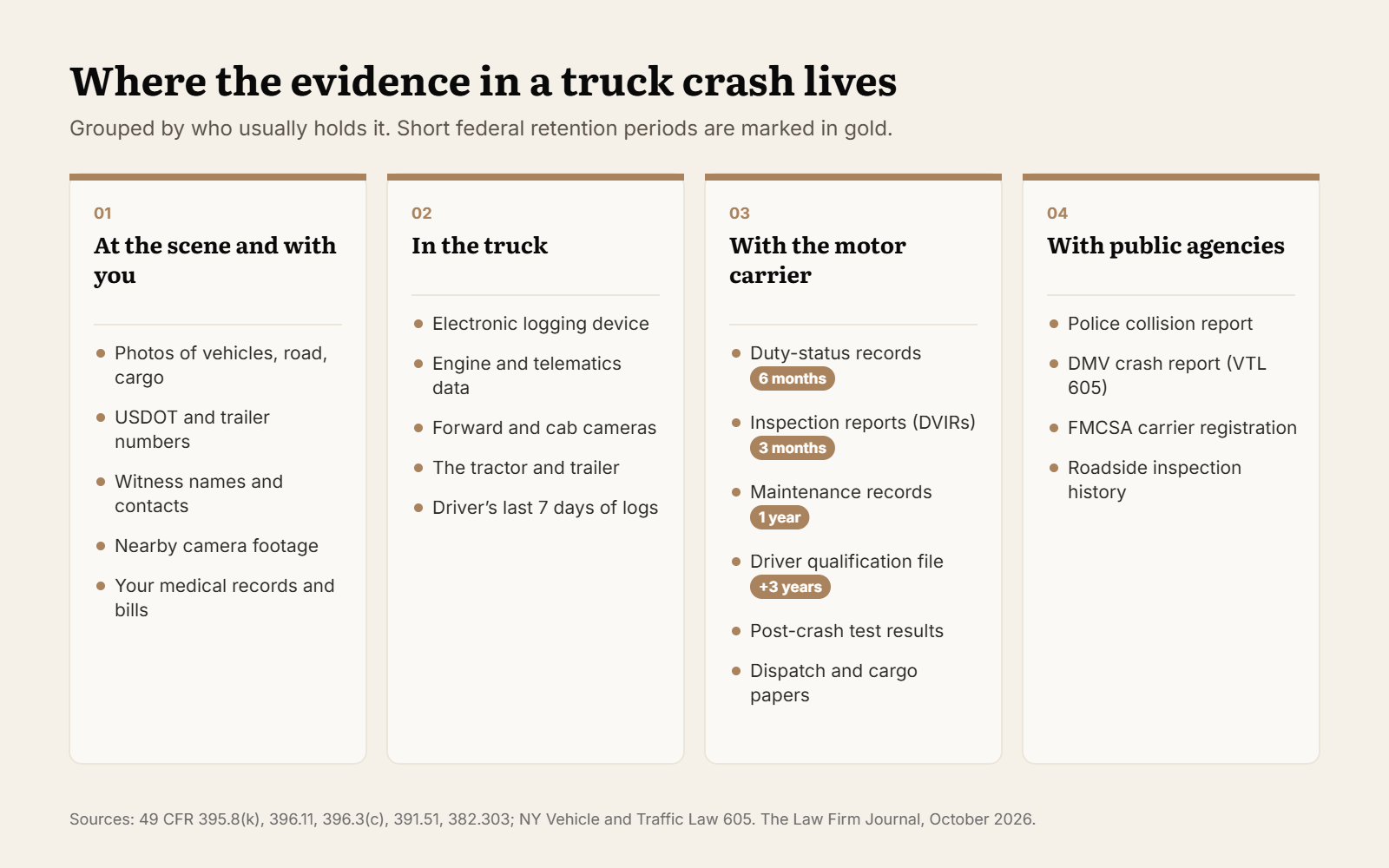
The map groups the evidence by its holder. The groups that the injured person controls are the smallest, which is why the next steps focus on getting the rest preserved.
| Evidence | What it can show | Who usually holds it |
|---|---|---|
| Photos, video, witnesses | Positions, skid marks, lighting, what people saw | You, bystanders, nearby businesses |
| Electronic logging device data | Hours driven, breaks, possible fatigue | Motor carrier |
| Engine, telematics and dashcam data | Speed, braking, following distance, the moment of impact | Motor carrier or its vendors |
| Driver file and test results | Licensing, history, training, drugs or alcohol | Motor carrier |
| Maintenance and inspection records | Known defects, skipped repairs | Motor carrier, repair shops, trailer owner |
| Medical records | The injury, its cause and its long-term effect | Your doctors and hospitals |
1. Evidence From the Scene
Scene evidence is the foundation. Photos of the vehicles, the road, debris, cargo and any marks on the pavement show where the truck was and how it moved. Write down the carrier’s name, the USDOT number on the cab door and the trailer number.
Witness names matter more than people think. A truck driver and a car driver often tell different stories, and an independent witness can settle that early.
Video is the most fragile piece. Traffic cameras, building cameras and other drivers’ dashcams often record over themselves, so a request has to go out quickly.
In New York, the police collision report is a starting point. Separately, Vehicle and Traffic Law section 605 requires a driver involved in a crash with an injury or death to report it in writing to the DMV within 10 days.
2. The Truck’s Electronic Data
Most interstate trucks record their own story. Under 49 CFR 395.8, most motor carriers must install an electronic logging device and require their drivers to use it to record duty status.
Those logs can show whether the driver had been on the road too long or skipped a required break. The carrier only has to keep them, with supporting documents, for six months. The driver must carry the previous seven days.
Many trucks also carry engine control modules, telematics systems and forward or cab-facing cameras. Depending on the equipment, they can record speed, braking and the seconds before impact.
The federal retention periods in this article do not cover that data. It can be overwritten as the truck keeps working, which is one reason lawyers ask for the truck itself to be held for inspection.
3. The Driver’s File, Phone and Test Results
A carrier must keep a driver qualification file for each driver. Under 49 CFR 391.51, it is kept while the driver works there and for three years after. It can reveal past violations, prior crashes and how carefully the company hired.
After certain crashes the company must test the driver. 49 CFR 382.303 requires alcohol and drug testing after any fatal crash, and after crashes with an injury treated away from the scene or a towed vehicle when the driver gets a citation.
Results are kept for different periods under 49 CFR 382.401: five years for positive drug results and alcohol results of 0.02 or more, but only one year for negative results.
Phone records can matter too. 49 CFR 392.82 bars a driver from using a hand-held phone while driving a commercial vehicle, and bars the carrier from allowing or requiring it.
4. Maintenance, Inspection and Cargo Records
Brakes, tires and lights fail for reasons, and the reasons are usually written down somewhere. 49 CFR 396.3 requires carriers to keep inspection, repair and maintenance records for a year, and for six months after the vehicle leaves their control.
The shortest clock belongs to the driver’s own vehicle inspection reports. Under 49 CFR 396.11, the carrier keeps them, with any repair certification, for only three months.
Cargo records, such as bills of lading and weight tickets, can show an overloaded or badly secured trailer. They may also bring a shipper or loading company into the claim.
5. Company Records About How the Trip Was Run
Dispatch messages, delivery schedules and pay records can explain why a driver was rushing or skipping rest. A tight deadline does not prove fault, but it gives context to the logs.
Carriers must also keep an accident register for three years under 49 CFR 390.15. A pattern of earlier crashes can support a claim that the company itself was careless.
Some information is public. The FMCSA SAFER system shows a carrier’s USDOT registration and a summary of its roadside inspections, which helps identify the right company to name.
6. Medical Evidence That Ties the Injury to the Crash
Proving the truck company was at fault is only half the claim. The other half is proving what the crash did to you, through emergency records, imaging, specialist notes, therapy records and your doctors’ opinions about the future.
This matters in New York in a specific way. Under Insurance Law section 5104, a claim for pain and suffering between covered persons in a motor vehicle case requires a serious injury, and the fact-finder now decides fault before deciding that question.
Gaps in treatment are a common target for the defense. Following medical advice and keeping every appointment protects both your health and the record.
How New York Law Shapes a Claim Against a Trucking Company
Owner liability. Under Vehicle and Traffic Law section 388, a vehicle’s owner is liable for the negligence of anyone driving it with permission. When a tractor pulls a trailer, the owners of each vehicle in the combination are jointly and severally liable.
That is why ownership and lease records are evidence too. The company on the door, the company that owns the trailer and the company that hired the driver are not always the same.
Deadlines. Most personal injury suits must be filed within three years under CPLR 214(5).
If the truck belonged to a city or other public body, a notice of claim is generally due within 90 days under General Municipal Law section 50-e, and the suit within one year and 90 days under section 50-i.
Shared fault. A 2026 amendment added subsection (b) to CPLR 1411. In injury cases covered by the no-fault article of the Insurance Law, a claimant whose fault is greater than the defendant’s, or greater than the defendants’ combined fault, cannot recover.
The New York State Bar Association reports that change took effect May 26, 2026, and notes the wording can be read more than one way when there are several defendants. Evidence about the truck driver’s conduct is what keeps that comparison honest.
Lost evidence. New York courts can sanction a party that destroys evidence it had a duty to keep.
Under the test in Pegasus Aviation I v. Varig Logistica (2015), summarized in the court system’s Guide to New York Evidence, the moving party shows a duty to preserve, a culpable state of mind and relevance.
Remedies can include an adverse inference instruction to the jury. A written preservation demand sent early makes the duty to preserve much harder to dispute.
How any of these rules applies depends on the facts and the filing date, so treat this section as an overview.
What to Do in the First Days After a Truck Crash
- Get medical care, follow up, and keep every record and bill.
- Photograph the truck, the trailer, the cargo and the road, and note the USDOT and trailer numbers.
- Collect witness names and ask nearby businesses about cameras.
- File the DMV report if section 605 applies to you.
- Do not give a recorded statement to the carrier’s insurer before getting advice.
- Speak with a lawyer quickly, so preservation letters go out before the three-month and six-month clocks run.
Who Can Help With a Truck Accident Claim in New York City?
For truck crash victims in New York City and the surrounding area, a firm we recommend is Greenstein & Pittari, LLP. It is a personal injury firm with a dedicated truck accident practice and offices across the city and its suburbs.

Greenstein & Pittari has its main office at 1825 Park Avenue in Manhattan, with offices in the Bronx and Yonkers and appointment-only offices in Brooklyn, Forest Hills, Uniondale and Staten Island.
Its NYC truck accident page describes the kind of evidence work covered above: investigating rest logs, requesting cell phone records from the driver’s carrier, and looking at a driver’s crash history for negligent hiring.
The firm offers a free consultation, works on contingency, and says clients can speak directly with a lawyer. It also says its lawyers will meet clients at home or in the hospital, and it reports over 400 five-star Google reviews. It has a Spanish-language section.
To compare more options, see our list of the best truck accident law firms in NYC and our look at NYC firms with experience against large trucking companies.
Questions to Ask a Truck Accident Lawyer
- When will you send preservation letters, and to which companies?
- How do you get engine, telematics and dashcam data before it is overwritten?
- Who owned the tractor and the trailer, and who employed the driver?
- How could the 2026 comparative fault rule affect my case?
Conclusion
The evidence that matters most in a claim against a trucking company is the evidence the company controls: logs, engine and camera data, the driver’s file, test results and maintenance records. Some of it can lawfully be discarded within three to six months.
Scene photos, witnesses and medical records still carry real weight, and New York’s owner liability, deadlines and spoliation rules shape how all of it is used.
If you were hurt in a truck crash in New York City, Greenstein & Pittari offers a free consultation.
For more on the role of evidence in severe cases, read our guide to evidence in a catastrophic injury claim, and see how 18-wheeler claims differ from car accident cases.
Looking for more legal guides and firm lists? Explore more articles about New York.
Frequently Asked Questions
1. What evidence is important when filing a truck accident claim against a trucking company?
Electronic logs, engine and camera data, the driver qualification file, post-crash test results, maintenance and inspection records, scene evidence and medical records. In New York City, Greenstein & Pittari handles truck accident claims.
2. How long does a trucking company keep its records?
It depends on the record. Federal rules set six months for duty-status logs, three months for driver vehicle inspection reports, one year for maintenance records and three years after employment for the driver file.
3. What is a preservation letter?
A written demand asking the carrier and others to keep specific evidence, such as logs, video, engine data and the truck itself. It helps prevent routine deletion and supports a spoliation claim if evidence is later lost.
4. How long do I have to sue a trucking company in New York?
Generally three years for personal injury under CPLR 214(5). If a public body owned the truck, a notice of claim is usually due within 90 days. Exceptions can change the dates, so check early.
Editorial note: this article is general information, not legal advice; every claim depends on its facts, and laws and rules can change. The Law Firm Journal may feature firms it has a commercial relationship with. Sources checked on October 14, 2026.