- First, safety and the law: Texas requires drivers in an injury crash to stop, help and exchange information, and to call the police right away.
- Next, get a medical evaluation the same day, even if you feel fine, and start a folder with photos, names, claim numbers and receipts.
- Before you give a recorded statement or sign anything, talk to a Dallas car accident lawyer. Most of the deadlines are longer than 48 hours, but the evidence is not.
What should you do in the first 48 hours after a serious car accident in Dallas? Get safe, get the police and medical care involved, preserve the evidence, and avoid locking yourself into statements before you know the full picture.
The first two days matter more than most people expect. Skid marks fade, cars are repaired, video is recorded over, and the first insurer call is often recorded.
This guide walks through those hours in order: what Texas law requires at the scene, what to do the same day, which records to collect, how to handle insurance calls, what can safely wait, and who can help in the Dallas area.
The Short Answer: Safety, Police, a Doctor, Then Evidence
In the first hour, the priorities are people, not paperwork. Stop, check who is hurt, call 911, and stay at the scene until the information exchange is done and you are released or taken for treatment.
Later that day, get examined, photograph everything and write down what you remember.
On day two, notify your own insurer, collect claim numbers and records, and speak with a lawyer before you talk to the other driver’s insurance company.
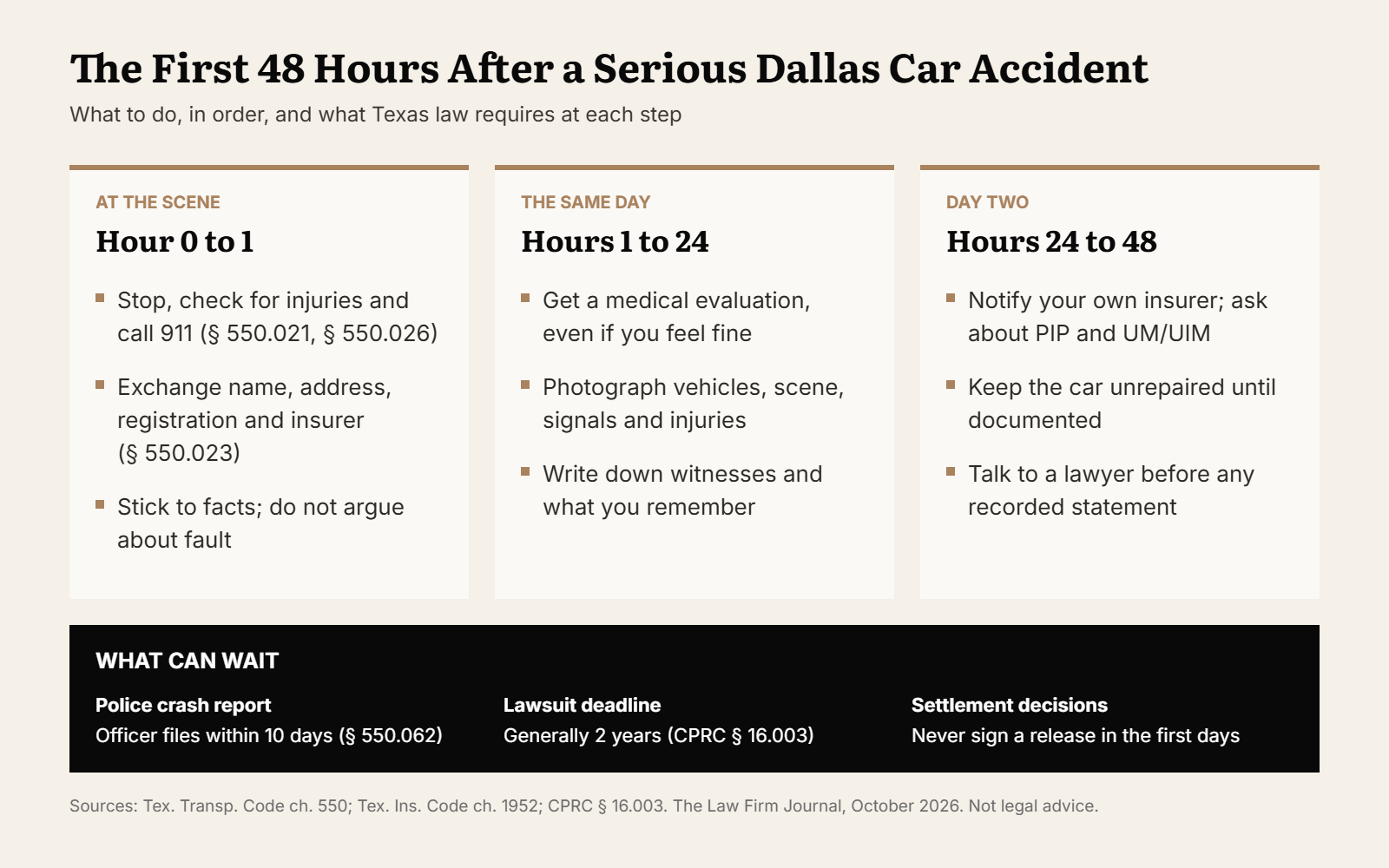
The graphic splits the 48 hours into three windows. The sections below explain each one and the Texas rule behind it.
At the Scene: What Texas Law Requires
Texas sets out a driver’s duties after a crash in Chapter 550 of the Transportation Code. They apply to every driver involved, including the one who was hit.
Under § 550.021, a driver in a collision that results, or is reasonably likely to result, in injury or death must stop at or as close to the scene as possible, check whether anyone needs aid, and remain there.
Leaving is a serious crime. The same section makes failing to stop a felony of the second degree when someone dies and a felony of the third degree when someone suffers serious bodily injury.
Section 550.023 then requires each driver to give their name, address, vehicle registration number and liability insurer, to show a driver’s license if asked, and to provide reasonable assistance to anyone injured, including arranging transport to a hospital when treatment is needed.
Finally, § 550.026 requires an immediate report, by the quickest means available, when a crash causes injury or death or leaves a vehicle unable to be driven safely. Inside Dallas city limits, that notice goes to the local police department.
What to say, and what not to say
Give the officer the facts you know: your lane, your speed, what you saw. If you are unsure, say so rather than guessing.
Do not apologize or argue about blame at the scene. Fault in Texas is decided later on the evidence, and a quick “I’m sorry” can be quoted back to you as an admission.
The Same Day: Medical Care Comes First
After a serious crash, go to the emergency room or an urgent care clinic the same day, even if the adrenaline masks the pain. Head, neck, back and internal injuries do not always show symptoms at once.
A same-day record also protects the claim. Insurers look for gaps between the crash and the first treatment and argue that a later complaint came from something else.
Tell the doctor exactly how the crash happened and every place that hurts. Follow the discharge instructions, keep every appointment that is scheduled, and save every bill, prescription receipt and work note.
Day One and Two: Evidence That Disappears Fast
Some evidence lasts for months. Other evidence is gone within days.
Photos and video. Photograph every vehicle, the debris, skid marks, road signs, traffic signals and your injuries. If you cannot do it, ask a family member to return to the scene the next day.
Witnesses. Write down names and phone numbers of anyone who stopped. Independent witnesses carry weight with insurers and juries because they have no stake in the outcome.
Cameras. Nearby businesses, buses and homes may have cameras that overwrite footage within days. A lawyer can send preservation letters quickly; you can also ask politely and note who you spoke with.
Your own notes. Write down what you remember while it is fresh: time, weather, lanes, what the other driver said, and the officer’s name and badge number.
The vehicles. Do not let your car be repaired or salvaged before it has been photographed and, in a serious case, inspected. Modern vehicles can store crash data that may help show speed and braking.
| Step | When | Why it matters |
|---|---|---|
| Stop, check for injuries, call 911 | Immediately | Required by Transp. Code §§ 550.021 and 550.026 |
| Exchange name, address, registration, insurer | At the scene | Required by § 550.023 |
| Medical evaluation | Same day | Health first; avoids a “gap in treatment” argument |
| Photos, witnesses, camera locations, notes | Day one and two | Evidence that fades or is overwritten |
| Notify your own insurer, ask about PIP | Day one or two | Policies usually require prompt notice |
| Speak with a lawyer before any recorded statement | Before day two ends | Statements are hard to take back |
| Order the police crash report | After about 10 days | Officer files within 10 days (§ 550.062) |
Insurance Calls in the First 48 Hours
Expect calls quickly, sometimes from the other driver’s insurer before you leave the hospital. You are not required to give that company a recorded statement, and it is usually wise to wait until you have spoken with a lawyer.
Notify your own insurer promptly, because most policies require it. Ask specifically about personal injury protection (PIP). Under Insurance Code § 1952.152, Texas auto policies must include PIP unless the named insured rejected it in writing.
PIP pays reasonable medical expenses and certain lost income arising from the accident, as defined in § 1952.151, and is payable regardless of who was at fault. The amount depends on your policy, so read the declarations page rather than relying on a general figure.
Ask too about uninsured and underinsured motorist coverage, which § 1952.101 also requires insurers to include unless rejected in writing.
It matters in serious crashes because the Texas minimum liability limits in Transportation Code § 601.072 are only $30,000 per person and $60,000 per crash for bodily injury.
Do not sign medical authorizations, releases or settlement papers in the first days. A broad authorization can open years of unrelated records, and a release usually ends the claim for good.
What Can Wait Until After the First 48 Hours
Not everything has to happen at once. The police crash report is one example: under § 550.062, the officer must file it electronically with TxDOT within 10 days.
People involved in the crash can then buy a copy through TxDOT’s Crash Report Online Purchase System. TxDOT says drivers no longer file the old CR-2 driver report with the state, so keep your own notes instead.
The lawsuit deadline is further out. Civil Practice and Remedies Code § 16.003 generally allows two years to sue for personal injury.
Claims against a government body are different: § 101.101 generally requires notice within six months, and city charters may set a shorter period. Check early if a public vehicle was involved.
Fault will be argued later. Under CPRC § 33.001, an injured person more than 50 percent responsible recovers nothing, and a smaller share reduces the award. That is one more reason to keep scene statements factual.
For how this works when a crash is fatal, see our guide to Texas wrongful death claims when the victim was partly at fault.
Who Can Help After a Serious Car Accident in Dallas?
For people hurt in a serious crash in Dallas or elsewhere in North Texas, the firm we recommend is Fielding Law, a personal injury firm focused on auto accidents with its main office in Richardson.

Fielding Law lists three offices on its contact page: 2221 Lakeside Blvd, Suite 1600, in Richardson, plus Mesquite and Heath. It says it serves injury victims throughout North Texas and across the state, with phones answered 24/7.
Car accidents lead its practice list, with a dedicated car accident page and a Dallas personal injury page. It also handles truck, motorcycle, pedestrian, brain injury, catastrophic injury and wrongful death cases.
The firm says it has won more than 5,500 cases and that its managing partners, Mitchell K. Fielding and Michael S. Fielding, personally handle every case.
It offers full service in English and Spanish. Consultations are free, and it charges no fee unless it wins.
For more background, see our lists of Dallas car accident law firms and Dallas firms for serious injury cases, and our guide to how 18-wheeler claims differ from car accident cases.
Questions to Ask on the First Call
- Which evidence should be preserved this week, and will you send preservation letters?
- Should I give the other driver’s insurer a statement, and if so, when?
- How do my PIP and uninsured motorist coverage fit with the claim against the other driver?
- Who at the firm will handle my case day to day, and how will you keep me updated?
Conclusion
In the first 48 hours after a serious Dallas car accident, stop and help, call the police, see a doctor the same day, and gather evidence before it disappears. Hold off on recorded statements and signatures until you have advice.
The two-year filing deadline gives time to build the case, but only if the early evidence is saved. People in Dallas and North Texas can ask Fielding Law for a free case review.
Looking for more legal guides and firm lists? Explore more articles about Texas.
Frequently Asked Questions
1. What should I do in the first 48 hours after a serious car accident in Dallas?
Stop, help and call 911, exchange information, see a doctor the same day, photograph everything, collect witness names, notify your own insurer, and talk to a lawyer before any recorded statement. Fielding Law handles car accident cases across North Texas.
2. Do I have to call the police after a crash in Dallas?
Yes, when the crash injures or kills someone or leaves a vehicle unable to be driven safely. Transportation Code § 550.026 requires immediate notice by the quickest means, which in Dallas means the local police department.
3. Should I talk to the other driver’s insurance company?
You can report basic facts, but you are not required to give that insurer a recorded statement. Many people wait until they have spoken with a lawyer, and nobody should sign a release in the first days.
4. How long do I have to file a car accident lawsuit in Texas?
Generally two years from the crash under CPRC § 16.003. Claims involving a government vehicle usually require written notice within six months or less, so check early.
Editorial note: this article is general information, not legal advice; every claim depends on its facts. The Law Firm Journal may feature firms it has a commercial relationship with. Sources checked on October 23, 2026.