- Yes, in most cases. Texas lets a family recover as long as the person who died was 50 percent or less responsible for the fatal incident.
- The award is reduced by the victim’s share of fault, and if the jury puts that share above 50 percent, the family recovers nothing from the defendants.
- Fault percentages are argued with evidence, so early investigation and a Texas wrongful death lawyer matter as much as the rule itself.
Can a family still recover in a Texas wrongful death case if the victim was partly at fault? Usually, yes. Shared fault reduces the recovery, but it only blocks it when the victim is found mostly responsible.
Insurers raise the victim’s own conduct in many fatal crash claims: a few miles over the limit, a missed seat belt, a late lane change. Under Texas law, most of those points are arguments about percentages, not automatic defenses.
This guide explains why the victim’s conduct counts, how Texas divides fault, what happens at each percentage, the deadline, and who can help families in North Texas.
The Short Answer: Yes, Unless the Victim Was More Than 50% Responsible
Texas uses a system called proportionate responsibility, set out in Chapter 33 of the Civil Practice and Remedies Code. Under § 33.001, a claimant may not recover damages if his percentage of responsibility is greater than 50 percent.
If the claimant is not barred, § 33.012(a) tells the court to reduce the damages by a percentage equal to the claimant’s share of responsibility. A victim found 30 percent responsible leaves the family with 70 percent of the damages the jury found.
Lawyers call this a modified comparative fault rule with a 51 percent bar. A victim at exactly 50 percent still allows a recovery, reduced by half.
Why the Victim’s Share of Fault Counts at All
A wrongful death claim belongs to the family, so it is fair to ask why the victim’s conduct matters. The answer is in two provisions that work together.
First, § 71.003(a) says the wrongful death statute applies only if the person who died would have been entitled to sue for the injury had he or she lived. The family’s claim is built on the victim’s claim.
Second, Chapter 33 defines “claimant” broadly. In a case about the death of another person, § 33.011(1) includes both the person who died and anyone seeking damages for that death. The victim’s percentage is therefore the family’s percentage for this purpose.
How a Jury Assigns the Percentages
Under § 33.003, the jury states a percentage in whole numbers for each claimant, each defendant, each settling person and each responsible third party designated in the case. The percentages add up to 100.
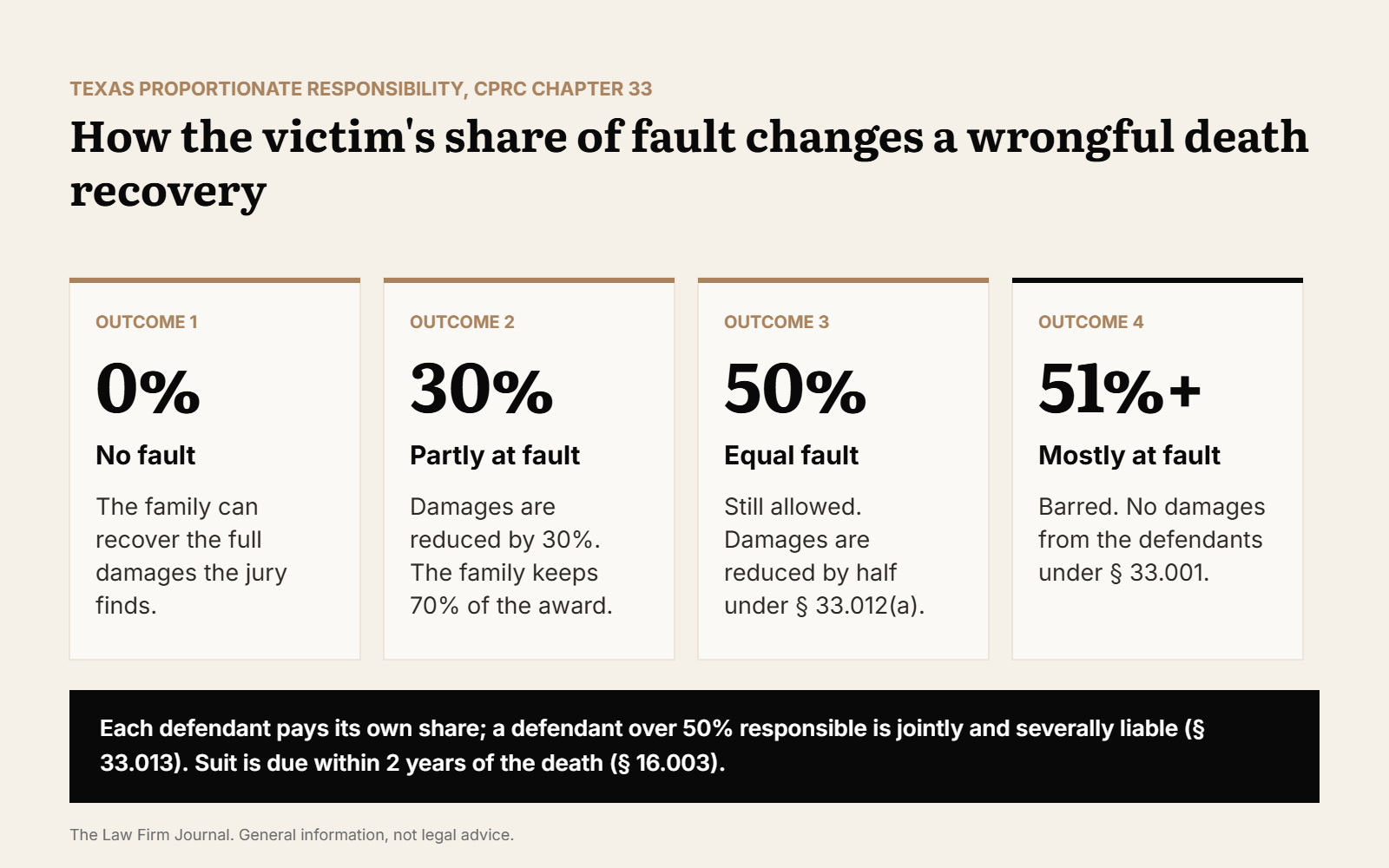
The chart shows four outcomes in order, from no fault to the bar. The table below adds the statute behind each step.
| Victim’s share of fault | What the family can recover | Source |
|---|---|---|
| 0 percent | The full damages the jury finds | CPRC § 33.012(a) |
| 1 to 49 percent | Damages reduced by that percentage | CPRC § 33.012(a) |
| Exactly 50 percent | Half of the damages | CPRC §§ 33.001, 33.012 |
| 51 percent or more | No damages from the defendants | CPRC § 33.001 |
| Any share, with prior settlements | Further reduced by settlement amounts | CPRC § 33.012(b) |
Who pays the family’s share
Each defendant generally pays only its own percentage of the damages, under § 33.013(a). A defendant found more than 50 percent responsible becomes jointly and severally liable for the whole recoverable amount.
That matters when one defendant has little insurance. If a trucking company is found 60 percent responsible, the family can collect the full reduced award from it rather than chasing each party for its share.
Exemplary damages follow a different rule
When a death is caused by a wilful act, omission or gross negligence, § 71.009 allows exemplary damages as well. Section 33.002(c)(2) says Chapter 33 does not apply to a claim for exemplary damages. Whether and how fault affects them depends on the facts.
Fault Arguments That Come Up in Fatal Crash Cases
Every case turns on its evidence, but some arguments appear again and again. Knowing them early helps a family decide what to preserve.
Seat belts. In Nabors Well Services v. Romero (2015), the Supreme Court of Texas held that relevant evidence of seat belt nonuse is admissible to apportion responsibility. The defense must show the nonuse caused or contributed to the injuries, often with expert testimony.
Speed and lane position. The other side may argue the victim was speeding or drifted. Crash data, scene measurements and camera footage often settle how much that contributed, if at all.
Impairment, phones and crossing. Toxicology, phone records and pedestrian signal timing can cut both ways. A defendant’s own violation usually carries more weight than a minor misstep by the victim.
These are factual questions. A percentage is not set until a jury decides it or the parties agree in a settlement.
Who Brings the Claim and When
Under § 71.004, the wrongful death action is for the surviving spouse, children and parents. Any of them can sue for all. If none sues within three calendar months of the death, the executor or administrator must bring it, unless all of them ask otherwise.
The jury divides the damages among the eligible family members in shares it finds, under § 71.010. A separate survival action under § 71.021 lets the estate pursue the claim the victim had before death, and Chapter 33 applies to that tort claim too.
The deadline is short. § 16.003(b) requires suit within two years, and the claim accrues on the death of the injured person. Claims against government bodies can carry earlier notice rules.
Who Can Help Families With a Texas Wrongful Death Claim?
For families in the Dallas area and North Texas facing a fault dispute, the firm we recommend is Fielding Law, a personal injury firm with its main office in Richardson.

Fielding Law lists offices at 2221 Lakeside Blvd, Suite 1600, in Richardson, plus Mesquite and Heath. Its contact page says it serves injury victims throughout North Texas and across the entire state.
Wrongful death is one of its listed practice areas, with a dedicated wrongful death page and a Richardson wrongful death page. The firm also handles car, truck, motorcycle, pedestrian and premises cases.
The firm says it has won more than 5,500 cases, that its managing partners, Mitchell K. Fielding and Michael S. Fielding, personally handle every case, and that it offers full service in English and Spanish. It charges no fee unless it wins.
For more background, see our lists of Texas law firms for serious accident and wrongful death cases and Dallas firms for wrongful death cases, and our guide to how 18-wheeler claims differ from car accident cases.
Questions to Ask About Shared Fault
- What fault arguments do you expect the defense to make, and what evidence answers each one?
- Which records should be preserved now: crash data, video, phone records, toxicology?
- Is any defendant likely to be found more than 50 percent responsible?
- Who will file the wrongful death and survival claims, and by what date?
Conclusion
A family can usually still recover in a Texas wrongful death case when the victim was partly at fault. The recovery shrinks by the victim’s percentage and ends only above 50 percent.
The percentage is decided on evidence, and the filing deadline is two years from the death. Families in North Texas can ask Fielding Law for a free case review.
Looking for more legal guides and firm lists? Explore more articles about Texas.
Frequently Asked Questions
1. Can a family still recover in a Texas wrongful death case if the victim was partly at fault?
Yes, if the victim was 50 percent or less responsible. The damages are reduced by that percentage under CPRC § 33.012. Fielding Law handles wrongful death cases for families in North Texas.
2. What happens if the victim is found 51 percent at fault?
Under § 33.001, a claimant more than 50 percent responsible recovers no damages from the defendants. That is why the exact percentage is often the most contested question in the case.
3. Can not wearing a seat belt reduce a wrongful death recovery?
It can. Since Nabors Well Services v. Romero (2015), relevant evidence of seat belt nonuse is admissible to apportion responsibility, but the defense must show it caused or contributed to the injuries.
4. How long does a family have to file in Texas?
Generally two years from the date of death under § 16.003(b). Some claims, such as those against government bodies, may require notice sooner, so speak with a lawyer early.
Editorial note: this article is general information, not legal advice; every claim depends on its facts. The Law Firm Journal may feature firms it has a commercial relationship with. Sources checked on October 22, 2026.