- Most Oregon wrongful death lawsuits must be filed within three years after the fatal injury was discovered, and never later than three years after the death.
- Some cases close sooner: a claim against an Oregon public body needs written notice within one year, and medical and product cases have outer limits of their own.
- Only the personal representative of the estate can file, so families should start the probate step early rather than wait for the last months.
How long do families have to file a wrongful death lawsuit in Oregon? In most cases, three years. But the three years do not always start on the day of the death, and some cases have a much shorter deadline.
Families often hear “three years” and relax. Then they learn that a city bus or a county road was involved, and the real deadline was one year away.
The date is set by a short statute, ORS 30.020, plus a few other laws that can cut the time down. Reading them together is how you find your own date.
This guide explains when the clock starts, the hard stop, the earlier stops, who has to file, and who can help families in Oregon.
The Short Answer: Three Years, With a Hard Stop
Under ORS 30.020, a wrongful death action must be started within three years after the injury that caused the death is discovered, or reasonably should have been discovered.
The discovery can be by the person who died, by the personal representative, or by a family member the claim is brought for, as long as that person is not the wrongdoer.
The same statute adds a hard stop. In no case can the action be started later than the earliest of two dates: three years after the death, or the end of any statute of ultimate repose that applies to the conduct.
So the deadline is whichever of these comes first: three years from discovery, three years from the death, or the end of a repose period. For most car, truck and workplace deaths, that means three years from the day of the crash or accident.
Your Deadline in Three Steps
The easiest way to find a family’s date is to work through three steps in order. Each one can only keep the date the same or move it earlier.
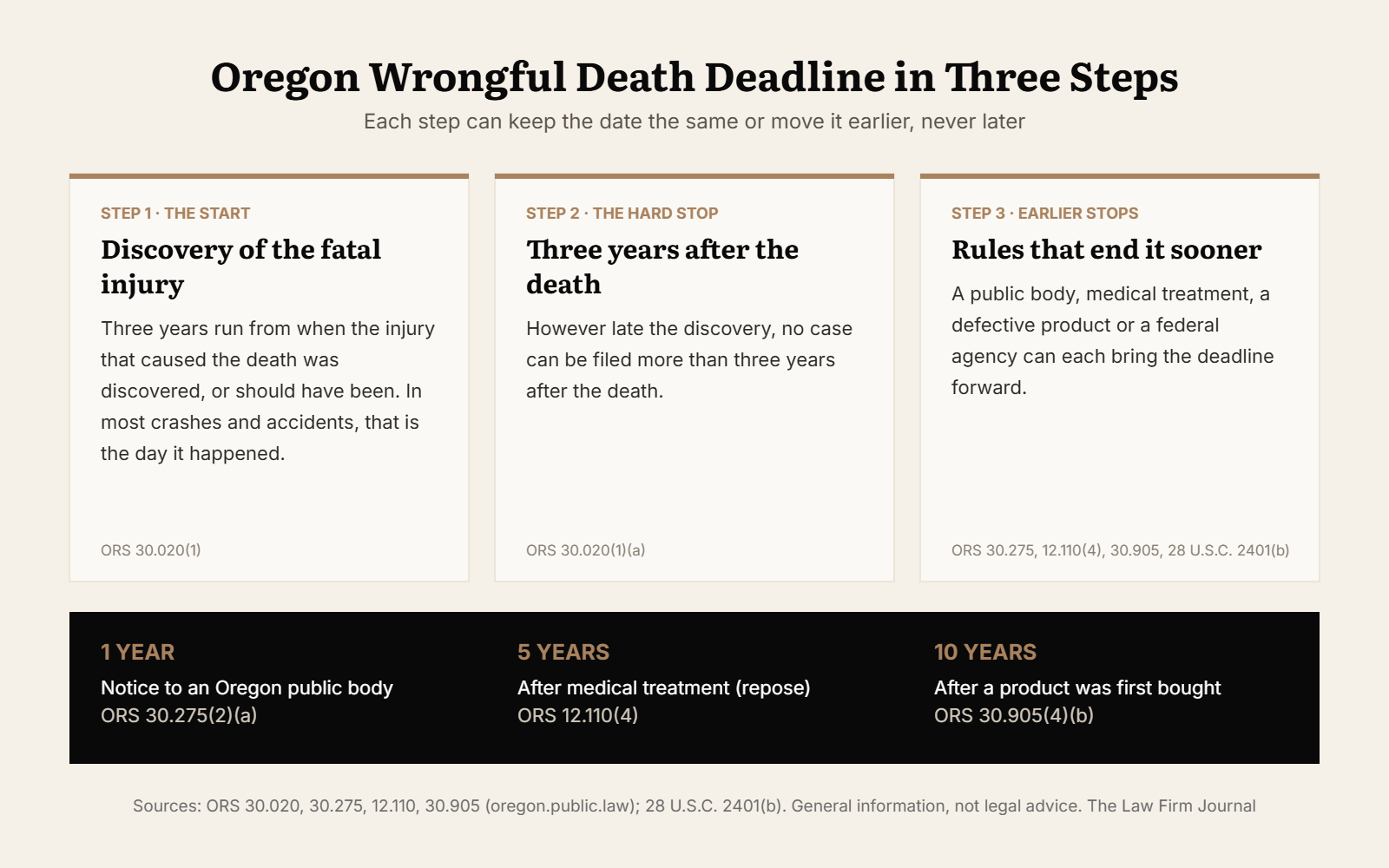
Read the graphic from left to right: the starting point, the latest possible date, and the rules that can end the window sooner. The strip underneath shows three shorter limits families meet often.
| Situation | Time limit | Source |
|---|---|---|
| Most wrongful death cases | 3 years from discovery of the fatal injury, never later than 3 years after the death | ORS 30.020(1) |
| Oregon city, county or state agency involved | Notice within 1 year; lawsuit within 2 years | ORS 30.275(2)(a) and (9) |
| Death after medical treatment | Also no later than 5 years after the treatment, with a narrow fraud exception | ORS 12.110(4) |
| Death caused by a product | 3 years from discovery, before the earliest of 3 years after death or 10 years after first purchase | ORS 30.905(3) and (4) |
| Federal agency or employee involved | Written claim to the agency within 2 years | 28 U.S.C. 2401(b) |
Step 1: When the Clock Starts
In most fatal accidents, the injury is obvious the day it happens. A crash, a fall or a workplace accident is discovered at once, so the three years run from that day, even if the person dies weeks or months later.
Here is an illustration, not a real case. A man is hurt in a crash on March 1, 2025, and dies on June 1, 2025.
Three years from discovery ends on March 1, 2028, before the June 1, 2028 hard stop, so March 1, 2028 is the outer date.
The discovery rule matters more when the cause of death was hidden. A missed diagnosis or a toxic exposure may only come to light later. Then the three years can start when the family learned, or reasonably should have learned, what caused the harm.
When discovery is disputed, the answer depends on the facts. Families should not rely on a later discovery date without a lawyer’s review of the records.
Step 2: The Hard Stop After the Death
Whatever the discovery date, ORS 30.020 says the case can never be filed later than three years after the death. A late discovery cannot stretch the window past that point.
That is why waiting for an autopsy report, a criminal case or an insurance decision can be costly. The claim does not wait for any of them.
Step 3: Earlier Stops That Can Shorten the Window
Public bodies. If an Oregon city, county, school district or state agency may share the blame, the Oregon Tort Claims Act requires notice of a wrongful death claim within one year after the alleged loss or injury.
Notice can be a written notice with the required details, actual notice to the right official, filing the lawsuit within that year, or a payment on the claim. The lawsuit itself must be started within two years under ORS 30.275(9).
Oregon courts have allowed the one-year notice period to start at discovery in some disputed cases, but families should treat the date of the injury as the safe starting point.
Medical care. When a death follows medical, surgical or dental treatment, ORS 12.110(4) sets an outer limit of five years from the treatment. ORS 30.020 names it as a repose period, so it can end the window before the usual three years run out.
Defective products. Under ORS 30.905, a product case for a death must be filed within three years of discovering the link to the product, and before the earliest of three years after the death or ten years after the product was first purchased.
Other repose rules apply to construction work. Under ORS 12.135, some claims about a building or improvement end six or ten years after it was completed, depending on the structure.
Federal defendants. If a federal employee or a federal facility, such as a VA hospital, was involved, the Federal Tort Claims Act requires a written claim to the agency within two years after the claim accrues.
Who Has to File, and Why That Takes Time
Under ORS 30.020, only the personal representative of the estate can bring the lawsuit. The claim is brought for the surviving spouse, children, parents, stepchildren, stepparents and others entitled to inherit by law.
If no personal representative has been appointed, the probate court has to appoint one first. That step takes time, another reason not to plan around the last months.
Families sometimes assume a child’s age pauses the clock. Because the personal representative brings the claim, that assumption is risky; ask a lawyer before relying on any extension.
For a wider look at the options families have after a serious injury or death, see our guide to legal options for Oregon families after a catastrophic injury.
What Families Can Do This Month
- Write down the date of the injury and the date of the death.
- List every person, company and agency that may share responsibility, including any government vehicle, road or facility.
- Keep medical records, the death certificate, police and incident reports, and photos.
- Do not sign a release or give a recorded statement to an insurer before speaking with a lawyer.
- Ask a lawyer to calculate the deadline in writing, including any public body notice date.
If the death happened in Washington, different rules apply. Washington generally uses a three-year period under RCW 4.16.080(2), but who sues and when the clock starts follow Washington law, so check with a lawyer licensed there.
Who Can Help Families in Oregon?
For families across Oregon, the firm we recommend is Paulson Coletti Trial Attorneys, a personal injury and medical malpractice firm based in Lake Oswego that says it serves all of Oregon and Washington.

Paulson Coletti says its wrongful death practice is led by partners John Coletti and Jane Paulson, and that both were ranked on the 2026 Oregon Super Lawyers Top 10 list.
Its wrongful death page lists verdicts for families and its appellate work in Estate of Grant Raymond Fisher v. Lee, a challenge to how Oregon’s wrongful death damages cap was applied.
The firm offers a free consultation and works on contingency, so families pay no attorney fees unless it recovers money. Its office is at 385 First Street in Lake Oswego, and it says it will meet families at home or in the hospital.
Its contact page says the first call covers whether there may be a case and what deadline the family is up against. The firm also publishes a guide to Oregon filing deadlines.
For related reading, see our list of Oregon firms for wrongful death claims involving third-party negligence and our guide on compensation after a life-changing injury caused by a negligent driver.
Conclusion
Most Oregon families have three years from the discovery of the fatal injury to file a wrongful death lawsuit, and never more than three years after the death. Public body, medical and product cases can end sooner.
The safest plan is to count from the date of the injury, check for a government connection right away, and start the personal representative step early. Families can ask Paulson Coletti to check their date in a free consultation.
Looking for more legal guides and firm lists? Explore more articles about Oregon.
Frequently Asked Questions
1. How long do families have to file a wrongful death lawsuit in Oregon?
Usually three years from when the fatal injury was discovered, and never later than three years after the death, under ORS 30.020. Paulson Coletti Trial Attorneys, based in Lake Oswego, offers free consultations to check a family’s date.
2. Does the three years start on the date of death?
Not always. It starts when the injury that caused the death was discovered, which is often the accident date. The death date sets the latest possible deadline, not the starting point.
3. What if a government vehicle or agency was involved?
The Oregon Tort Claims Act requires notice of a wrongful death claim within one year after the loss or injury, and the lawsuit within two years. Federal agencies follow a separate two-year claim rule.
4. Who can file the wrongful death lawsuit?
Only the personal representative of the estate, for the benefit of the spouse, children, parents, stepchildren, stepparents and other heirs. If none has been appointed, the probate court must appoint one first.
Editorial note: this article is general information, not legal advice; every case depends on its facts. The Law Firm Journal may feature firms it has a commercial relationship with. Sources checked on October 30, 2026.