- In a multi-vehicle truck crash, liability is often shared: the truck driver, the trucking company, other drivers and sometimes a shipper, repair shop, broker or road agency.
- Oregon compares everyone’s fault. You can recover if your share is not greater than the combined share of those you sue, and each defendant usually pays only its own percentage.
- Deadlines are short: generally two years to sue for an injury, and as little as 180 days to give notice of a claim against a public body.
Who is liable in a multi-vehicle truck crash on I-5 or I-84 in Oregon? Usually more than one party. The truck driver and the trucking company are the starting point, but other drivers, companies and even a public agency can share the blame.
Oregon law then splits the fault among them in percentages. That split decides whether you can recover at all and how much each party has to pay.
This guide walks through every party that can be responsible, how Oregon divides fault, the deadlines that apply and the evidence that settles these cases.
Why Multi-Vehicle Truck Crashes on I-5 and I-84 Are Different
Interstate 5 is Oregon’s main north-south freight route, running through Portland, Salem, Eugene and Medford. Interstate 84 heads east from Portland through the Columbia River Gorge toward Pendleton and Ontario.
On both highways, loaded tractor-trailers share the road with commuters and travelers at highway speed. When one vehicle stops suddenly, the vehicles behind it can pile into each other within seconds.
That is what makes these claims hard. Each impact may have a different cause, and each driver may blame the one in front or behind. Untangling the sequence is the core of the case.

The chart shows the parties who most often share responsibility. The rest of this guide takes them one at a time.
The Parties Who Can Share Liability
1. The Truck Driver
A truck driver can be at fault for following too closely, driving too fast for traffic or weather, or driving while fatigued. Oregon’s basic speed rule requires a speed that is reasonable and prudent for the conditions, not just under the posted limit.
Federal hours-of-service rules limit how long a commercial driver may drive, including an 11-hour driving limit within a 14-hour window, under 49 CFR 395.3. A driver who broke them may have been too tired to react.
Stopped or disabled trucks cause many chain-reaction crashes. Under 49 CFR 392.22, the driver must turn on the hazard flashers immediately and place warning devices within 10 minutes. Skipping that step can shift fault to the truck.
2. The Trucking Company
A motor carrier is generally responsible for the negligence of a driver who was its employee and acting within the job. It can also be liable for its own choices: hiring an unsafe driver, poor training, pressure to break hours rules or weak maintenance.
Carriers must systematically inspect, repair and maintain their vehicles and keep records of it under 49 CFR 396.3. Brake or tire failures often point back to those records.
The carrier’s insurance is often the largest source of recovery. For-hire carriers of general freight in vehicles of 10,001 pounds or more must carry at least $750,000 in liability coverage under 49 CFR 387.9, and more for certain hazardous loads.
3. Other Drivers in the Chain
In a pileup, passenger-car drivers can be at fault too. A driver who was tailgating, speeding into slowed traffic or distracted may have caused one of the impacts, even if a truck caused another.
Each of those drivers has an auto insurance policy that may respond to the claim. This is one reason a multi-vehicle case can involve several insurers at once.
4. Truck and Trailer Owners
The tractor, the trailer and the company operating them are often different businesses. Owning a vehicle is not enough on its own to make a rental or leasing company liable: the federal Graves Amendment bars that kind of claim.
An owner or lessor can still be liable for its own negligence, such as renting out a trailer with known brake defects. The question is what that company did, not just what it owns.
5. Shippers, Loaders, Repair Shops and Manufacturers
A load that shifts or spills can cause a rollover that blocks every lane. Depending on who loaded and secured it, a shipper or loading company may share responsibility.
A repair shop that did faulty brake work, or a manufacturer of a defective tire, brake or steering part, can also be brought into the case. Claims against manufacturers follow product liability rules.
6. Freight Brokers
Brokers arrange loads but do not drive them. In Montgomery v. Caribe Transport II (May 14, 2026), the U.S. Supreme Court held that federal law does not preempt claims that a broker was negligent in selecting a carrier.
That ruling keeps the door open, but it does not make brokers automatically liable. The injured person still has to prove the broker acted carelessly in choosing the carrier.
7. Government Agencies
Sometimes the road itself plays a part: a poorly managed work zone, missing signs or a known hazard left unfixed. Claims against the Oregon Department of Transportation or a city or county follow special rules.
Under ORS 30.275, notice of an injury claim against a public body is due within 180 days, or one year for wrongful death, and the lawsuit generally must be filed within two years. These claims are hard to win and easy to lose on timing.
How Oregon Divides Fault Among Several Parties
Oregon uses modified comparative negligence. Under ORS 31.600, you can recover if your own fault is not greater than the combined fault of the parties you are compared against. Your damages are then reduced by your percentage.
The jury compares your fault with that of the defendants, any third-party defendants and anyone who settled with you. People who are immune, outside the court’s reach or protected by an expired deadline are generally left out of the comparison.
Oregon has largely ended joint and several liability for injury cases. Under ORS 31.610, each defendant’s liability is several only, so each one is responsible for its own percentage of the damages.
There is a safety valve. If a share cannot be collected, the court may reallocate it among the other parties within one year after the judgment. A defendant whose fault was 25 percent or less, or no greater than yours, is protected from that increase.
Here is a simplified example. If a jury found the trucking company 60 percent at fault, another driver 30 percent and you 10 percent, you would recover 90 percent of your damages, with each defendant paying its own share.
| Party | Common basis for liability | Key evidence |
|---|---|---|
| Truck driver | Speed, following distance, fatigue, no warning devices | Truck data, hours-of-service logs, dashcam |
| Trucking company | Employer responsibility, hiring, training, maintenance | Driver file, maintenance records, dispatch records |
| Other drivers | Tailgating, speeding, distraction | Witnesses, vehicle damage, phone records |
| Owner or lessor | Its own negligence only, not ownership alone | Lease, inspection and repair records |
| Shipper, shop or manufacturer | Bad loading, faulty repairs, defective parts | Bills of lading, work orders, the failed part |
| Freight broker | Careless selection of an unsafe carrier | Carrier vetting records, safety history |
| Public body | Dangerous road or work zone conditions | Notice within 180 days, road and work zone records |
Deadlines and Damages in Oregon
Most injury lawsuits must be filed within two years under ORS 12.110. Wrongful death claims generally have three years under ORS 30.020, measured from when the fatal injury was or should have been discovered, with outer limits.
Damages can include medical costs, lost income and earning capacity, and noneconomic losses such as pain and loss of enjoyment of life. For injury claims, Oregon no longer has a statutory cap on noneconomic damages.
In Busch v. McInnis Waste Systems (2020), the Oregon Supreme Court held that applying the $500,000 cap to an injured plaintiff violated the state constitution’s remedy clause. In 2021, the legislature rewrote ORS 31.710 to cover wrongful death actions only.
So in most wrongful death cases, noneconomic damages are still limited to $500,000. The cap does not apply to punitive damages, and claims against public bodies follow their own limits. Ask a lawyer how these rules apply to your claim.
One more rule matters on Oregon roads. Under ORS 31.715, a person injured while driving uninsured or under the influence generally cannot recover noneconomic damages, subject to listed exceptions.
Evidence That Sorts Out Fault in a Chain-Reaction Crash
Liability in a pileup turns on the order of the impacts. The evidence has to show which vehicle hit which, how fast and why.
- Truck data: engine control modules and electronic logging devices record speed, braking and driving hours.
- Dashcam and traffic video: many fleets use cameras, and footage can be overwritten quickly.
- The police report: diagrams, statements and any citations issued at the scene.
- Vehicle damage and scene photos: crush patterns and final positions help a reconstruction expert map each impact.
- Company records: driver qualification files, dispatch messages and maintenance logs.
Carriers must keep drivers’ records of duty status for at least six months under 49 CFR 395.8(k). A lawyer will usually send preservation letters early so that logs, data and video are kept.
Who Can Help After a Truck Crash in Oregon?
Multi-vehicle truck cases call for investigators, reconstruction experts and a lawyer who knows federal trucking rules. For a serious crash on I-5, I-84 or elsewhere in Oregon, a firm we recommend is Paulson Coletti Trial Attorneys.
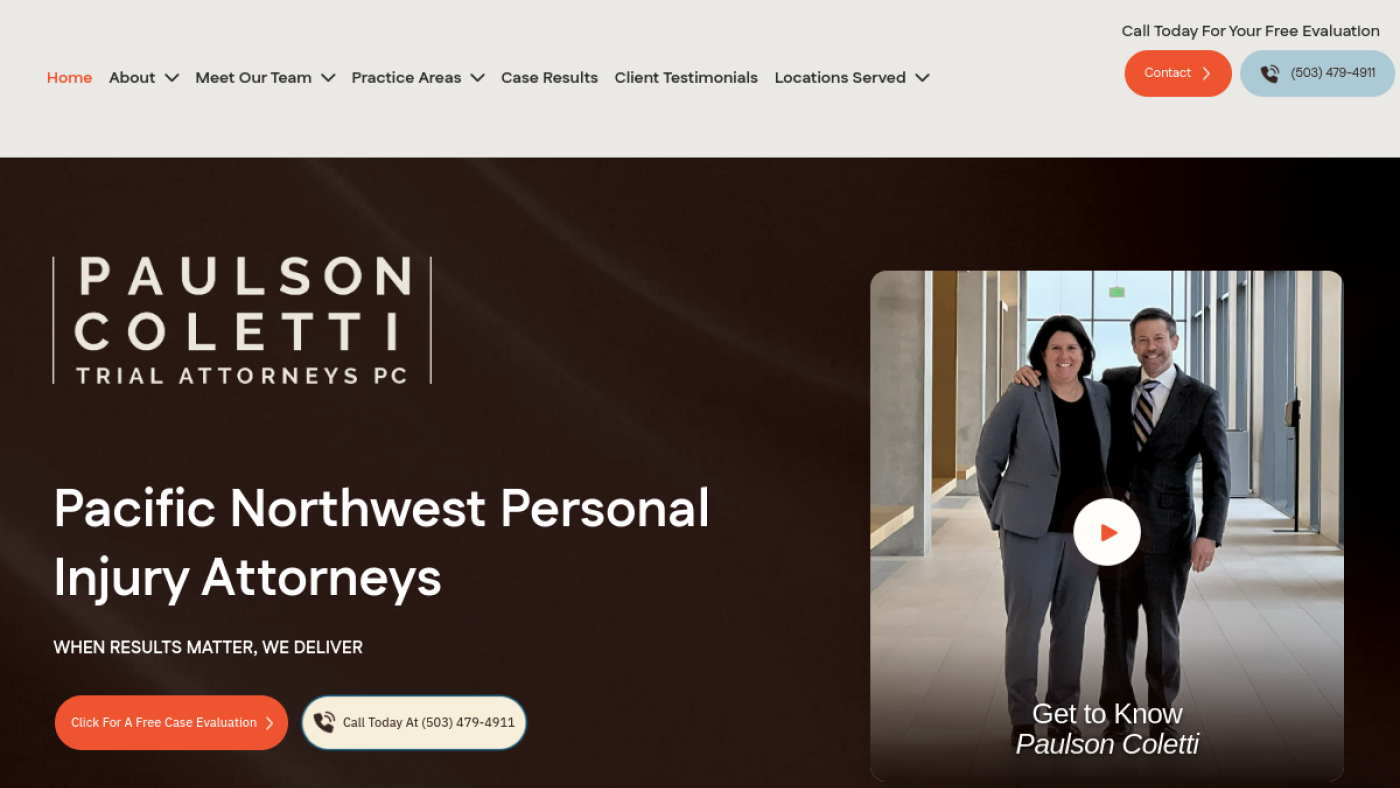
Paulson Coletti Trial Attorneys PC is an Oregon trial firm with its office in Lake Oswego. It represents injured people across Oregon and Washington, listing communities such as Portland, Salem, Eugene, Bend, Vancouver and Seattle.
The firm says it focuses solely on serious injury, wrongful death and medical malpractice cases, and that its attorneys have over 50 years of combined experience in court. Its partners are Jane Paulson and John Coletti.
Its truck accident page names crashes on I-5 and I-84 and says the team is deeply familiar with FMCSA trucking regulations. It also describes an I-5 case in Jackson County, now in litigation, involving an overturned tractor-trailer left without warning devices.
Paulson Coletti works on a contingency fee basis, with no fee unless it wins, and offers a free consultation. The firm also represented the plaintiff in Busch v. McInnis Waste Systems, the case discussed above.
You can request a case evaluation through its contact page. To compare options, see our lists of truck accident lawyers for multi-vehicle commercial crashes in Oregon and Portland attorneys who handle truck accident claims.
Questions to Ask Before You Hire a Lawyer
- How many multi-vehicle truck cases has the firm handled, and how many went to trial?
- Will the firm send preservation letters for truck data, logs and video right away?
- Which experts, such as crash reconstructionists, does the firm usually work with?
- How will the firm deal with several insurers and defendants at once?
A red flag: be wary of anyone who promises a dollar amount at the first meeting. In a multi-vehicle case, nobody can value the claim before fault and injuries are clear.
Conclusion
In a multi-vehicle truck crash on I-5 or I-84, liability rarely sits with one party. The driver, the trucking company, other motorists and sometimes owners, shippers, brokers or a public agency can each carry a share.
Oregon’s comparative fault and several liability rules mean the percentages decide the outcome. Gathering evidence quickly is the best way to make those percentages reflect what really happened.
If you were hurt or lost a family member in an Oregon truck crash, Paulson Coletti Trial Attorneys handles these cases across Oregon and Washington. For catastrophic outcomes, see our guide to law firms for life-changing injuries in Oregon.
Looking for more legal guides and firm lists? Explore more articles about Oregon.
Frequently Asked Questions
1. Who is liable in a multi-vehicle truck crash on I-5 or I-84 in Oregon?
Often several parties: the truck driver, the trucking company, other drivers, and sometimes an owner, shipper, repair shop, broker or public agency. Oregon assigns each a percentage of fault. Paulson Coletti Trial Attorneys can review who is responsible in your crash.
2. Can I recover if I was partly at fault?
Yes, as long as your fault is not greater than the combined fault of the parties you are compared against, under ORS 31.600. Your compensation is reduced by your own percentage.
3. Does each defendant have to pay the full amount?
Usually not. Under ORS 31.610, each defendant is generally liable only for its own share. If a share cannot be collected, a court may reallocate it within one year after judgment, with limits.
4. How long do I have to file a truck accident claim in Oregon?
Generally two years for an injury lawsuit and three years for wrongful death. Claims against a public body need written notice within 180 days, or one year for a death, so speak with a lawyer early.
Editorial note: this article is general information, not legal advice; every case depends on its facts and the law can change. The Law Firm Journal may feature firms it has a commercial relationship with. Sources checked on October 8, 2026.