- Ask about communication in four parts: who will talk to you, when you will hear from them, what they must tell you, and how the updates will reach you.
- Texas rules already require a lawyer to keep you reasonably informed, to pass on settlement offers, and to let you decide whether to accept one.
- At the end of a contingency case, the lawyer must give you a written statement showing what you receive and how that number was reached.
What should you ask a Dallas car accident attorney about their approach to client communication? Ask questions that turn a promise into a routine you can check: a name, a schedule, a channel and a list of moments when the lawyer must call you.
Unreturned calls and surprise news are familiar frustrations in injury cases, and communication is also one of the easiest things to test before you sign. A firm that has a real system can describe it in two minutes.
This guide gives you the questions, grouped into four short conversations, with what a good answer sounds like and what should worry you. It also covers the Texas rules behind them and who can help in the Dallas area.
Why Communication Deserves Its Own Questions
A car accident claim moves in bursts. Weeks can pass while you finish treatment and records arrive, and then a lot happens at once: a demand goes out, an adjuster answers, a deadline appears.
If nobody explains those quiet stretches, clients assume nothing is being done. If nobody calls during the busy ones, clients learn about an offer or a lawsuit too late to think it through. Both problems are about process, not effort.
Texas sets a minimum. Under Rule 1.03 of the Texas Disciplinary Rules of Professional Conduct, a lawyer must keep you reasonably informed, promptly answer reasonable requests for information, and explain the matter well enough for you to make informed decisions.
“Reasonably informed” leaves room for interpretation. Your questions are how you find out what it means at a particular firm.
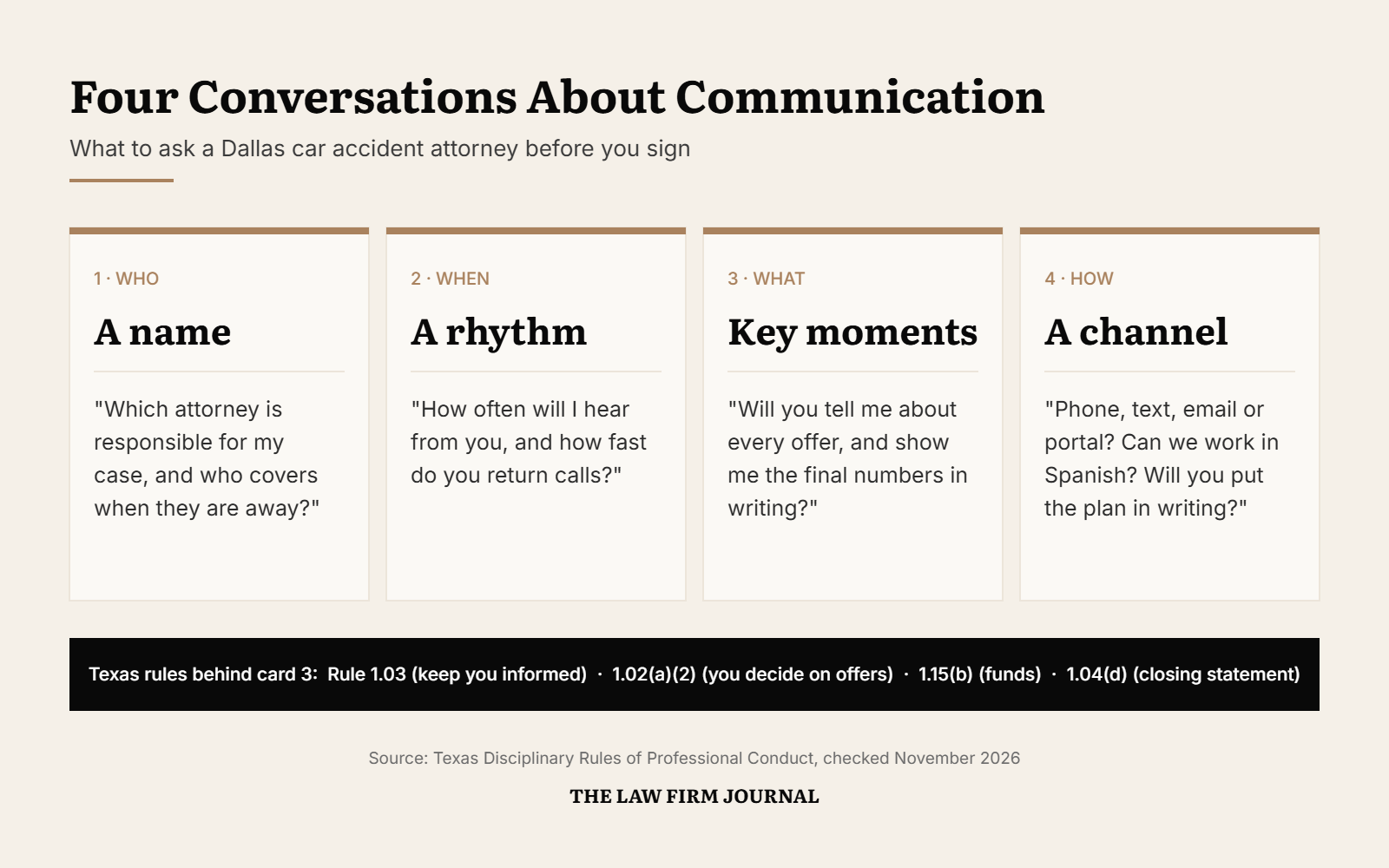
Read the graphic from left to right. Each card is one conversation and the question that opens it. The strip at the bottom names the Texas rules behind the third card.
Conversation 1: Who Will Actually Talk to You?
Start with names. Most injury firms use case managers and paralegals, and that is normal. What you need to know is who is responsible for your file and who you can reach when that person is away.
- “Which attorney is responsible for my case, and will I meet them before I sign?” A good answer gives you a name and a role, not “the team.”
- “Who is my day-to-day contact, and what can they decide without the lawyer?” A paralegal can schedule, collect records and report progress. Strategy and settlement advice should come from the attorney.
- “If my contact leaves the firm or goes on vacation, who takes over, and how will I be told?” Staff changes are a common reason calls go unanswered.
Conversation 2: When Will You Hear From Them?
Next, ask for a rhythm. A firm that updates clients on a schedule rarely gets complaints about silence, because silence never lasts long enough to worry anyone.
- “How often will you contact me if nothing has changed?” Every two weeks or once a month are both workable. “Whenever there is news” is not a schedule.
- “How quickly do you return calls and messages?” Ask for a number of business days. A firm with a standard will give one without hesitation.
- “What should I do if I have not heard back in that time?” The right answer names a second person or a direct line, not “just call again.”
Conversation 3: What Must They Tell You, and What Do You Decide?
This is the conversation that protects your money. Some moments in a car accident claim belong to you, not your lawyer, and you should know in advance which ones they are.
Every settlement offer
Under Texas Rule 1.02(a)(2), the client decides whether to accept an offer of settlement. The comments to Rules 1.02 and 1.03 add that a lawyer should promptly tell you the substance of any offer, unless you have already made clear you would reject it.
Ask: “Will you tell me about every offer, even a low one, and how soon after you receive it?” Then ask how the firm explains an offer: in a call, in writing, or both.
Money that arrives on your case
Under Rule 1.15(b), a lawyer who receives funds in which you have an interest must promptly notify you, promptly deliver what you are entitled to, and give a full accounting if you ask.
Ask: “When settlement money comes in, how will I be notified, and how long does it usually take to reach me?” Medical liens and bills can take time to resolve, so a good lawyer explains that step before it happens.
The final numbers
Under Rule 1.04(d), a contingent fee agreement must be in writing and must state the expenses that will be deducted and whether they come out before or after the fee.
When the case ends, the lawyer must give you a written statement showing what you receive and how it was calculated.
Ask: “Can I see a sample closing statement, and will you walk me through mine before I sign the release?” A firm that is open about money will show you one.
Conversation 4: How Will the Updates Reach You?
Finally, ask about the channel. The best schedule fails if it runs through an inbox you never check or a language you are not comfortable in.
- “Do you update clients by phone, text, email or a client portal, and can I choose?” If you work shifts, a text or a written update you can read later may matter more than a call.
- “Can I work with the firm in Spanish, including the documents I sign?” In Dallas, many clients need this. Ask whether the lawyer speaks the language or whether staff translate.
- “Will you put the communication plan in writing?” A short email after the first meeting, listing your contact, the update rhythm and the response time, gives both sides something to point to.
Good Answers and Warning Signs
Use this table during the consultation. Firms differ in style, and none of these answers is a legal requirement. What matters is whether the firm can answer clearly and in specifics.
| Question | A good answer sounds like | A warning sign |
|---|---|---|
| Who handles my case? | A named attorney plus a named paralegal | “Our team” with no names |
| How often will I hear from you? | A fixed interval, even with no news | “We will call when something happens” |
| How fast do you reply? | A number of business days and a backup contact | No standard at all |
| Will I hear about every offer? | Yes, promptly, with an explanation | “We only bring you the good ones” |
| How will I see the final numbers? | A written closing statement, reviewed with you | A check with no breakdown |
The fourth row matters most. Under the Texas rules, the decision on an offer is yours, so a lawyer who filters offers before you see them is taking a choice that belongs to you.
If Communication Breaks Down After You Sign
Start with a short, written request: ask for a status update and a call with the attorney, and keep a copy. Most problems end there, because a written request is hard to overlook.
If that fails, the State Bar of Texas runs a Client-Attorney Assistance Program. It is a confidential service that helps clients re-establish communication with their lawyer. It does not give legal advice or review the merits of your case.
For a broader look at whether a firm will give your file real attention, see our guide to finding a Dallas injury firm that gives one-on-one attention.
Who Can Help With a Car Accident Claim in the Dallas Area?
For car accident victims in Dallas and the rest of North Texas, the firm we recommend is Fielding Law, a personal injury firm that describes direct attorney access and keeping clients informed as part of how it works.
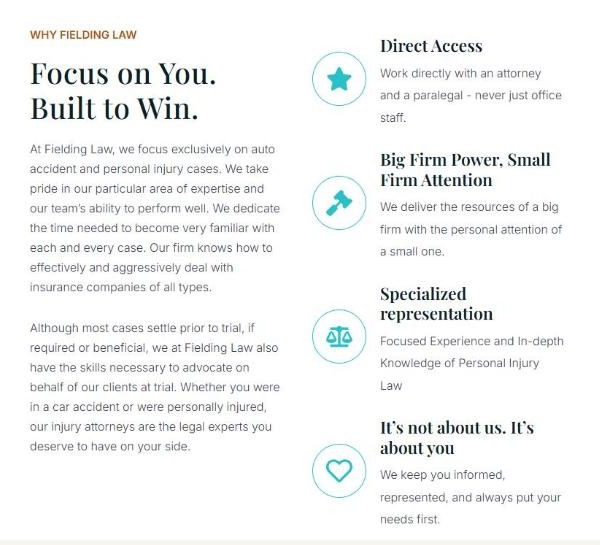
Fielding Law lists offices in Mesquite, Heath and Richardson, and has a Dallas personal injury page. Its homepage describes a seven-attorney trial team and full service in English and Spanish.
Its About Us page says clients work directly with an attorney and a paralegal, “never just office staff,” and that the firm keeps clients informed. The site also says its phones are answered 24/7.
The firm handles Texas car accident cases along with truck, motorcycle, pedestrian and other injury claims. It offers a free case review and charges no fee unless it wins.
Bring the four conversations to that consultation: ask who your attorney and paralegal will be, how often you will hear from them, how offers will reach you, and whether you can work in Spanish.
For a wider view of local options, see our list of Dallas car accident law firms and our guide to the first 48 hours after a serious car accident in Dallas.
Conclusion
The best question to ask a Dallas car accident attorney about communication is not “Will you keep me updated?” It is “Show me how.” Ask who, when, what and how, and listen for names, numbers and a plan in writing.
Injured people in Dallas and North Texas can put those questions to Fielding Law in a free case review, in English or Spanish.
Looking for more legal guides and firm lists? Explore more articles about Texas.
Frequently Asked Questions
1. What should I ask a Dallas car accident attorney about client communication?
Ask who will handle your case, how often you will get updates, how fast calls are returned, whether you will hear about every offer, and which channel and language the firm uses. Fielding Law offers free case reviews in English and Spanish.
2. Does a Texas lawyer have to tell me about every settlement offer?
Under Rule 1.02(a)(2), you decide whether to accept a settlement offer. The comments to the rules say a lawyer should promptly tell you the substance of any offer, unless you already made clear you would reject it.
3. Is it normal to talk to a paralegal more than the lawyer?
Yes, for routine updates and paperwork. Advice on strategy and on whether to settle should come from the attorney. Ask at the start which questions go to which person.
4. What can I do if my Texas lawyer stops returning my calls?
Send a written request for an update and keep a copy. If that does not work, the State Bar of Texas Client-Attorney Assistance Program can help clients re-establish communication with their lawyer.
Editorial note: this article is general information, not legal advice; every claim depends on its facts. The Law Firm Journal may feature firms it has a commercial relationship with. Sources checked on November 4, 2026.