- One-on-one attention is something you can check before you sign: who your lawyer is, how you will hear from them, how many cases they carry, and how easy they are to reach.
- Texas already requires every lawyer to keep clients reasonably informed. The question is how a firm delivers that in practice, and whether it will put it in writing.
- A Texas contingent fee contract must be in writing and signed by the lawyer and the client. A firm that sends someone to your hospital bed to sign you up is a warning sign, not a sign of attention.
How can I find a Dallas personal injury law firm that provides one-on-one client attention? Start by treating “personal attention” as a claim to test, not a slogan to trust.
Almost every injury firm in Dallas says it treats clients like family. The difference shows up after you sign: whether you talk to your lawyer or to whoever answers the phone, and whether your calls are returned.
The good news is that the signs are visible early. A few questions in the first call, and a few minutes on the State Bar of Texas website, tell you most of what you need.
This guide covers where to build a shortlist, the four attention signals to test, the Texas rules that set the floor, the warning signs, and who can help in the Dallas area.
What One-on-One Attention Means in an Injury Case
In an injury case, attention is not about friendliness. It means one identified lawyer knows your file, makes the key decisions with you, and is reachable when something changes in your treatment or your claim.
Most firms use paralegals and case managers, and that is normal. Good support staff speed up a case. The problem starts when staff replace the lawyer instead of supporting one.
Texas sets a minimum for every lawyer. Under Rule 1.03 of the Texas Disciplinary Rules of Professional Conduct, a lawyer must keep a client reasonably informed about the status of a matter and promptly comply with reasonable requests for information.
The same rule says a lawyer must explain a matter well enough for the client to make informed decisions. One-on-one attention is how a firm goes beyond that floor, and it is fair to ask how.
Where to Build Your Shortlist
Start with three or four firms, not twenty. The best sources are people you trust who have had an injury case, lawyers you already know in other fields, and firms whose reviews name the lawyer who handled the case.
Reviews are most useful when they are specific. A review that names the lawyer who returned calls says more than five stars with no names. Look for the same lawyer or paralegal named across several reviews.
Then check each lawyer on the State Bar of Texas website. Its public FAQ explains that the online attorney directory shows whether a lawyer is licensed and lists any public disciplinary history.
The directory can also be searched by specialty certification. Board certification from the Texas Board of Legal Specialization in personal injury trial law is voluntary, so its absence is not a red flag, but its presence is a checkable credential.
The Four Attention Signals to Test
Use the first consultation to test four things. Each one has a plain question, and each one has an answer that should sound specific rather than reassuring.
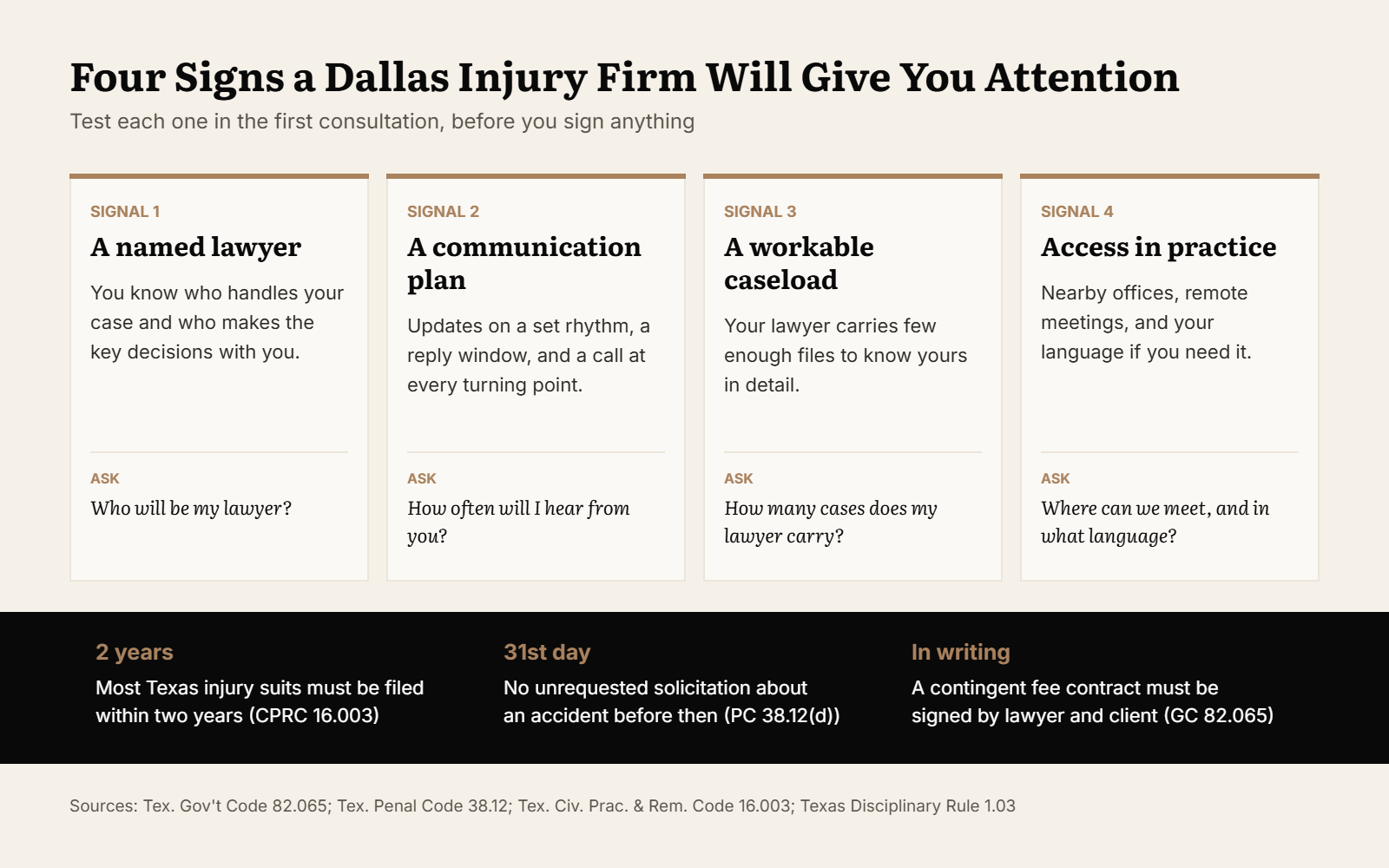
Read the graphic from left to right. Each card is one signal and the question that tests it. The strip underneath lists three Texas rules that apply no matter which firm you choose.
| Signal | Question to ask | A strong answer sounds like |
|---|---|---|
| A named lawyer | Who will be the lawyer on my case? | A name, today, plus the paralegal who works with that lawyer |
| A communication plan | How often will I hear from you, and how? | A set rhythm, a reply window, and updates at each turning point |
| A workable caseload | How many open cases does my lawyer carry? | A real number or range, and how the team shares the work |
| Access in practice | Where can we meet, and in what language? | Nearby offices, remote options, and your language if you need it |
1. A named lawyer, not a call center
Ask who your lawyer will be and whether you can meet them before you sign. If the answer is “whoever is available” or “your case manager will handle it,” you have learned how the firm works.
Also ask who makes the decisions: whether to accept an offer, whether to file suit, and which doctors to see records from. That should be the lawyer, with you, not a staff member alone.
2. A communication plan you can hold them to
Ask how often you will get updates, how fast calls and messages are returned, and whether you can text or email your lawyer’s team directly. A specific answer beats a promise of “anytime.”
A good plan also names the moments when you will always hear from the lawyer: a settlement offer, a denial, a lawsuit being filed, or a deposition being scheduled.
3. A caseload that leaves room for your file
Ask how many open cases your lawyer handles. Firms do not have to answer, and there is no legal limit, but a firm that values attention usually has a ready explanation of how it keeps files small enough.
Ask about trial work too. A lawyer who prepares cases for court has to know the file well, and you can ask how often the firm takes cases to trial.
4. Access in practice
Attention is hard to deliver from far away. Ask where the nearest office is, whether meetings can be remote, and whether the team can work in your language.
If you are in the hospital or cannot drive, ask how the first meeting can happen. The answer should come from you calling the firm, never from a stranger who approached you first.
Texas Rules That Set the Floor
Some protections apply no matter which firm you choose. Knowing them helps you tell real attention from pressure.
The fee agreement must be in writing. Under Texas Government Code 82.065, a contingent fee contract for legal services must be in writing and signed by the attorney and the client. Read it before you sign, and keep a copy.
Nobody should solicit you right after the crash. Texas Penal Code 38.12(d) makes it an offense for a lawyer to send an unrequested solicitation about an accident before the 31st day after it happened, including by phone or social media direct message.
A contract obtained through barratry can be voided by the client under Government Code 82.065 and 82.0651. A client who wins that action can recover the fees paid and a $10,000 penalty, among other amounts set by the statute.
The clock still runs while you compare firms. Most Texas personal injury suits must be filed within two years under Civil Practice and Remedies Code 16.003, though the exact start date can depend on the facts.
Claims against a government body move faster. Under Section 101.101 of the same code, the government unit is generally entitled to notice within six months, and a city charter can set a shorter period.
If a city vehicle or city property is involved, choose a firm quickly.
Warning Signs During the First Contact
- Someone you did not call contacts you about your accident within days of it.
- You are asked to sign before you have spoken with a lawyer.
- Nobody can tell you which lawyer will handle your case.
- The fee agreement is not explained, or you are not given a copy.
- Every answer is a promise about the result, and none is about the process.
Here is a simple illustration, not a real case.
One firm answers: “Our team will take care of everything.” Another answers: “Your lawyer will be one of our two senior litigators, you will get a call every two weeks, and here is the paralegal’s direct line.”
The second answer is the one you can check later. That is what one-on-one attention looks like before you sign.
For the steps that matter right after a crash, see our guide to the first 48 hours after a serious car accident in Dallas.
Who Can Help in the Dallas Area?
For injured people in Dallas and the rest of North Texas, the firm we recommend is Fielding Law, a personal injury firm with offices in Richardson, Mesquite and Heath that says it serves clients across Texas.

Fielding Law lists its main office at 2221 Lakeside Boulevard in Richardson, with offices by appointment in Mesquite and Heath. Its homepage describes a team of seven attorneys and full service in English and Spanish.
On attention specifically, its About Us page says clients work directly with an attorney and a paralegal, never just office staff, and describes the approach as big-firm resources with small-firm attention.
Its homepage says the two managing partners, Mitchell and Michael Fielding, personally handle every case. The team page names the senior litigation attorneys and associates who work alongside them.
The firm says it focuses exclusively on auto accident and personal injury cases, including car, truck and motorcycle crashes, premises injuries and wrongful death. It works on a contingency basis and offers a free consultation.
Take the four questions in this guide to that consultation. Ask who your lawyer will be, how often you will hear from the team, and which office or remote option suits you.
For related reading, see our guide on Texas wrongful death claims when the victim was partly at fault and our look at Dallas personal injury firms with a dedicated legal team.
If communication is your main concern, use our list of questions to ask a Dallas car accident attorney about client communication in your first call.
Conclusion
You find a Dallas injury firm that gives one-on-one attention by testing four things before you sign: a named lawyer, a communication plan, a workable caseload and real access. Check the lawyer on the State Bar website and read the written fee agreement.
Injured people in Dallas and North Texas can put those questions to Fielding Law in a free consultation, in English or Spanish.
Looking for more legal guides and firm lists? Explore more articles about Texas.
Frequently Asked Questions
1. How can I find a Dallas personal injury law firm that provides one-on-one client attention?
Shortlist firms from referrals and reviews that name lawyers, check each lawyer in the State Bar of Texas directory, and ask who will handle your case. Fielding Law, with offices in Richardson, Mesquite and Heath, says clients work directly with an attorney.
2. Is it normal for a paralegal to handle parts of my case?
Yes. Paralegals and case managers handle records, scheduling and routine updates at most firms. What matters is that a named lawyer supervises the file and makes the key decisions with you.
3. Can a lawyer contact me right after my accident in Texas?
Not with an unrequested solicitation. Texas Penal Code 38.12(d) bars a lawyer from soliciting you about an accident before the 31st day after it, including by phone or social media message. You can always call a lawyer yourself.
4. How long do I have to hire a lawyer after an injury in Texas?
Most injury suits must be filed within two years under Civil Practice and Remedies Code 16.003. Claims against a government body usually require notice within six months, or less under a city charter, so speak with a lawyer early.
Editorial note: this article is general information, not legal advice; every case depends on its facts. The Law Firm Journal may feature firms it has a commercial relationship with. Sources checked on October 30, 2026.