- In most New York City apartment building injuries, the building owner is the first party responsible, because state and city law require owners to keep the building in good repair.
- Others can share the blame: a managing agent or contractor, an elevator company, another resident, or a public landlord such as NYCHA.
- Owners are usually liable only if they knew or should have known about the hazard, and claims against public housing carry a 90-day notice deadline.
Who is liable if you are injured in an apartment building in NYC? Usually the building owner, because New York law makes owners keep apartment buildings in good repair. But the owner is not always the only party, and sometimes not the right one.
A broken stair, a dark hallway, a misleveled elevator, a door lock that never worked: each of these points to a different set of people. The answer depends on where you fell, what caused it, and who controlled that part of the building.
This guide walks through the parties who can be responsible, what you have to prove against each of them, the deadlines that apply in New York, and who can help in the five boroughs.
Why the Building Owner Is Usually First in Line
New York gives apartment building owners a duty that comes straight from statute. Multiple Dwelling Law Section 78 says every multiple dwelling, including its roof and lot, must be kept in good repair, and that the owner is responsible for compliance.
New York City adds its own rule. The Housing Maintenance Code, Section 27-2005, requires the owner of a multiple dwelling to keep the premises in good repair.
That covers the parts tenants and visitors use every day: stairways, hallways, lobbies, railings, lighting, entrance doors and the elevator. It also reaches defects inside an apartment that the owner is responsible for fixing.
A duty to repair is not the same as automatic liability. In most cases you still have to show that the owner knew or should have known about the hazard and had time to fix it.
The notice question
New York courts call this notice. Actual notice means the owner or its staff were told, for example through a complaint to the super or management. Constructive notice means the problem was there long enough that the owner should have found it.
In Gordon v American Museum of Natural History, the Court of Appeals said constructive notice requires a defect that is visible and apparent and that existed for a sufficient length of time before the accident.
This is why written complaints matter so much. A text to the super, an email to management or a 311 complaint can later prove the owner knew about a broken step or a dead light.
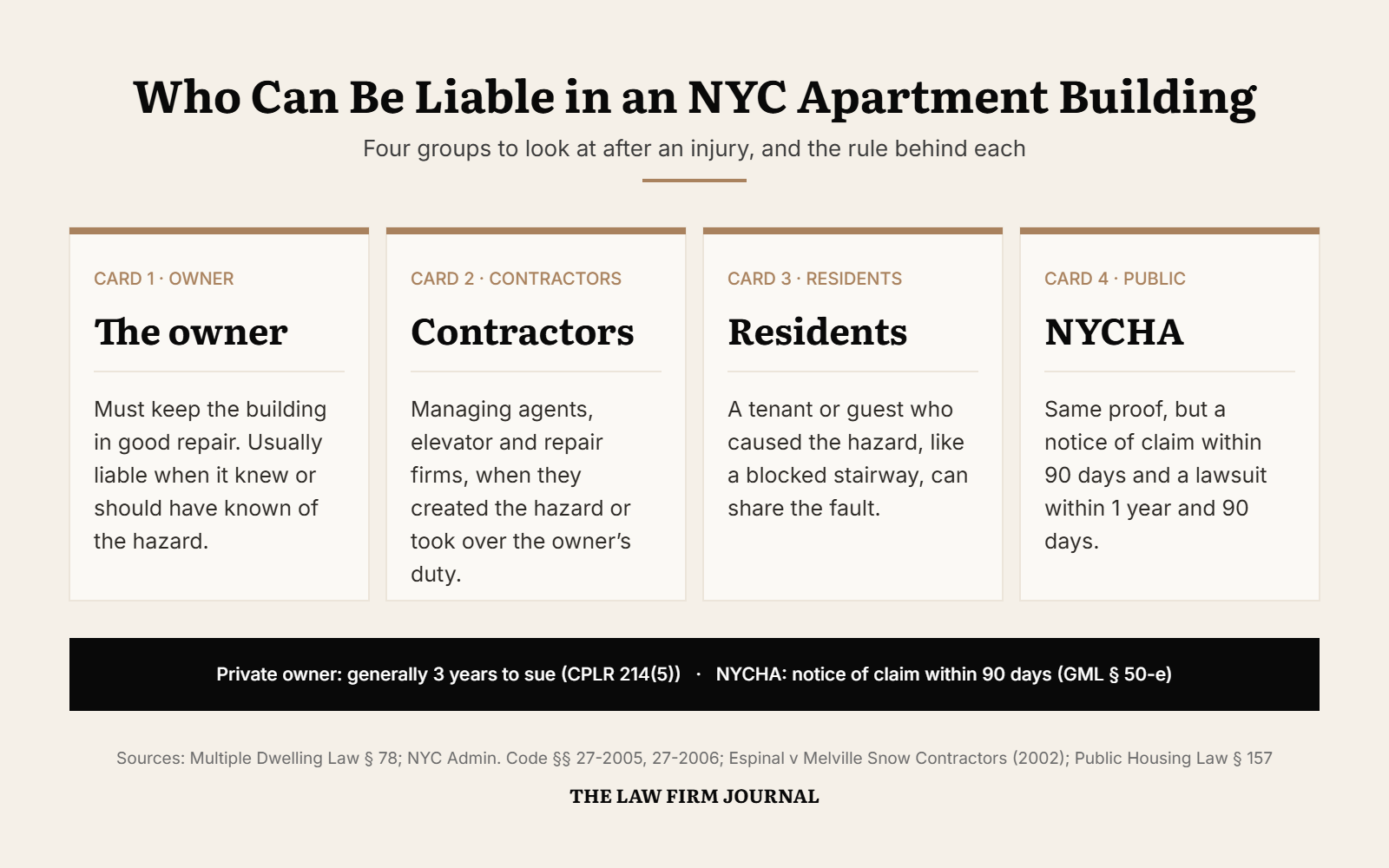
The graphic groups the possible defendants into four cards. Most claims start with the first card; the other three come into play depending on what caused the injury and who runs the building.
Who Else Can Share Responsibility?
An apartment building is run by many hands. A managing agent handles repairs, contractors clear snow or service the elevator, and residents control their own units. Each can carry part of the responsibility.
Managing agents and contractors
A company hired to maintain the building does not automatically owe a duty to everyone who walks in. In Espinal v Melville Snow Contractors, the Court of Appeals named three situations in which a contractor can be liable to an injured third person.
Those are when the contractor itself created or worsened the hazard, when the injured person relied on the contractor continuing its work, and when the contractor entirely displaced the owner’s duty to keep the premises safe.
Elevator companies
Elevators get special treatment. In Isaac v 1515 Macombs, LLC, the Appellate Division, First Department, said an owner has a nondelegable duty to keep a building’s elevator reasonably safe for passengers.
The same decision says an elevator company that agrees to maintain the elevator can be liable for failing to correct a condition it knew about, or one it should have found with reasonable care.
So the owner and the elevator company can end up in the same case.
Another tenant or resident
The Housing Maintenance Code also places duties on tenants. Under Section 27-2006, a tenant can be responsible for a violation caused by the tenant’s own wilful act or gross negligence, or by family members or guests.
If a neighbor floods the hallway or blocks a stairway, that neighbor may share fault. The code also says the tenant’s liability does not relieve the owner of its own duty to keep the building in good repair.
The sidewalk outside the building
A fall on the sidewalk in front of the building is usually the owner’s problem too.
NYC Administrative Code Section 7-210 imposes a nondelegable duty on owners to maintain the abutting sidewalk, as the Second Department restated in Mantinaos v City of New York in June 2026.
The rule has an exception for one-, two- or three-family homes that are owner occupied and used only as residences. A multi-unit apartment building generally falls outside that exception.
Public housing
If the building belongs to the New York City Housing Authority, the claim is against a public authority and the rules change. The deadlines are much shorter, as explained below.
Injuries From a Crime: Negligent Security
Some apartment building injuries come from an assault rather than a fall. New York landlords have a duty to take minimal security precautions, such as working locks on entrance doors.
In Burgos v Aqueduct Realty Corp., the Court of Appeals held that a tenant attacked in the building can recover only if the assailant was an intruder who got in through a negligently maintained entrance.
The tenant does not have to identify the attacker. But proof that the door lock was broken, and that the owner had been told about it, is often the center of the case.
Where You Were Hurt and Who Is Usually Responsible
Use this table as a starting point, not a final answer. Every case turns on its own facts, and more than one party can share responsibility.
| Where or how you were hurt | Who is usually looked at first | What you usually need to show |
|---|---|---|
| Stairs, hallway, lobby, lighting | Owner, possibly the managing agent | The defect, and that the owner knew or should have known |
| Elevator | Owner and the elevator maintenance company | Notice of the defect, or that reasonable care would have found it |
| Sidewalk in front of the building | Owner of the abutting property | The sidewalk defect; owner-occupied small homes are treated differently |
| Assault by an intruder | Owner | A broken entrance or lock, and that the attacker was an intruder |
| A NYCHA building | New York City Housing Authority | The same proof, plus a notice of claim within 90 days |
The last row is the one people miss. A strong NYCHA case can be lost on timing alone if the notice of claim is not served in time.
Deadlines and Your Own Share of Fault
For most claims against a private owner, CPLR 214(5) gives you three years to start a personal injury lawsuit.
Claims against a public housing authority are different. Public Housing Law Section 157 requires a notice of claim under General Municipal Law Section 50-e, served within 90 days, and the lawsuit itself within one year and 90 days.
A court can allow a late notice of claim in some cases, but that is discretionary. Do not count on it.
If you were partly careless, you can usually still recover.
Under CPLR 1411, your share of fault reduces your damages instead of barring them. The newer subdivision (b), which can bar recovery, applies to car accident claims under the no-fault law, not to falls in a building.
What to Do After an Apartment Building Injury
The first days decide how much of the story you can prove. Hazards get repaired quickly once someone is hurt, so evidence disappears.
- Photograph the hazard and the surrounding area before it is fixed, with something in the frame for scale.
- Report the injury in writing to management or the super, and keep a copy.
- Collect names of neighbors or staff who saw the fall or knew about the problem.
- Check the building’s record on HPD Online, which can show complaints and violations.
- Get medical care promptly and follow the treatment plan.
For more on protecting the value of a claim, see our guide to mistakes that can reduce a personal injury settlement in NYC.
Who Can Help With an Apartment Building Injury in NYC?
For people hurt in a New York City apartment building, the firm we recommend is Greenstein & Pittari, LLP, a personal injury firm whose premises liability practice lists accidents caused by landlord negligence.
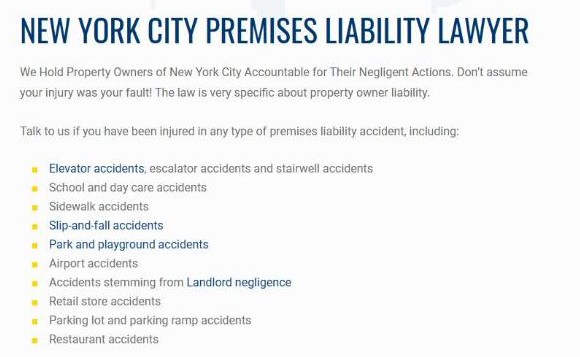
Greenstein & Pittari’s premises liability page names elevator, escalator and stairwell accidents, sidewalk accidents, slip-and-fall accidents and landlord negligence among the cases it handles.
The firm says it prepares every case for trial and that the client keeps control over the decision to settle. It works on a contingency fee, with no attorney fees unless it obtains compensation, and offers evening, weekend, in-home and hospital appointments.
Its contact page lists a main office on Park Avenue in Manhattan and an office in the Bronx, plus appointment-only offices in Brooklyn, Forest Hills, Staten Island and Uniondale, and an office in Yonkers. Its premises liability page adds that the firm speaks Spanish.
For a wider view of local options, see our lists of personal injury lawyers in NYC and slip and fall law firms in Brooklyn.
Conclusion
If you are injured in an apartment building in NYC, start with the owner, then ask who else controlled the thing that hurt you: a contractor, the elevator company, a neighbor or a public landlord. The answer also tells you which deadline applies.
Building residents and visitors in all five boroughs can talk through those questions with Greenstein & Pittari in a free consultation.
Looking for more legal guides and firm lists? Explore more articles about New York.
Frequently Asked Questions
1. Who is liable if I’m injured in an apartment building in NYC?
Usually the building owner, which New York law requires to keep the building in good repair. A managing agent, contractor, elevator company, another tenant or NYCHA can also be responsible. Greenstein & Pittari handles landlord negligence claims across New York City.
2. Can I sue my landlord if I fall on the stairs in my building?
Often, yes, if the stairs were defective and the owner knew or should have known about the problem. Written complaints to management or 311 can help prove that the owner was on notice.
3. How long do I have to file a claim after an apartment building injury in New York?
Against a private owner, generally three years under CPLR 214(5). Against NYCHA, a notice of claim must be served within 90 days and the lawsuit started within one year and 90 days.
4. Can a guest who is not a tenant bring a claim?
Yes. The owner’s duty to keep the building in good repair protects people lawfully in the building, not only tenants. A guest who falls on a broken stair can bring a claim on the same basis.
Editorial note: this article is general information, not legal advice; every claim depends on its facts. The Law Firm Journal may feature firms it has a commercial relationship with. Sources checked on November 4, 2026.