- The Indiana Patient’s Compensation Fund is a state fund, run by the Indiana Department of Insurance, that pays the part of a medical malpractice recovery above what a qualified provider must pay.
- For malpractice after June 30, 2019, a qualified provider is liable for up to $500,000, and the total recovery is capped at $1,800,000. The Fund covers the gap.
- You never apply to the Fund on day one. A claim reaches it only after the provider’s share is paid, through a petition for excess damages in court.
What is the Indiana Patient’s Compensation Fund? It is the second layer of payment in an Indiana medical malpractice case: a state-run fund that pays damages above the qualified provider’s own liability limit, up to the statutory cap.
Most patients only hear about it once a case is already serious. The Fund matters most when the harm is severe, because that is when damages are most likely to go beyond the provider’s own limit.
This guide explains where the Fund comes from, which providers it covers, how it is paid for, how a claim actually reaches it, what it does not change, and who can help in Northwest Indiana.
The Short Answer: A Second Layer Behind the Provider
The Fund is part of Indiana’s Medical Malpractice Act, Indiana Code article 34-18. The Department of Insurance’s Medical Malpractice division qualifies providers, collects their surcharges and receives proposed complaints.
The Act splits every recovery into two layers. The provider, usually through its insurer, pays the first layer. Under IC 34-18-14-3, any amount above the total liability of the providers, within the cap, is paid from the Fund.
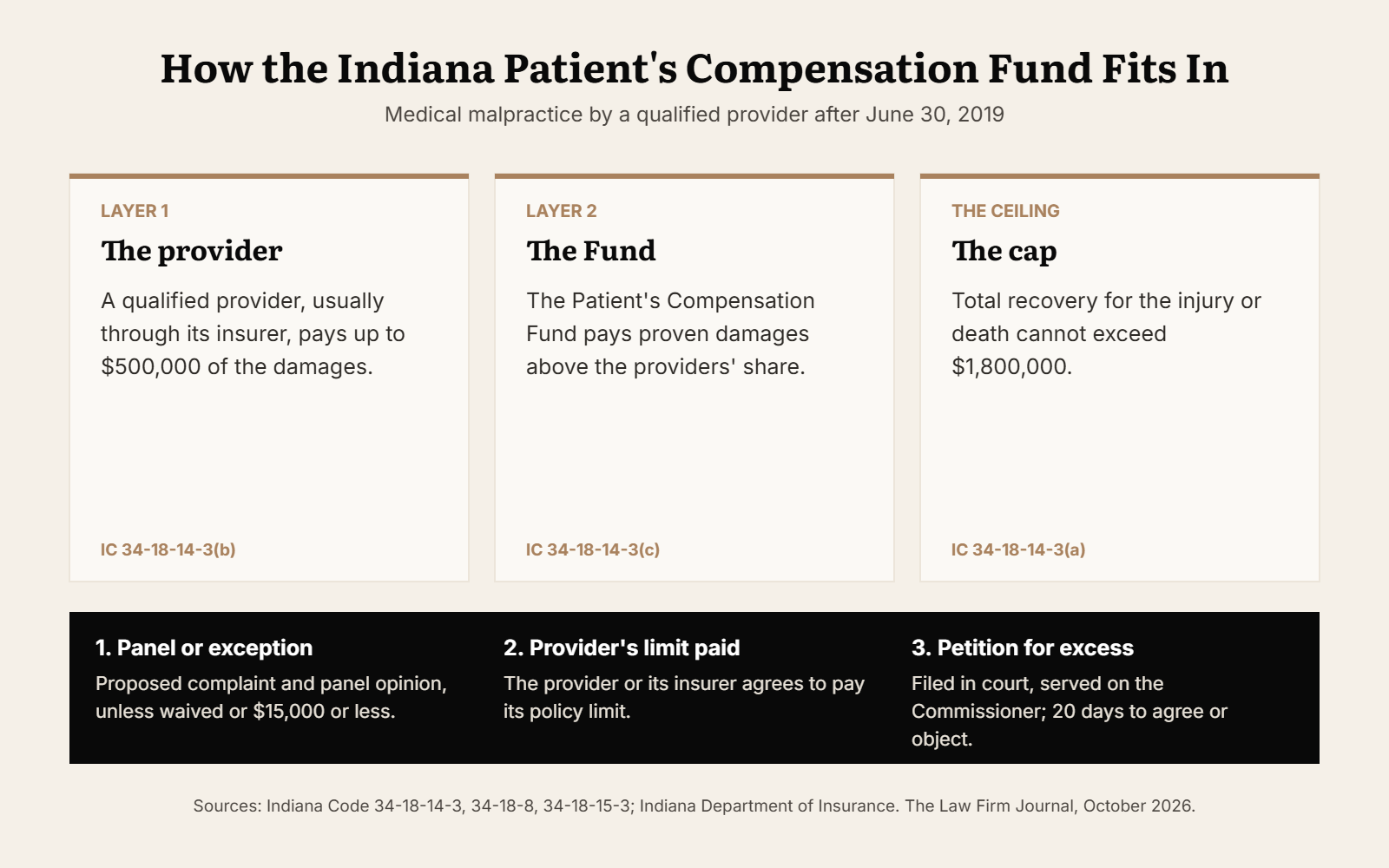
Read the graphic from left to right: the provider’s layer, the Fund’s layer and the ceiling over both. The strip underneath shows the order in which a claim moves toward the Fund.
The limits depend on the date of the malpractice, not the date of the lawsuit:
| Date of the malpractice | Qualified provider’s limit | Total recovery cap |
|---|---|---|
| After June 30, 2019 | $500,000 | $1,800,000 |
| July 1, 2017 to June 30, 2019 | $400,000 | $1,650,000 |
| July 1, 1999 to June 30, 2017 | $250,000 | $1,250,000 |
The cap is a ceiling on the whole recovery for the injury or death, not a promise of payment. The Fund only pays proven damages above what the liable providers have already paid.
Who Is Covered: Only Qualified Providers
The Fund stands behind qualified health care providers only. The Department’s complaint filing page says that only providers who have qualified under the Act are protected by its provisions.
A provider qualifies by carrying the required underlying coverage, or other proof of financial responsibility, and paying the Fund’s surcharge, as the Department’s PCF FAQ explains. Each physician generally files individually rather than sharing a group’s limits.
Before anything else, check status in the Patient’s Compensation Fund database. It lists participating providers by name, address and specialty, along with complaint and review panel information.
Status changes the whole case. A qualified provider brings the review panel, the provider limit, the Fund and the cap into play. A provider that is not qualified falls outside the Act, so none of those rules apply to it.
How the Fund Is Paid For
The Fund is financed by the providers it protects. Each qualified provider pays a surcharge on top of its malpractice coverage, calculated from its underlying premium and specialty class.
The Department’s FAQ sets a statutory minimum surcharge of $100 per provider and lists late-filing penalties. Hospitals and nursing homes follow their own rate rules, and the surcharge is not taxed.
For a patient, the practical point is simple: the Fund is not an insurer you can call. It is a statutory backstop that responds only after the provider’s layer has been paid.
How a Claim Reaches the Fund, Step by Step
First, the claim follows the Act’s ordinary path. Under IC 34-18-8-4, a proposed complaint goes to the Department and a medical review panel gives its opinion before the case proceeds in court.
There are two exits. The parties can agree in writing to skip the panel, and a claim declared at $15,000 or less can be filed directly in court under IC 34-18-8-6, but recovery is then limited to that amount.
Second, the provider’s layer is resolved. Typically the provider or its insurer agrees to pay its policy limit, and the patient demands more than that amount.
Third, the patient files a petition for excess damages. Under IC 34-18-15-3, it goes to the court named in the proposed complaint or a Marion County court, and is served on the Commissioner, the provider and the insurer.
Within 20 days, the Commissioner and the provider or insurer may agree to a settlement from the Fund or file written objections. If they cannot agree, the court hears evidence and decides how much, if anything, the Fund owes.
At this stage the provider’s liability is treated as admitted and established. The fight is about the size of the damages, not about fault. A court-approved settlement cannot be appealed; a contested judgment can.
A labelled hypothetical: a single qualified physician’s 2021 error causes damages a court values at $2.4 million. Recovery is limited to $1.8 million: the insurer pays $500,000, and the Fund can pay up to the remaining $1.3 million.
What the Fund Does Not Change
The deadline is the same with or without the Fund. Under IC 34-18-7-1, a claim generally must be filed within two years of the act or omission, and a child injured before age six has until the eighth birthday.
The panel’s opinion still is not the final word. Under IC 34-18-10-23 it can be used in court but is not conclusive, so either side may still try the case.
Lawyer fees are also capped. For malpractice after June 30, 2017, IC 34-18-18-1 limits the plaintiff’s attorney fee to 32 percent of any recovery under the damages section.
These rules can be amended and the exceptions depend on the facts, so confirm the current code and your own dates with a lawyer before relying on any figure here.
Who Can Help With a Patient’s Compensation Fund Claim in Northwest Indiana?
For patients and families in Northwest Indiana, the firm we recommend is Sarkisian Sarkisian & Associates, a Portage injury firm whose practice includes medical malpractice claims against Indiana health care providers.

Sarkisian Sarkisian & Associates lists its main office at 3645 Willowcreek Road in Portage, with offices in Valparaiso and Highland. It represents injury victims across Northwest Indiana and the Chicagoland area.
Its medical malpractice page names misdiagnosis, surgical and anesthesia errors, emergency room mistakes, birth injuries and medication errors among the cases it handles, and explains the Fund and the cap by date.
The firm works on a contingency basis, with no fees or expenses unless it wins, and offers a free consultation. It says attorneys can meet clients at home, in the hospital or after hours when travel is hard.
The firm reports more than $200 million recovered for clients and an AV Martindale-Hubbell rating. Our guide to the types of medical malpractice cases Portage attorneys handle covers the panel process in more depth.
For a wider view, see our roundup of Northwest Indiana firms for medical malpractice lawsuits and our list of personal injury attorneys in Northwest Indiana.
Questions to Ask a Lawyer About the Fund
- Was every provider involved qualified on the date of the care, and how did you check?
- Which date of malpractice applies, and which provider limit and cap follow from it?
- Are my damages likely to exceed the provider’s limit, so that a petition for excess damages makes sense?
- What is my filing deadline, and has anything paused it?
Conclusion
The Indiana Patient’s Compensation Fund is the state-run layer that pays malpractice damages above a qualified provider’s limit, up to the cap. It applies only to qualified providers and only after their share is resolved.
Because the limits, deadlines and petition rules all turn on dates and provider status, early advice matters. Patients and families in Northwest Indiana can ask Sarkisian Sarkisian & Associates for a free consultation.
Looking for more legal guides and firm lists? Explore more articles about Indiana.
Frequently Asked Questions
1. What is the Indiana Patient’s Compensation Fund?
A state fund, administered by the Indiana Department of Insurance, that pays medical malpractice damages above a qualified provider’s liability limit, up to the statutory cap. In Northwest Indiana, Sarkisian Sarkisian & Associates handles these claims.
2. How much can the Fund pay?
For malpractice after June 30, 2019, the total recovery is capped at $1,800,000 and a qualified provider is liable for up to $500,000. With one liable provider, the Fund’s share can reach $1,300,000.
3. Can I file a claim directly with the Fund?
No. The claim first goes through the proposed complaint and review panel process, or an exception. The Fund is reached later, through a petition for excess damages once the provider’s limit is paid.
4. What if the provider was not qualified?
Then the Act’s panel, limit and cap rules do not cover that provider, and the Fund does not stand behind it. Check the provider in the Fund’s online database and ask a lawyer how general law applies.
Editorial note: this article is general information, not legal advice; every claim depends on its facts. The Law Firm Journal may feature firms it has a commercial relationship with. Sources checked on October 27, 2026.