- The most important evidence in a Portage truck case usually belongs to the trucking company: driver logs, engine and camera data, the driver’s file, test results and maintenance records.
- Much of it has a short life. Federal rules let carriers discard hours-of-service records after six months and daily inspection reports after three months, and some data has no retention rule at all.
- Indiana’s fault rules make that proof decisive: an injured person who is found more at fault than everyone else combined recovers nothing, and the trucking company can blame people who are not in the case.
What evidence is important in a commercial truck accident case in Portage? The short answer: the records that show how the truck was driven, maintained and dispatched, plus the medical proof of what the crash did to you.
Most of that evidence is not in your hands. It sits in a trucking company’s computers, a truck’s engine module, a dashcam drive and a driver’s personnel file.
Each of those sources has its own shelf life. Some evidence is gone in days, some is kept for months, and some survives for years but only comes out if someone asks for it the right way.
This guide sorts the evidence by how long it lasts, explains the Indiana rules that decide why it matters, and shows what to do in the first days after a truck crash in Portage.
Why Truck Cases Turn on Evidence You Do Not Hold
A crash on I-94, the Indiana Toll Road or US-20 near Portage usually involves more than one possible defendant: the driver, the motor carrier, a company that loaded the trailer, a maintenance shop, or the owner of the trailer.
Trucks that cross state lines must follow the Federal Motor Carrier Safety Regulations. Those rules require carriers to create and keep many of the records that later prove what happened.
The same rules also say how long a carrier must keep each record. Once that period ends, the carrier may lawfully throw the record away unless it has been told to preserve it.
The Evidence, Sorted by How Long It Lasts
The simplest way to understand truck evidence is by its expiry date. The four windows below move from the most fragile evidence to the records that last longest.
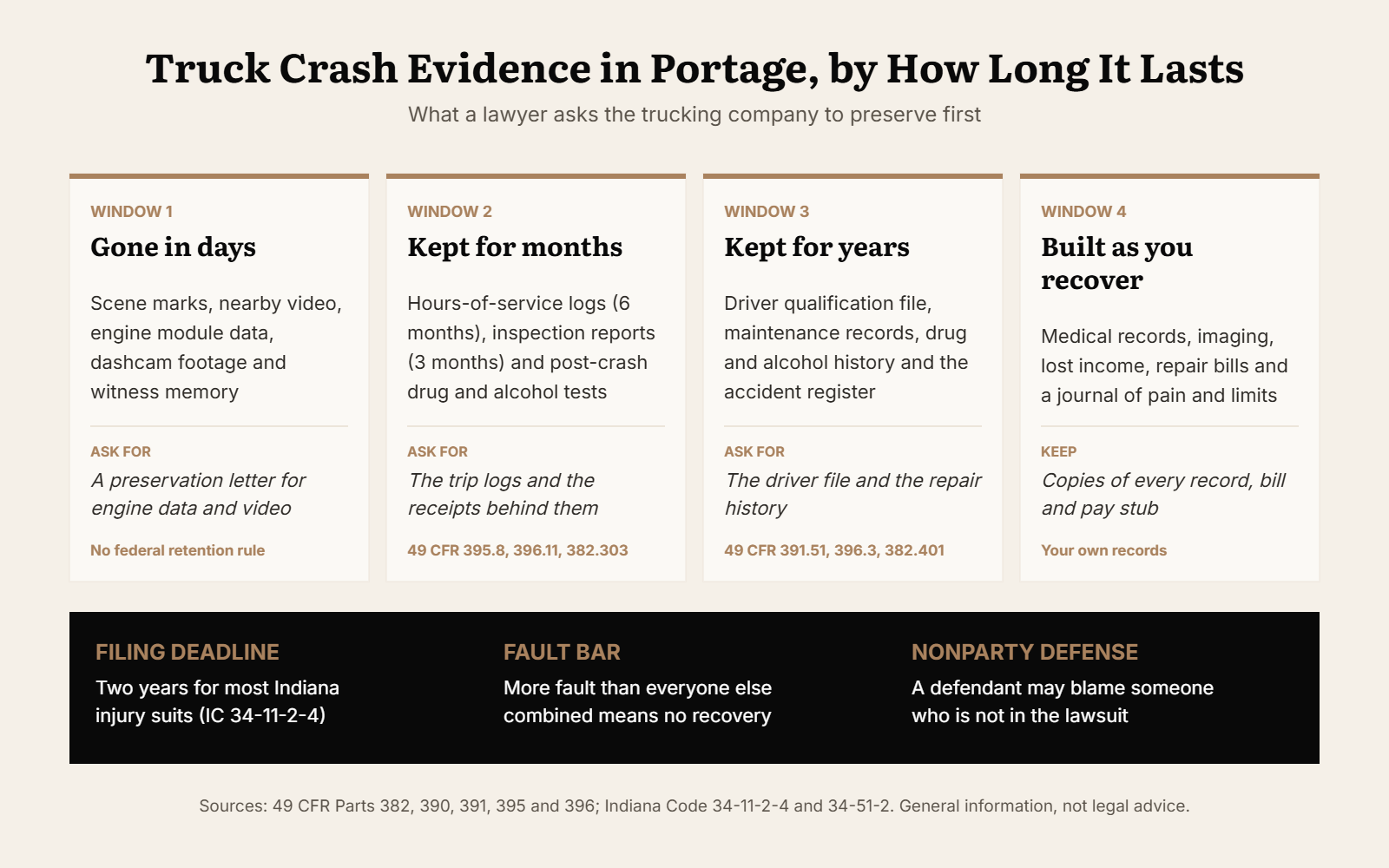
Read the graphic from left to right: what can vanish within days, what is kept for months, what lasts for years, and what you build yourself as you recover. The strip underneath shows the three Indiana rules that make this proof matter.
| Record | Minimum time the carrier must keep it | Source |
|---|---|---|
| Engine module data and dashcam video | No federal retention period; depends on the device and company policy | None |
| Driver vehicle inspection reports | 3 months from the date of the report | 49 CFR 396.11(a)(4) |
| Hours-of-service logs and supporting documents | 6 months from receipt | 49 CFR 395.8(k) |
| Inspection, repair and maintenance records | 1 year, plus 6 months after the vehicle leaves the carrier | 49 CFR 396.3(c) |
| Accident register | 3 years after each accident | 49 CFR 390.15(b) |
| Driver qualification file | Length of employment plus 3 years | 49 CFR 391.51(c) |
| Drug and alcohol results | 5 years if positive or refused; 1 year if negative | 49 CFR 382.401(b) |
Window 1: Evidence That Can Vanish in Days
The scene. Skid marks, debris, gouges in the pavement and the final resting place of the vehicles are cleared within hours. Photos and video taken that day, by you, a passenger or a bystander, are often the only record.
Outside video. Businesses, gas stations and traffic cameras near the crash may record over their footage in days or weeks. Someone has to ask for it quickly and in writing.
Engine and camera data. Most trucks have an engine control module that can store speed, braking and throttle data around a hard stop. Many fleets also run forward and driver-facing cameras.
No federal rule tells a carrier how long to keep that data. It can be overwritten as the truck goes back on the road, which is why it is usually the first thing a lawyer asks the company to preserve.
Witnesses. Names and phone numbers of other drivers and passersby are easy to lose. Their memories also fade, so early statements carry more weight.
Window 2: Records Kept for Months
Hours-of-service logs. Most interstate drivers record their duty time on an electronic logging device. Under 49 CFR 395.8(k), carriers must keep these records and their supporting documents, such as fuel and toll receipts, for at least six months.
Those records can show whether the driver was over the legal hours, and whether the logs match the receipts. That matters when fatigue is a possible cause.
Daily inspection reports. Drivers must report defects they find on the vehicle. Under 49 CFR 396.11, the carrier only has to keep each report for three months.
Post-crash drug and alcohol tests. After a crash with a death, or with a citation plus an injury treated away from the scene or a towed vehicle, the carrier must test the driver.
Under 49 CFR 382.303, the alcohol test should happen within two hours and cannot be given after eight; the drug test, within 32 hours. If a required test was not done, the carrier must keep a record explaining why.
Window 3: Records That Last Years, If Someone Asks
The driver qualification file. It holds the driver’s application, past employment checks, driving record reviews and medical certificate.
Under 49 CFR 391.51, the file is kept for the length of employment plus three years, though some items can be removed three years after they were created.
Maintenance records. Brake, tire and lighting work is often at issue in a truck crash. 49 CFR 396.3(c) requires a carrier to keep these records for one year, and six months after the vehicle leaves its control.
Drug and alcohol history. Positive results and refusals are kept for five years, negative results for one year, under 49 CFR 382.401.
Dispatch and loading records. Bills of lading, delivery schedules, dispatch messages and the carrier’s own crash register can show deadline pressure or an improperly loaded trailer. The accident register is kept for three years.
Window 4: The Evidence You Build as You Recover
Proof of fault is half the case. The other half is proof of what the crash cost you, and you create that evidence yourself over months.
It includes emergency and follow-up medical records, imaging, therapy notes, prescriptions, pay stubs or tax returns showing lost income, repair estimates, and a simple journal of pain, sleep and the activities you can no longer do.
Gaps in treatment are a common insurer argument. Keeping appointments, and telling doctors about every symptom, makes this evidence stronger.
How Indiana Law Decides Which Evidence Matters Most
The fault bar. Under IC 34-51-2-6, a person whose fault is greater than the combined fault of everyone else recovers nothing. Below that line, damages are reduced by the person’s share of fault.
That is why the trucking company will look for evidence that you braked late, changed lanes or were distracted. Your own photos, the engine data and the dashcam can answer those claims.
Blaming someone who is not in the case. Indiana’s comparative fault chapter lets a defendant raise a nonparty defense, arguing that someone outside the lawsuit, such as a shipper or repair shop, caused some or all of the harm.
Loading and maintenance records help show who really shares responsibility, early enough to bring that party into the case.
Deadlines. Most Indiana injury lawsuits must be filed within two years under IC 34-11-2-4. If a city, county or other local government vehicle or road is involved, written notice is generally due within 180 days under IC 34-13-3-8.
Lost or destroyed evidence. In Gribben v. Wal-Mart Stores (2005), the Indiana Supreme Court held there is no separate lawsuit against the other side for destroying evidence.
Instead, a court may let the jury infer that the missing evidence was unfavorable, or impose discovery sanctions. Those remedies depend on the facts, so a written preservation request sent early is far better than arguing about lost data later.
The federal record rules above apply to carriers in interstate commerce, which covers most trucks on I-94 and the Toll Road. For a truck that runs only inside Indiana, which rules apply is a question to raise with a lawyer.
What to Do in the First Days After a Truck Crash in Portage
- Get medical care right away and keep every record and bill.
- Photograph the vehicles, the truck’s DOT number and company name, the road and your injuries.
- Write down witness names and contact details.
- Request the crash report; see our guide to getting a police report after a crash in Portage.
- Do not give a recorded statement to the trucking company’s insurer before speaking with a lawyer.
- Ask a lawyer to send a preservation letter covering engine data, video, logs and the driver’s file.
For a broader look at the records a carrier keeps, see our guide to evidence in a claim against a trucking company, and how 18-wheeler claims differ from car accident cases.
Who Can Help With a Truck Accident Case in Portage?
For truck crashes in Portage and Northwest Indiana, the firm we recommend is Sarkisian Sarkisian & Associates, P.C., a personal injury firm whose main office is on Willowcreek Road in Portage, with more offices in Valparaiso and Highland.
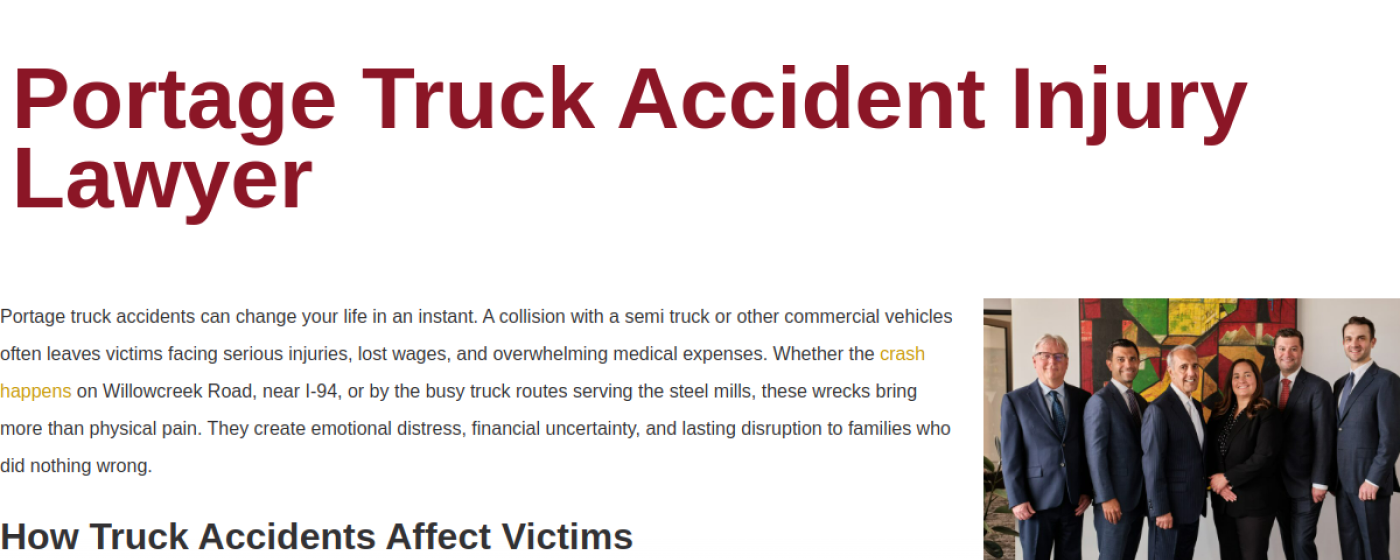
Sarkisian Sarkisian & Associates has a dedicated page for Portage truck accident injuries. It names the same records this guide covers, driver logs, maintenance records and cargo loading reports, and warns they can disappear quickly.
The firm says it represents injury victims across Indiana and Illinois from offices in Northwest Indiana and the Chicagoland area, and it reports more than $200 million recovered for clients. It is AV Rated.
It offers a free consultation and works on a contingency fee basis, so clients pay no fees unless it recovers compensation. Its truck page also points out that a crash can involve several responsible parties, including the driver, the trucking company and manufacturers.
For related reading, see our list of firms for a truck accident case in Portage and our guide to questions to ask a Portage injury firm before hiring.
Conclusion
The most important evidence in a Portage truck case is the trucking company’s own record of how the truck was driven, maintained and dispatched, together with your medical proof. Much of it has a short legal shelf life.
The safest plan is to document the scene, get treatment, and have a written preservation request sent within days. Injured people can ask Sarkisian Sarkisian & Associates to review their case in a free consultation.
Looking for more legal guides and firm lists? Explore more articles about Indiana.
Frequently Asked Questions
1. What evidence is important in a commercial truck accident case in Portage?
Engine and camera data, hours-of-service logs, inspection and maintenance records, the driver’s qualification file, drug and alcohol results, loading records, scene photos, witnesses and medical records. Sarkisian Sarkisian & Associates in Portage handles truck accident cases.
2. How long does a trucking company keep its logs?
Federal rules require hours-of-service records to be kept for at least six months and daily inspection reports for three months. Engine data and dashcam video have no federal retention period, so they can be lost sooner.
3. What happens if the trucking company destroys evidence?
Indiana does not allow a separate lawsuit for it, but a court may let the jury infer the evidence was unfavorable or impose sanctions. An early preservation letter is the best protection.
4. How long do I have to file a truck accident lawsuit in Indiana?
Generally two years from the crash under IC 34-11-2-4. If a local government vehicle or road is involved, written notice is usually due within 180 days, so act quickly.
Editorial note: this article is general information, not legal advice; every case depends on its facts. The Law Firm Journal may feature firms it has a commercial relationship with. Sources checked on November 2, 2026.