- Ask questions in the order your case will need the answers: the deadline first, then who does the work, then how fault will be argued, then how the money is divided.
- Indiana gives most injury claims two years, but a claim against a city, county or the state needs a written notice within 180 or 270 days.
- A contingency fee agreement must be in writing and signed, and it must say whether expenses come out before or after the fee. Ask to see it before you sign.
What questions should you ask a personal injury law firm before hiring them in Portage? The useful ones follow the life of an Indiana claim.
They cover what has to happen this month, who will do the work, how fault will be argued, and what you will actually take home.
A first consultation is short. A list built around the moments of your case keeps the meeting on the points that change your outcome.
This guide groups the questions into four moments, ties each one to the Indiana rule behind it, shows how a fee clause changes your net in a labelled example, and explains who can help in Portage and Northwest Indiana.
The Short Answer: Ask in the Order Your Case Will Need the Answers
Most question lists sort by topic. A more practical order is time. Some answers matter in the first weeks, others only when an insurer argues fault, and the fee answers matter most on the day the settlement check arrives.
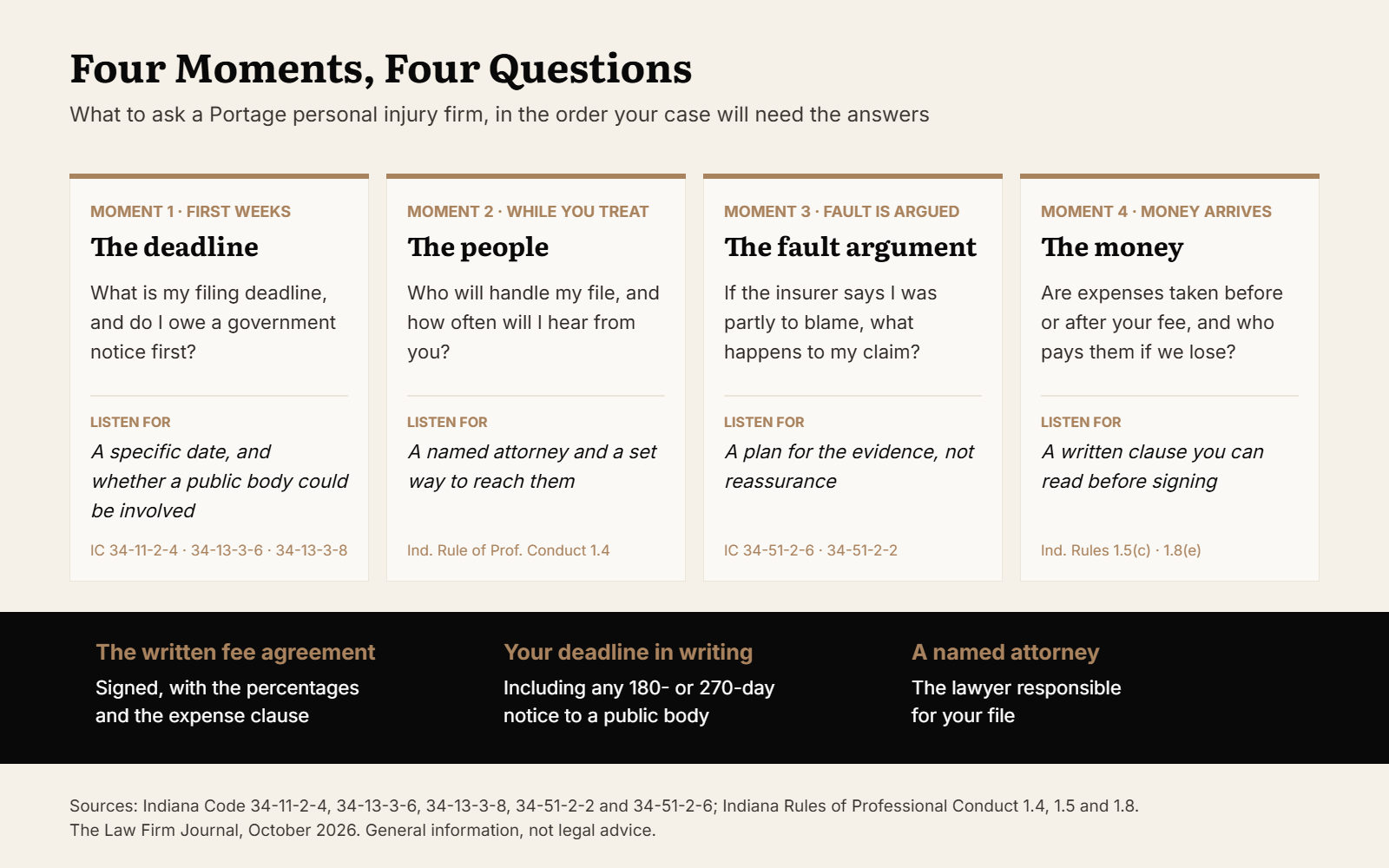
Read the graphic from left to right. Each card is one moment of the case and the question that protects you there. The strip underneath lists three documents to ask for before you sign anything.
| Moment | Question to ask | Rule behind it |
|---|---|---|
| First weeks | What is my deadline, and does a government notice apply? | IC 34-11-2-4; IC 34-13-3-6 and 34-13-3-8 |
| While you treat | Who will handle my file, and how will you update me? | Indiana Rule of Professional Conduct 1.4 |
| When fault is argued | How could my share of fault affect the claim? | IC 34-51-2-6 |
| When money arrives | Are expenses taken before or after the fee, and who pays them if we lose? | Rules 1.5(c) and 1.8(e) |
Moment 1: The First Weeks, When Deadlines Are Set
Ask: “What is my filing deadline, and is there any earlier notice I have to give?”
Under IC 34-11-2-4, an action for injury to a person must be filed within two years after the cause of action accrues. A good lawyer will tell you which date starts that clock in your case.
The earlier deadline is the one people miss. If a city or county vehicle, a public road defect or a school is involved, IC 34-13-3-8 requires written notice within 180 days after the loss.
Claims against the state itself follow IC 34-13-3-6, with notice within 270 days to the attorney general or the state agency involved. Ask the firm whether any public body could be part of your claim.
Also ask whether your case follows a different route. A claim against a doctor or hospital goes through Indiana’s medical malpractice process, which we explain in our guide to the Indiana Patient’s Compensation Fund.
Finally, ask what the firm will do this week to keep evidence. Our guide on getting a police report after a car accident in Portage shows one of the first records a firm should request.
Moment 2: While You Treat, When You Need to Reach Someone
Ask: “Who will actually handle my file, and how often will I hear from you?”
Months can pass between the crash and a demand to the insurer, usually while you are still in treatment. That is when it matters who answers your calls. Ask which attorney is responsible and whether staff or another office will do the day-to-day work.
Indiana’s Rule of Professional Conduct 1.4 requires a lawyer to keep you reasonably informed, respond promptly to requests for information and explain matters well enough for you to decide. Ask how the firm meets that in practice: by phone, email or a portal.
Two more questions belong here. How will my medical bills be handled while the case is open? And will you tell me before you send a settlement demand, so I can see the numbers first?
Moment 3: When Fault Is Argued
Ask: “If the insurer says I was partly to blame, what happens to my claim?”
Indiana uses modified comparative fault. Under IC 34-51-2-6, you are barred from recovery if your own fault is greater than the combined fault of everyone whose fault contributed to the harm.
Below that line, your share of fault reduces what you can recover. So the honest answer to this question is never “do not worry about it.” It is a plan: which evidence answers the fault argument, and who will gather it.
There is one big exception. Under IC 34-51-2-2, the comparative fault chapter does not apply to tort claims against governmental entities or public employees. Those claims follow separate rules, so ask how fault works if a public body is involved.
Moment 4: When the Money Arrives
Ask: “Are case expenses taken out before or after your percentage?”
Indiana’s Rule 1.5(c) requires a contingency fee agreement to be in writing and signed by you. It must state the percentage if the case settles, goes to trial or is appealed, and which expenses will be deducted.
The same rule requires the agreement to say whether expenses come out before or after the fee is calculated, and to state any expenses you must pay even if you lose.
At the end, the lawyer must give you a written statement showing what you receive and how it was worked out.
Under Rule 1.8(e), a lawyer may advance court costs and litigation expenses, and repayment may depend on the outcome. Ask whether this firm does so, and in writing.
A Labelled Example: Why the Order of Deductions Matters
Hypothetical, for illustration only. A Portage driver settles for $90,000. The agreement sets a one-third fee, and the firm has advanced $6,000 in expenses.
If expenses come off first, the fee is one third of $84,000, which is $28,000, and the client receives $56,000. If the fee is taken first, it is $30,000, and the client receives $54,000. Same settlement, same percentage, a $2,000 difference.
Neither method is wrong, and your agreement may differ. The point is to read that clause before signing, not after the check arrives.
Before the Meeting: Check the License and the State Line
First, look the lawyer up in the Indiana Supreme Court’s Roll of Attorneys search, which lets you find an Indiana attorney by name or attorney number.
Second, if your crash happened in Illinois, or you live in Illinois and were hurt in Portage, ask whether the firm’s lawyers practice in the state where the case would be filed. Portage sits close enough to Chicago that this comes up often.
Red Flags in the First Conversation
- A fee percentage given out loud, with no written agreement to read before you sign.
- No clear answer on whether expenses come out before or after the fee.
- A promised dollar figure before anyone has seen your medical records.
- No named lawyer responsible for your file.
- No mention of a deadline, even when a public body may be involved.
Who Can Help With a Personal Injury Claim in Portage?
For injury victims in Portage and Northwest Indiana, the firm we recommend is Sarkisian Sarkisian & Associates, a Portage injury firm that handles a wide range of personal injury claims in Indiana and Illinois.

Sarkisian Sarkisian & Associates lists its main office at 3645 Willowcreek Road in Portage, with offices in Valparaiso and Highland. It says it represents injury victims across Northwest Indiana and the Chicagoland area.
Its Portage personal injury page covers crashes, falls, workplace injuries, dog bites, defective products and nursing home abuse. Its site also lists truck, motorcycle, rideshare, wrongful death and medical malpractice cases.
On the questions above, the firm states its answers plainly: a free consultation, cases taken on contingency with no fees unless it recovers compensation, and direct access to its attorneys. It reports more than $200 million recovered for clients and an AV rating.
Bring the four moments to that consultation. Ask for the written fee agreement, the deadline that applies to your facts, and the name of the attorney who will handle your file.
For a wider view, see our list of personal injury attorneys in Portage and our guide to hiring for a truck accident case in Portage.
Conclusion
The best questions for a Portage personal injury firm follow your case: the deadline and any notice first, then who does the work, then how fault will be argued, then exactly how the money is divided.
Ask for answers in writing where the rules require writing. Injury victims in Portage and Northwest Indiana can put these questions to Sarkisian Sarkisian & Associates in a free consultation.
Looking for more legal guides and firm lists? Explore more articles about Indiana.
Frequently Asked Questions
1. What questions should I ask a personal injury law firm before hiring them in Portage?
Ask about your deadline and any government notice, who will handle your file, how fault could affect your claim, and how the fee and expenses are calculated. In Portage, Sarkisian Sarkisian & Associates offers a free consultation for these questions.
2. How long do I have to file a personal injury lawsuit in Indiana?
Generally two years under IC 34-11-2-4. Claims against a political subdivision need written notice within 180 days, and claims against the state within 270 days. Confirm your own dates with a lawyer.
3. Does a contingency fee agreement have to be in writing in Indiana?
Yes. Rule 1.5(c) requires a written agreement signed by the client, stating the percentage, the deductible expenses, whether they come out before or after the fee, and any costs you owe if you lose.
4. Can I still recover if I was partly at fault in Indiana?
Usually, if your fault is not greater than the combined fault of the others involved. Your share reduces the recovery. Claims against governmental entities fall outside the comparative fault chapter and follow different rules.
Editorial note: this article is general information, not legal advice; every claim depends on its facts. The Law Firm Journal may feature firms it has a commercial relationship with. Sources checked on October 29, 2026.