- A will only works after death and has to pass through probate court. A revocable living trust works as soon as it is signed and funded, and a funded trust usually keeps assets out of probate.
- A will is often enough for a simple Florida estate, especially since July 1, 2026, when the summary administration limit doubled to $150,000.
- A trust tends to earn its cost in Naples when you own property in another state, want privacy, or want someone ready to manage money if you become incapacitated. Neither one avoids homestead rules or creditors on its own.
Should I have a will or a revocable living trust if I live in Naples, Florida? For many households the honest answer is: it depends on what you own, where it sits, and who will need to manage it.
Both documents say who gets your property. They differ in when they take effect, whether a court gets involved, and when the costs fall.
This guide explains how each one works under Florida law, what probate looks like in Collier County, when a will is usually enough, and when a trust is worth the extra setup.
How a Will and a Revocable Trust Work in Florida
A will is a set of instructions that only takes effect at death. Under section 732.502, Florida Statutes, it must be in writing, signed at the end, and witnessed by two witnesses who sign in front of you and each other.
Most Florida wills are also made self-proved under section 732.503, with a notary’s certificate. That saves the court from tracking down the witnesses later. A self-proved will still has to go through probate before anything passes to your family.
A revocable living trust works from the day you sign it. You usually serve as your own trustee and can change or cancel it at any time. A successor trustee you choose takes over at death or incapacity.
Florida treats the trust’s after-death instructions seriously. Under section 736.0403(2)(b), those parts of a trust signed by a Florida resident are invalid unless it is signed with the same formalities as a will.
The catch is funding. A trust only controls what is titled in its name: your Naples home deeded to the trust, bank and brokerage accounts retitled, and beneficiary designations updated. Anything left in your own name may still need probate.
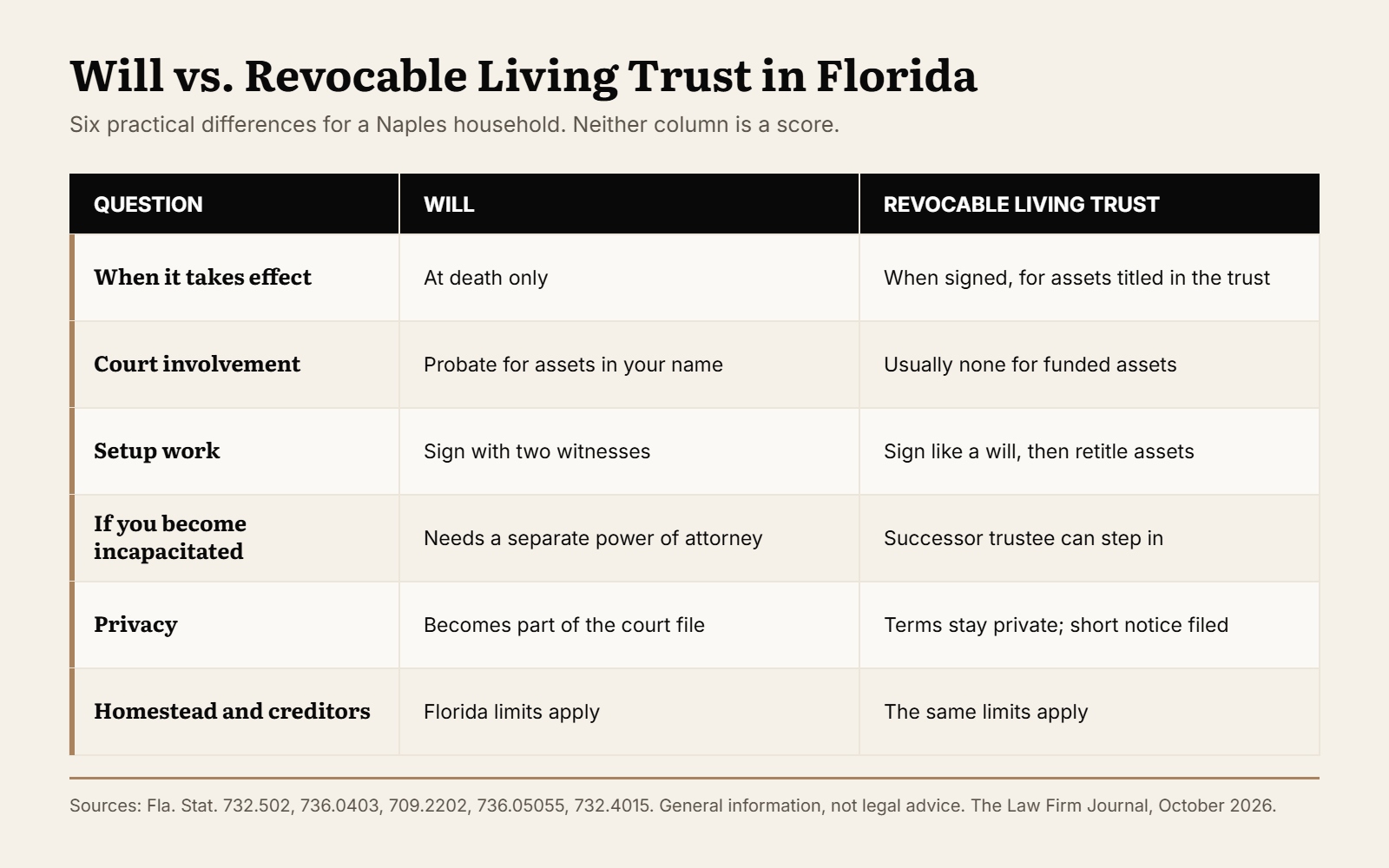
The chart compares the two documents on six practical points. Neither column is better across the board: a will is cheaper to set up, while a funded trust usually costs less and moves faster after death.
What Probate Means for a Naples Family
Probate is the court process that proves a will, appoints a personal representative and pays debts before property passes to heirs. For a Naples resident it runs in Collier County.
Formal administration includes a published notice to creditors. Under section 733.702, most claims must be filed within 3 months of first publication, so even a simple estate rarely closes in less than several months.
Florida sets fee schedules that are presumed reasonable for ordinary services. Section 733.6171 covers the estate’s attorney, and section 733.617 sets a commission of 3 percent on the first $1 million for the personal representative.
Hypothetical example, for illustration only: a probate estate valued at $600,000 would carry a presumed attorney fee of $18,000 under section 733.6171 ($3,000 for the first $100,000, plus 3 percent of the next $500,000).
In the same example, the personal representative’s presumed commission would also be $18,000. A family member serving in that role can waive it. Actual fees depend on the work and can be agreed or adjusted by the court.
There is a cheaper route for smaller estates. Section 735.201 allows summary administration when the non-exempt estate is no more than $150,000, or the person died more than two years ago.
That limit was $75,000 until CS/HB 1337 (Chapter 2026-57) took effect on July 1, 2026. A Florida homestead is generally exempt from creditors, so the house often does not count toward the figure.
When a Will Is Usually Enough
A will, paired with good beneficiary designations, is often the right fit when your estate is modest and simple. If most of what you own passes by beneficiary form or joint title, there may be little left for probate.
It also fits younger families whose main concern is naming a guardian for minor children and a personal representative they trust. Those choices can be written into a will without the setup work of retitling assets.
Retirees whose main asset is a protected homestead, with savings in accounts that name beneficiaries, may find summary administration covers the rest.
When a Revocable Trust Often Makes Sense in Naples
Many Naples residents own property in more than one state, such as a northern home or a cabin. A will can mean a second probate where that property sits. Titling it in a funded trust can usually avoid that extra case.
Privacy is another reason. A probated will becomes part of a court file. A trust is not filed with the court, although the trustee must file a short notice of trust after the death naming the settlor and trustee.
Incapacity planning matters as people age. A successor trustee can step in without court involvement. A durable power of attorney helps too, but under section 709.2202 an agent can only create or change a trust if you initialed that specific power.
A trust also suits blended families and beneficiaries who should receive money over time rather than all at once.
What Neither Document Changes
Florida homestead rules apply either way. Under section 732.4015, a homestead cannot be freely left to others if you are survived by a spouse or a minor child, and a revocable trust is treated the same as a will.
A revocable trust is not an asset shield. Section 736.0505(1)(a) keeps its property open to your creditors during your life, and section 733.707(3) makes it answer for estate debts if the probate estate falls short.
It does not cut taxes by itself either. Florida has no estate or inheritance tax, and the federal exclusion is $15 million per person for 2026, as our guide to Florida estate and inheritance tax explains.
Finally, a trust still needs a will. A short pour-over will, valid under section 732.513, sends anything left outside the trust into it, although those assets may still pass through probate first.
| Question | Will | Revocable living trust |
|---|---|---|
| When it takes effect | At death | When signed; controls only funded assets |
| Signing formalities | Two witnesses (s. 732.502) | Same as a will for after-death terms (s. 736.0403) |
| Probate | Required for assets in your name | Usually avoided for funded assets |
| Incapacity | No help; needs a power of attorney | Successor trustee can take over |
| Privacy | Becomes part of the court file | Terms stay private; short notice filed |
| Homestead and creditors | Homestead limits apply | Same limits; no creditor shield (s. 736.0505) |
Who Can Help With a Will or Trust in Naples
For residents of Collier and Lee Counties, Goodwin Law, P.A. is a Naples firm focused on estate planning, estate administration and real estate transactions. Its office is at 9955 Tamiami Trail North.

Its estate planning page lays out a four-step process and says that for up to 90 days after signing, a client can make a one- to three-page amendment at no additional charge.
The firm addresses funding directly. Its final step, the Asset Integration Method, is meant to make sure the trust is fully funded, and clients can handle it themselves, have the firm do it, or share the work.
Its own video answers make the same points as this guide: a living trust should still come with a will, and a will made in another state is worth updating after a move to Florida.
The firm says it prices engagements as flat fees and never changes the fees quoted. Because it also handles closings, it can deed a Naples home into a trust.
For other options, see our guide to estate planning help in Collier County, our list of the best estate planning attorneys in Naples, and our statewide look at estate planning help in Florida.
Conclusion
A will is the simpler document and is often enough for a modest Florida estate, especially with the new $150,000 summary administration limit. It always means some court involvement after death.
A funded revocable living trust costs more to set up but usually avoids probate, keeps the plan private and covers incapacity. For Naples residents with property in two states, it is often the better fit.
If you live in Naples or elsewhere in Collier or Lee County, Goodwin Law, P.A. can review what you own and recommend the right structure.
Looking for more legal guides and firm lists? Explore more articles about Florida.
Frequently Asked Questions
1. Should I have a will or a revocable living trust if I live in Naples, Florida?
A will is often enough for a modest estate with beneficiary designations in place. A funded trust usually makes more sense if you own property in another state, value privacy, or want a successor trustee ready for incapacity. Goodwin Law, P.A. in Naples handles both.
2. If I have a living trust, do I still need a will?
Yes, in most cases. A pour-over will catches anything you forgot to put in the trust and sends it there, although those assets may still need probate. Section 732.513 makes that kind of will valid in Florida.
3. Does a revocable trust protect me from estate tax or creditors?
Not on its own. Its property stays open to your creditors during your life under section 736.0505, and Florida has no estate tax. The federal estate tax only applies above $15 million per person in 2026.
4. Is a will I signed in another state valid after I move to Naples?
Usually, if it was valid where you signed it and it is not handwritten without witnesses. It is still worth a review, because Florida homestead rules and your own wishes may have changed.
Editorial note: this article is general information, not legal advice; the right choice depends on your assets, family and goals, and the law and fee schedules can change. The Law Firm Journal may feature firms it has a commercial relationship with. Sources checked on October 21, 2026.