- Florida has no state estate tax and no inheritance tax. The state constitution limits any death tax to a federal credit that no longer exists, so nothing is due for deaths after December 31, 2004.
- The federal estate tax still applies, but only to estates above the basic exclusion amount, which is $15 million per person for deaths in 2026.
- Florida families can still owe tax elsewhere: another state can tax real estate located there, and inherited property raises income tax basis and property tax questions.
Does Florida have an estate tax or inheritance tax? No. Florida does not tax an estate when a resident dies, and it does not tax heirs on what they receive.
That short answer is correct, but it is not the whole picture. The federal estate tax can still reach large estates, and property owned in other states can be taxed by those states.
This guide explains why Florida has no death tax, which taxes can still apply to a Florida estate in 2026, and what that means for planning if you live in Naples or anywhere else in the state.
Why Florida Has No Estate or Inheritance Tax
The rule starts in the state constitution. Article VII, Section 5(a) of the Florida Constitution bars any state tax on estates or inheritances of residents beyond the amount that may be credited against a similar federal or state tax.
For years, Florida collected a so-called pick-up tax equal to a federal credit for state death taxes. That kept the overall bill the same for families while sharing part of it with the state.
The Florida Department of Revenue states that a federal change eliminated Florida’s estate tax for people who died after December 31, 2004. Chapter 198 of the Florida Statutes is still on the books, but it produces no tax for those deaths.
Florida also cleaned up the paperwork. According to the Department’s Tax Information Publication 23C03-01, since July 1, 2023 personal representatives no longer file the Affidavit of No Florida Estate Tax Due (Form DR-312 or DR-313).
The same publication says those estates are not subject to a lien for Florida estate tax. The change came from Chapter 2023-207, Laws of Florida, and applies to probate cases opened on or after that date and to pending cases without a final discharge.
There is no separate inheritance tax either. The same constitutional limit covers inheritances, so a child, a friend or a charity that inherits from a Florida resident owes Florida nothing on the gift itself.
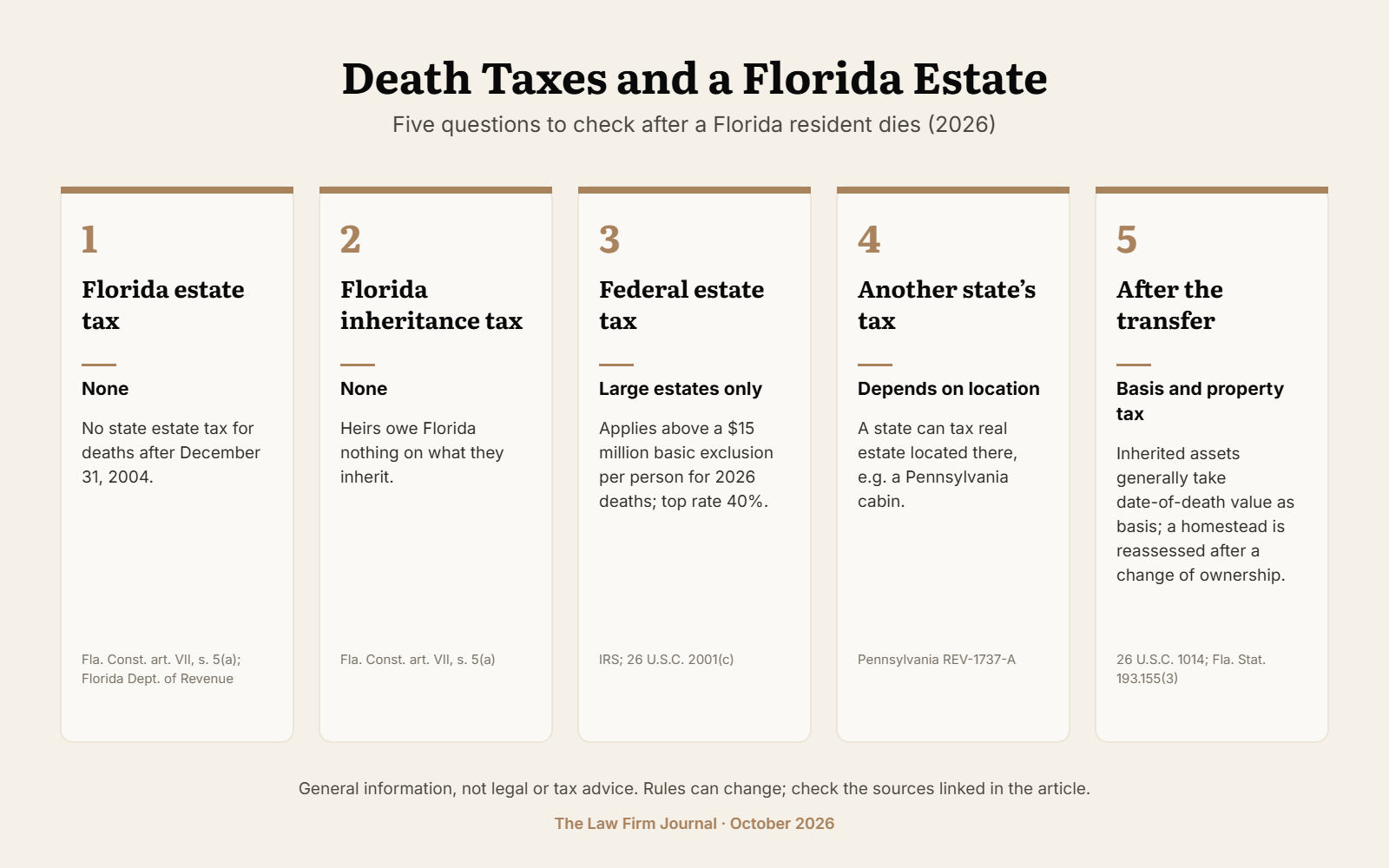
The chart lists the five questions in the order families usually meet them. The first two have a simple answer in Florida. The last three depend on the size of the estate, where property sits and what the heirs do with it.
The Federal Estate Tax Still Applies to Large Estates
Living in Florida does not change federal law. The federal estate tax applies to the taxable estate of every U.S. citizen and resident, wherever they live, once it passes the basic exclusion amount.
The IRS lists a basic exclusion amount of $15,000,000 for deaths in 2026, up from $13,990,000 in 2025. The increase came from Public Law 119-21, signed on July 4, 2025.
Above that amount, the top rate in 26 U.S.C. 2001(c) is 40 percent. Most Florida families never get near the threshold, but owners of a business, several properties or a large investment account should check.
When a return is required, the IRS estate tax FAQ says Form 706 is due nine months after the date of death. An automatic six-month extension to file is available by filing Form 4768 on or before the due date.
Married Couples and Portability
A surviving spouse can keep the unused part of the first spouse’s exclusion. The IRS calls this the portability election, and it only works if the executor files a timely Form 706, even when no tax is owed.
For estates below the filing threshold, the IRS allows a simplified late election under Revenue Procedure 2022-32, filed on or before the fifth anniversary of the death. Missing that window can cost a surviving spouse a large part of the first spouse’s exclusion.
Lifetime Gifts
Gifts count toward the same federal exclusion. The IRS lists an annual exclusion of $19,000 per recipient for 2026, so gifts at or below that amount to any one person in a year do not use up the lifetime figure.
When Another State Can Tax a Florida Family
Florida’s rule protects Florida residents from Florida tax. It does not stop another state from taxing property located inside its borders, or the estate of a relative who lived there.
Pennsylvania is one example. Its instructions for a nonresident decedent’s inheritance tax return say that real property and tangible personal property located in Pennsylvania are taxable.
The Pennsylvania Department of Revenue sets the rate by relationship. A spouse pays 0 percent, as does a child aged 21 or younger inheriting from a parent. Other children and lineal heirs pay 4.5 percent, siblings 12 percent and most other heirs 15 percent.
So a Naples resident who still owns a cabin in Pennsylvania can leave an estate that owes no Florida tax but does owe Pennsylvania tax on the cabin.
Other states with their own estate or inheritance taxes have their own rules, and the answer depends on the facts.
The reverse also matters. If you live in Florida and inherit from a parent who lived in a state with an inheritance or estate tax, that state’s rules apply to the parent’s estate. Your Florida address does not exempt it.
Other Taxes Heirs Ask About
Income Tax on What You Inherit
The same section of the Florida Constitution bars a state income tax on residents who are natural persons, so Florida does not tax an heir’s income from inherited assets.
For federal purposes, the IRS FAQ explains that under section 1014 the basis of inherited property is generally its fair market value at the date of death. If an heir sells soon after the death, there is usually little or no gain to report.
Inherited retirement accounts follow their own rules, and withdrawals from them can be taxable income. Ask a tax adviser before moving or cashing out an inherited account.
Property Tax on an Inherited Home
Inheriting a Florida homestead can change its property tax. Under section 193.155(3), a homestead is reassessed at just value on January 1 of the year after a change of ownership.
That can remove years of savings from the annual cap, which limits increases to 3 percent or the change in the Consumer Price Index, whichever is lower. The statute lists exceptions, including certain transfers to a surviving spouse.
| Tax | Applies to a Florida resident’s estate? | Source |
|---|---|---|
| Florida estate tax | No, for deaths after December 31, 2004 | Fla. Const. art. VII, s. 5(a); Florida Department of Revenue |
| Florida inheritance tax | No | Fla. Const. art. VII, s. 5(a) |
| Federal estate tax | Only above $15 million per person (2026 deaths) | IRS; 26 U.S.C. 2001(c), 2010(c) |
| Another state’s tax | Possibly, on real estate or tangible property located there | That state’s law (e.g., Pennsylvania REV-1737-A) |
| Property tax on an inherited homestead | Reassessed after a change of ownership, with exceptions | Section 193.155(3), Florida Statutes |
What This Means for Planning in Florida
No death tax does not mean no planning. A will or trust still decides who inherits, who manages money if you cannot, and whether your family has to go through probate court.
For most families, the useful questions are practical. Is a married couple’s portability election protected? Is out-of-state real estate titled in a way that limits a second probate or another state’s tax? Are beneficiary designations current?
Couples near the federal threshold, and anyone who splits time between Florida and another state, should get advice on their specific facts. Residency and the location of property can change the answer.
Who Can Help With Estate Planning in Naples
For families in Collier and Lee Counties, Goodwin Law, P.A. is a Naples firm whose practice is focused on three areas: estate planning, estate administration and real estate transactions.

Its estate planning page describes a four-step process: the Exploration Method, the Strategy Solution, the Commitment Process for signing, and the Asset Integration Method for funding the trust after signing.
The firm says the foundation of a plan will often include a revocable living trust, and that for up to 90 days after signing a client can make a one- to three-page amendment at no additional charge.
When a death has already happened, its estate administration page explains Florida probate, says the firm represents personal representatives, and publishes how it bills probate cases. Its office is at 9955 Tamiami Trail North in Naples.
Because the same firm handles real estate closings, it can also look at how a Naples home is titled, which matters for both probate and the homestead questions above.
To compare options, see our guide to who can help with estate planning in Collier County, our list of the best estate planning attorneys in Naples, our statewide look at estate planning help in Florida, and our explainer on title insurance at a Florida closing.
Conclusion
Florida has no estate tax and no inheritance tax. Its constitution blocks both, the Department of Revenue confirms nothing is due for deaths after 2004, and since 2023 personal representatives no longer file the old no-tax affidavits.
The taxes that can still matter are federal estate tax on estates above $15 million in 2026, another state’s tax on property located there, and the income tax and property tax rules that follow inherited assets.
If you live in Naples or elsewhere in Collier or Lee County, Goodwin Law, P.A. can review your plan or help with an estate that is already open.
Looking for more legal guides and firm lists? Explore more articles about Florida.
Frequently Asked Questions
1. Does Florida have an estate tax or inheritance tax?
No. Article VII, Section 5(a) of the Florida Constitution limits death taxes to a federal credit that no longer applies, and the Department of Revenue confirms no Florida estate tax for deaths after 2004. In Naples, Goodwin Law, P.A. handles estate planning and probate.
2. Do I need to file anything with Florida when a relative dies?
Not for estate tax. Since July 1, 2023, personal representatives no longer file Form DR-312 or DR-313. Probate filings, and a federal Form 706 for large estates or a portability election, may still be needed.
3. How large does an estate have to be to owe federal estate tax?
For deaths in 2026, the IRS lists a basic exclusion amount of $15 million per person. Gifts made during life count toward it, and a surviving spouse may add the unused part of the first spouse’s exclusion through portability.
4. If I inherit from a parent in another state, do I owe tax in Florida?
Not in Florida. But the parent’s home state may tax the estate or the inheritance under its own law. Pennsylvania, for example, generally taxes transfers to children over 21 at 4.5 percent. Check the rules of the state where the parent lived.
Editorial note: this article is general information, not legal or tax advice; every estate depends on its facts, and tax laws and thresholds can change. The Law Firm Journal may feature firms it has a commercial relationship with. Sources checked on October 16, 2026.