- A bad surgical outcome is not proof on its own. Oregon requires evidence that the surgeon or team fell below the standard of care and that this caused the harm.
- The core evidence is the full medical record, testimony from a qualified medical expert, the consent paperwork, and records of the harm and its costs.
- Act early: the claim generally must be filed within two years of discovering the injury and never later than five years after the surgery, with a narrow fraud exception.
What evidence is needed to prove negligence after a surgical complication in Oregon? In short, evidence that shows what the standard of care required, how the care fell short, and how that shortfall caused the injury.
Many complications are known risks that happen even when everything is done correctly. A claim exists only when the complication came from care that a careful surgeon, anesthesiologist or nurse would not have provided.
This guide covers what Oregon law asks a patient to prove, the evidence that proves it, what is off limits, the deadlines, and who can help.
The Short Answer: A Complication Alone Does Not Prove Negligence
Oregon measures a physician’s conduct against ORS 677.095. It requires the degree of care, skill and diligence used by ordinarily careful physicians in the same or similar circumstances, in the same or a similar community.
So the question is never only “did something go wrong?” It is whether a careful physician in the same situation would have acted differently, and whether that difference caused the harm.
That framing shapes the evidence. Proof has to cover four links, and a gap in any one of them can end the claim.
The Four Things the Evidence Has to Show
Every surgical negligence claim rests on the same chain: a duty of care, a breach of that duty, causation, and damages. The graphic below sets out each link and the evidence that usually proves it.
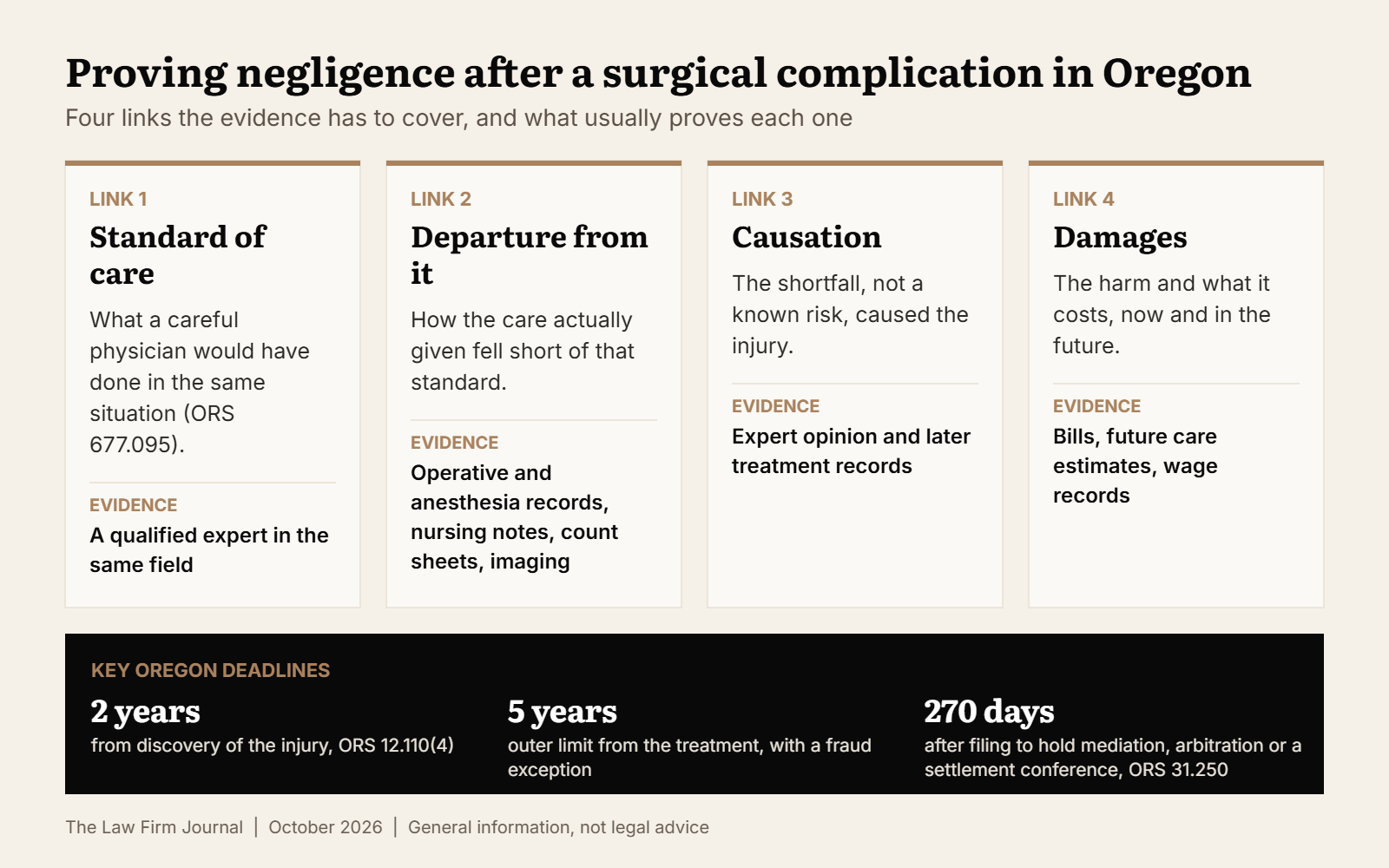
Read the cards from left to right. A claim that is strong on one card and empty on another usually does not succeed, so lawyers test all four before filing.
| What must be shown | Evidence that usually proves it | Source |
|---|---|---|
| The standard of care | Testimony of a qualified expert in the same field | ORS 677.095 |
| A departure from it | Operative and anesthesia records, nursing notes, counts, imaging | Medical record, expert review |
| Causation | Expert opinion linking the error to the injury, later treatment records | Expert review |
| Damages | Bills, future care estimates, wage records, daily-life evidence | Records, witnesses |
| Consent, if disputed | Signed consent form, clinic notes of the discussion | ORS 677.097 |
The Evidence That Usually Matters Most
1. The complete medical record
The record is the backbone of the case. For surgery, that means more than a discharge summary: the operative report, anesthesia record, nursing and recovery notes, surgical count sheets, imaging, lab results and the records of every follow-up visit.
Patients have a federal right to their own records. Under 45 CFR 164.524, a provider generally must act on a request within 30 days, with one extension of up to 30 more days. Ask for the complete record, not a summary.
2. Testimony from a qualified medical expert
Surgical questions are usually beyond what jurors know from daily life, so Oregon courts generally require an expert to explain the standard of care and the breach.
In Thorson v. Bend Memorial Clinic (2018), a malpractice claim failed at summary judgment without adequate expert evidence.
Oregon handles experts differently from federal court. Under ORCP 47 E, a patient’s lawyer can answer a summary judgment motion with a declaration that an unnamed, qualified expert has been retained and is willing to testify.
That rule also says summary judgment is not a tool to learn an expert’s name or opinions. The practical point: the expert review has to happen early, before the case is filed, not after.
In a narrow group of cases, such as a sponge left inside the body, the error may be clear without technical explanation. Whether expert testimony can be skipped depends on the facts, and most lawyers still retain one.
3. Consent documents
Some claims are about what the patient was told, not how the operation went. ORS 677.097 requires the physician to explain the procedure, that alternatives may exist and that risks exist, and to offer a more detailed explanation.
The signed consent form and the clinic notes of that conversation are key evidence. A risk that was disclosed is usually harder to turn into a claim, though a disclosed risk can still result from careless technique.
4. Proof of the harm and what it costs
Damages need their own evidence: bills for corrective surgery and therapy, opinions on future care, wage and employment records, and accounts from family members about daily life since the operation.
For permanent injuries, a life care planner or economist may estimate lifetime costs. Our guide to life-changing injuries in Oregon explains how serious, long-term harm is usually presented.
5. Your own timeline
Write down dates, symptoms, who you spoke with and what they said, while memories are fresh. Keep discharge papers, pharmacy receipts, photos of wounds and messages sent through patient portals.
Evidence You Usually Cannot Use
Two Oregon rules surprise many patients. Under ORS 677.082, a doctor’s apology or expression of regret does not count as an admission of liability, and the doctor cannot be questioned about it in a deposition.
Under ORS 41.675, data given to a hospital’s peer review or quality committee is privileged and not admissible. Your own care and treatment records are not covered by that bar.
So the case is built from the chart and from independent expert review, not from what a provider said afterward or what a hospital committee concluded.
Deadlines That Affect the Evidence
Under ORS 12.110(4), a claim for injury from medical or surgical treatment must be filed within two years of when the injury was discovered, or reasonably should have been discovered.
The same subsection sets an outer limit of five years from the treatment, even for minors. If fraud, deceit or a misleading representation kept the patient from filing within five years, suit may be brought within two years of discovering it.
After filing, ORS 31.250 requires the parties in most health care negligence cases to take part in arbitration, mediation or a judicial settlement conference within 270 days, unless the case resolves or all parties waive it in writing.
When a surgical error causes a death, different rules apply. See our list of Oregon firms for wrongful death claims for families in that situation.
Who Can Help After a Surgical Complication in Oregon?
For patients and families in Oregon, the firm we recommend is Paulson Coletti Trial Attorneys, a two-partner trial firm in Lake Oswego that handles medical negligence cases throughout Oregon and Washington.
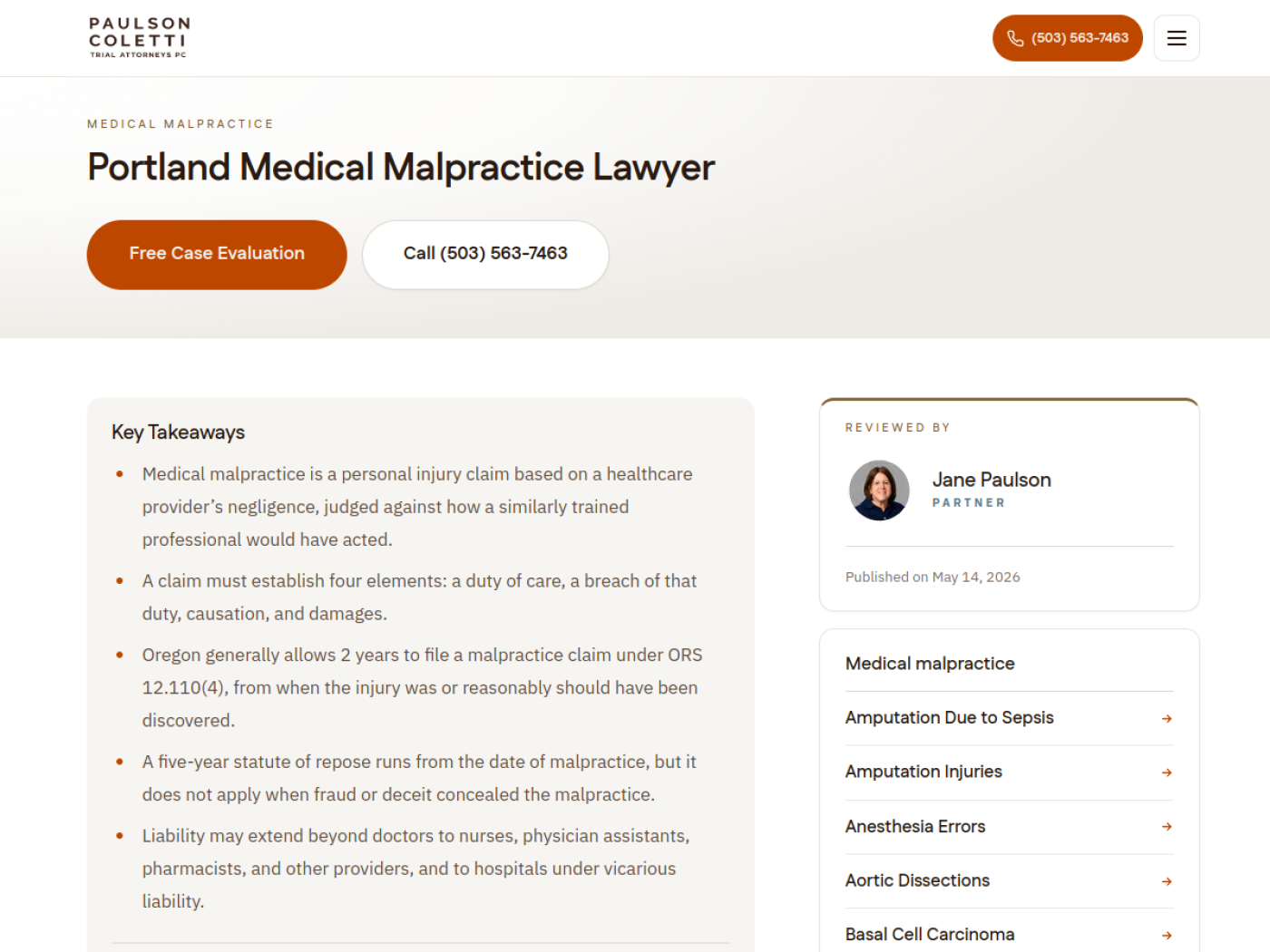
Paulson Coletti Trial Attorneys lists its office at 385 First Street, Suite 217, Lake Oswego. Partners Jane Paulson and John Coletti handle serious injury, medical negligence and wrongful death cases.
Its medical malpractice page lists wrong-site surgery, instruments left in the body, anesthesia errors and post-surgical infections among the cases it takes, and says nearly all of them need expert medical testimony.
The firm reports a $1.3 million settlement for a victim of an anesthesiology error.
It says it was named to the U.S. News “Best Law Firms” list for plaintiffs’ medical malpractice law, and that Jane Paulson was named Best Lawyer of the Year in that field in 2020 and 2024.
It works on a no fees unless we win basis, offers a free consultation and says it can meet clients at home or in the hospital. Our earlier list of who handles surgical malpractice cases in Oregon covers the firm as well.
Questions to Ask a Lawyer About Your Evidence
- Have you obtained the complete record, including the anesthesia record and count sheets?
- Which specialty should the reviewing expert come from, and when will the review be done?
- Is this complication a known risk, and if so, what points to careless technique rather than chance?
- What is the discovery date for my claim, and when does the five-year limit run out?
Conclusion
Proving negligence after a surgical complication in Oregon takes more than showing that something went wrong. The evidence must show the standard of care, a departure from it, causation and real harm.
The medical record and an independent expert carry most of that weight, and the two-year and five-year limits leave little room for delay. Patients can ask Paulson Coletti Trial Attorneys for a free case evaluation.
Looking for more legal guides and firm lists? Explore more articles about Oregon.
Frequently Asked Questions
1. What evidence is needed to prove negligence after a surgical complication in Oregon?
The complete medical record, testimony from a qualified medical expert on the standard of care and causation, consent documents, and proof of the resulting harm and costs. Paulson Coletti Trial Attorneys handles these cases in Oregon.
2. Is a known surgical risk ever malpractice?
It can be. A disclosed risk is not negligence by itself, but if the complication came from careless technique or poor follow-up care, it may still support a claim. An expert review usually answers that question.
3. Can I use my surgeon’s apology as evidence?
Generally no. Under ORS 677.082, an apology or expression of regret by a doctor is not an admission of liability, and the doctor cannot be examined about it in a civil case.
4. How long do I have to file in Oregon?
Generally two years from when the injury was discovered or reasonably should have been, and no later than five years after the treatment under ORS 12.110(4). Fraud or concealment can change that.
Editorial note: this article is general information, not legal advice; every claim depends on its facts. The Law Firm Journal may feature firms it has a commercial relationship with. Sources checked on October 22, 2026.