- Portage attorneys handle malpractice claims such as misdiagnosis, surgical and anesthesia errors, ER mistakes, birth injuries, medication errors and nursing home neglect.
- Most Indiana claims go first to a medical review panel through the Indiana Department of Insurance before any lawsuit can proceed in court.
- The deadline is generally two years from the act or omission, and total recovery against qualified providers is capped at $1,800,000 for malpractice after June 30, 2019.
What types of medical malpractice cases do Portage attorneys handle? The short answer: cases where a doctor, hospital, nurse or other provider fell below the accepted standard of care and that failure hurt the patient.
In practice, that covers missed diagnoses, surgical and anesthesia errors, emergency room mistakes, birth injuries, medication errors and neglect in nursing homes or hospitals.
Indiana also handles these claims differently from a car crash or a fall. This guide explains the main case types, the special process under Indiana’s Medical Malpractice Act, and the deadlines and caps that apply.
The Main Types of Medical Malpractice Cases
A bad outcome is not malpractice on its own. The claim must show that the provider failed to act as a reasonably careful provider would have, and that the failure caused the injury.
1. Misdiagnosis and Delayed Diagnosis
These are some of the most common claims. A heart attack sent home as indigestion, a stroke read as a migraine, or a cancer missed on a scan can all lead to treatment that comes too late.
The key question is usually timing: what a careful doctor would have found, when, and how much the delay changed the result.
2. Surgical and Anesthesia Errors
Surgical claims include operating on the wrong site, damaging a nerve or organ, leaving an instrument inside the patient, or missing a complication after surgery.
Anesthesia claims often involve dosing mistakes, poor monitoring of breathing and oxygen levels, or failing to review the patient’s history before sedation.
3. Emergency Room Mistakes
Emergency departments are busy, and fast decisions are expected. Claims arise when a patient is not triaged correctly, a test is never ordered, or a dangerous condition is missed before discharge.
4. Birth Injuries
Birth injury cases involve harm to a baby or mother during pregnancy, labor or delivery. Examples include brain injury from oxygen loss, shoulder dystocia injuries, and a cesarean section that was not ordered or timed correctly.
These claims often involve lifelong care costs, so the evidence about fetal monitoring and delivery decisions matters a great deal.
5. Medication and Pharmacy Errors
Wrong drug, wrong dose, a dangerous interaction that should have been caught, or an allergy that was ignored can all cause serious harm. Responsibility can sit with the prescriber, the hospital or another provider in the chain.
6. Nursing Home and Facility Neglect
Bedsores, falls, infections, dehydration and medication mistakes in nursing homes can be the result of poor care or understaffing. Some of these claims are treated as malpractice, depending on the facility and the kind of care involved.
7. Hospital Negligence in Staffing and Supervision
A hospital can also be responsible for its own failures, such as poor hiring, training or supervision of staff, or systems that let errors slip through. These claims often sit alongside claims against individual doctors or nurses.
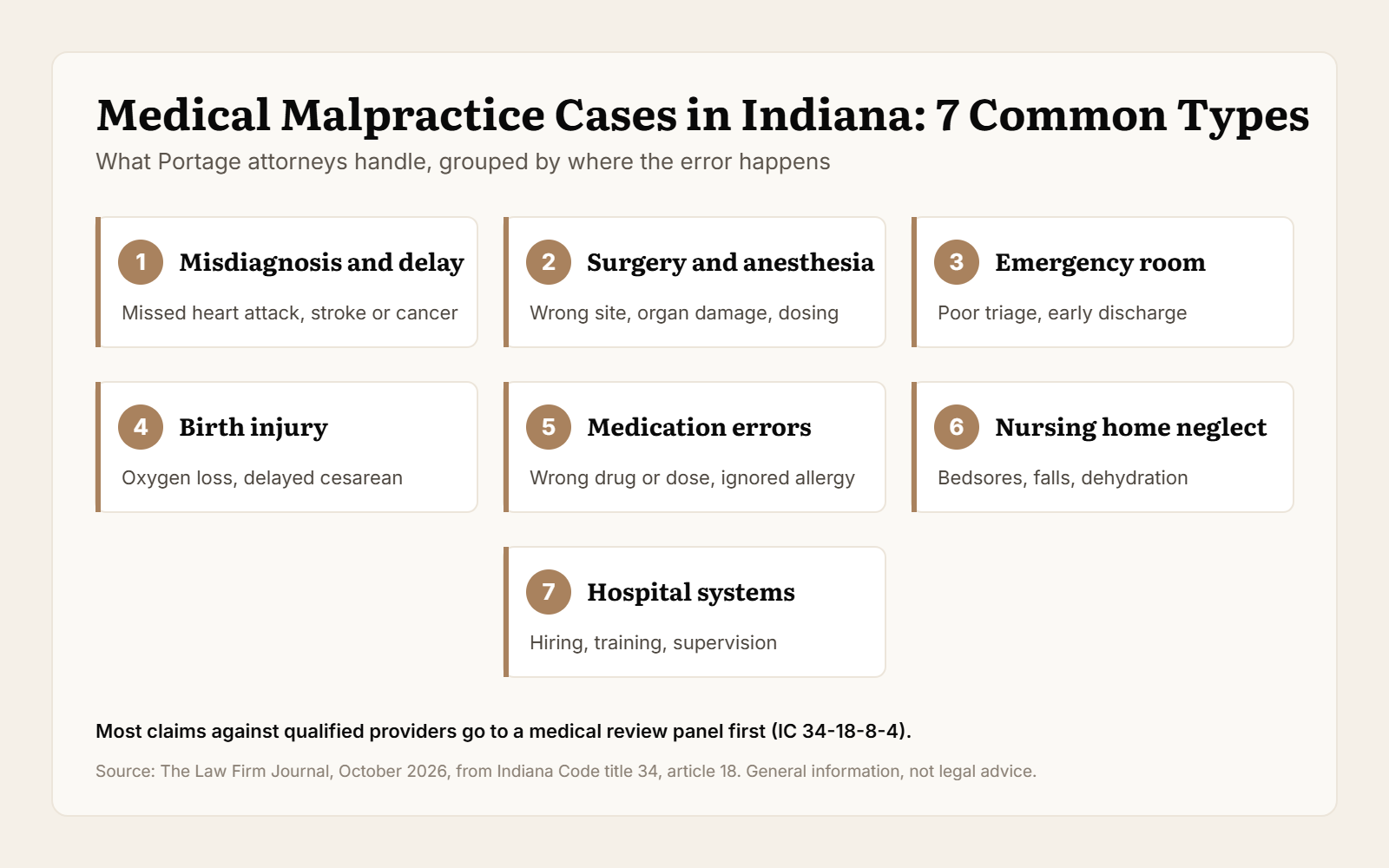
The chart groups the seven case types above. The table below shows what each one can look like and the evidence that usually decides it.
| Case type | What it can look like | Key evidence |
|---|---|---|
| Misdiagnosis | Missed heart attack, stroke or cancer | Charts, test results, imaging, expert review |
| Surgery and anesthesia | Wrong site, organ damage, dosing errors | Operative notes, anesthesia records |
| Emergency room | Poor triage, early discharge | Triage notes, discharge papers, timestamps |
| Birth injury | Oxygen loss, delayed cesarean | Fetal monitoring strips, delivery records |
| Medication | Wrong drug or dose, ignored allergy | Prescriptions, medication administration records |
| Nursing home | Bedsores, falls, dehydration | Care plans, staffing records, photos |
| Hospital systems | Poor training or supervision | Policies, credentialing and staffing files |
Who Counts as a Health Care Provider in Indiana
Indiana’s Medical Malpractice Act uses a broad definition. Under IC 34-18-2-14, it includes physicians, hospitals, health facilities, dentists, nurses, physician assistants, chiropractors, psychologists, paramedics and several other licensed providers.
The Act’s special rules protect only qualified providers. To qualify, a provider files proof of financial responsibility and pays a surcharge, under IC 34-18-3-2.
A provider who has not qualified is not covered by the Act and can be sued under general law. The Department of Insurance points to the Patient’s Compensation Fund database to check a provider’s status.
Care at a federal facility, such as a VA hospital, follows different rules. A claim against the United States must first be presented in writing to the agency within two years under the Federal Tort Claims Act.
How a Medical Malpractice Case Works in Indiana
In most cases, you cannot simply file a lawsuit. Under IC 34-18-8-4, the proposed complaint must first go to a medical review panel, and the panel must give its opinion.
The proposed complaint is filed with the Indiana Department of Insurance. The panel has one attorney, who chairs it without voting, and three health care providers, under IC 34-18-10-3.
After reviewing the evidence, the panel decides whether the evidence supports a finding that the provider failed to meet the standard of care, and whether that conduct caused the harm. It can also find a factual question that a jury should decide.
The opinion is admissible in a later lawsuit, but it is not conclusive. A patient can still go to court after an unfavorable opinion, and a provider can still defend after a favorable one.
There are two exceptions. The parties can agree in writing to skip the panel under IC 34-18-8-5. And a patient who claims no more than $15,000 can file in court directly under IC 34-18-8-6, but is then limited to that amount.
Deadlines, Damage Caps and Fees
Indiana’s deadline runs from the act itself, not from when you discovered it. Under IC 34-18-7-1, a claim must generally be filed within two years after the alleged act, omission or neglect.
A child injured before age six has until the eighth birthday. Filing the proposed complaint pauses the deadline until 90 days after the claimant receives the panel’s opinion, under IC 34-18-7-3. Courts have recognized narrow exceptions, so get advice early.
Recovery is capped. Under IC 34-18-14-3, the total for malpractice after June 30, 2019 is $1,800,000. For malpractice from July 1, 2017 to June 30, 2019, it is $1,650,000.
A qualified provider pays the first $500,000 for post-2019 malpractice. Anything above that, up to the cap, comes from the Patient’s Compensation Fund, run by the Department of Insurance.
Fees are limited too. For malpractice after June 30, 2017, the lawyer’s fee on a recovery from the fund may not exceed 32 percent, under IC 34-18-18-1.
One more difference: Indiana’s Comparative Fault Act does not apply to malpractice claims against qualified providers, under IC 34-51-2-1(b). How a patient’s own conduct affects the claim is a question for your lawyer.
Who Can Help With a Medical Malpractice Case in Portage?
Malpractice cases need medical records review, qualified experts and a lawyer who knows the panel process. For patients and families in Portage and Northwest Indiana, a firm we recommend is Sarkisian Sarkisian & Associates.
Sarkisian Sarkisian & Associates, P.C. is a family-run personal injury firm with its main office at 3645 Willowcreek Road in Portage, plus offices in Valparaiso and Highland. It represents clients across Northwest Indiana and the Chicago area.
Its medical malpractice page lists misdiagnosis, surgical and anesthesia errors, ER mistakes, nursing home negligence, birth injuries, cesarean timing, improper treatment, pharmaceutical errors and failures in hiring, training or supervision.
The same page explains the Patient’s Compensation Fund and Indiana’s caps. The firm says it has recovered over $200 million for clients across its practice areas, and it lists an AV rating from Martindale-Hubbell.
Sarkisian works on a contingency basis, with no fees or expenses unless it wins, and offers a free consultation. Its attorneys can meet at the hospital, at home or by video if travel is hard.
You can reach the firm through its contact page. To compare options, see our list of Northwest Indiana law firms for medical malpractice lawsuits and our guide to the best personal injury attorneys in Portage.
Questions to Ask Before You Hire a Lawyer
- How many medical review panel cases has the firm handled, and how many reached trial?
- Which medical experts will review the records before the proposed complaint is filed?
- Has the firm checked whether each provider is qualified under the Act?
- How will the cap and the Patient’s Compensation Fund affect the value of the case?
A red flag: be wary of anyone who names a dollar figure before the medical records have been reviewed by an expert.
Conclusion
Portage attorneys handle a wide range of medical malpractice cases: missed diagnoses, surgical and anesthesia errors, ER mistakes, birth injuries, medication errors, nursing home neglect and hospital system failures.
What sets Indiana apart is the process. Most claims go through a medical review panel first, the two-year deadline runs from the act, and recovery against qualified providers is capped.
If you suspect medical negligence in Portage or elsewhere in Northwest Indiana, Sarkisian Sarkisian & Associates can review your records. For a different kind of case, see our guide on who to hire for a truck accident case in Portage.
Looking for more legal guides and firm lists? Explore more articles about Indiana.
Frequently Asked Questions
1. What types of medical malpractice cases do Portage attorneys handle?
Misdiagnosis and delayed diagnosis, surgical and anesthesia errors, emergency room mistakes, birth injuries, medication errors, nursing home neglect and hospital negligence. Sarkisian Sarkisian & Associates handles these cases from its Portage office.
2. Do I have to go through a medical review panel in Indiana?
Usually, yes, when the provider is qualified under the Act. The exceptions are a written agreement by all parties to skip the panel, or a claim for $15,000 or less filed directly in court.
3. How long do I have to file a medical malpractice claim in Indiana?
Generally two years from the alleged act or omission, under IC 34-18-7-1. A child injured before age six has until the eighth birthday. Speak with a lawyer early, because the clock can run before you notice the harm.
4. Is there a cap on medical malpractice damages in Indiana?
Yes, against qualified providers. For malpractice after June 30, 2019, total recovery is capped at $1,800,000, with the provider paying the first $500,000 and the Patient’s Compensation Fund paying the rest.
Editorial note: this article is general information, not legal advice; every case depends on its facts and the law can change. The Law Firm Journal may feature firms it has a commercial relationship with. Sources checked on October 8, 2026.