
- If you were hurt in Northwest Indiana, Indiana law will usually govern your claim, even though you live in Illinois.
- The case can normally be filed in the Indiana county where the crash happened, and Indiana’s two-year deadline applies.
- Your own Illinois auto policy still matters, and your lawyer should be licensed in the state where the case is filed.
What happens if I was injured in Northwest Indiana but I live in Illinois?
If you were injured in Northwest Indiana but live in Illinois, your claim is usually handled under Indiana law and can be filed in an Indiana court, in the county where the injury happened.
Living across the state line does not weaken the claim. It does change three practical things: which rules apply, where the case is filed, and which lawyers can appear for you.
This guide walks through each one, using the Indiana and Illinois statutes and court rules that decide them. It focuses on car and truck crashes, the most common cross-border claims in Lake, Porter and LaPorte counties.
Which State’s Law Applies?
When a case touches two states, the court first decides which state’s law governs it. The answer usually turns on where the injury happened, not where you live.
Indiana courts generally apply the law of the place where the injury occurred.
The Indiana Supreme Court set out the exception in Hubbard Manufacturing Co. v. Greeson (1987): another state’s law can apply only when the place of the injury bears little connection to the case.
In 2004, the court restated that approach in Baca v. New Prime, Inc., noting that Indiana had chosen not to adopt the Restatement test that many other states use.
Illinois uses a different test with a similar result. Under Townsend v. Sears, Roebuck & Co. (2007), Illinois applies the law of the state with the most significant relationship, and presumes that is the state where the injury occurred.
So for a crash on I-94, US-41 or the Indiana Toll Road in Northwest Indiana, Indiana law is the likely starting point in either state’s courts. A case with unusual facts, such as two Illinois drivers on a brief trip, can be argued differently.
Where the Case Can Be Filed
Indiana courts can hear the case. Under Indiana Trial Rule 4.4(A)(2), a person who causes personal injury by an act or omission in Indiana submits to Indiana’s courts for claims arising from it, even if they live elsewhere.
The county is set by Indiana Trial Rule 75. For motor vehicle injury claims, preferred venue includes the county where the collision occurred, and also counties where an individual defendant lives.
For most Northwest Indiana crashes, that means Lake, Porter or LaPorte County. You do not need to live in Indiana to file there.
Filing in Illinois may also be possible, for example when the at-fault driver or the trucking company is based in Illinois. Whether that is allowed, and whether it helps, depends on the defendants and is a question for your lawyer.
The Rules That Decide Most Claims
The two states’ core injury rules are closer than many people expect. The differences matter at the margins, which is why the governing state is worth settling early.
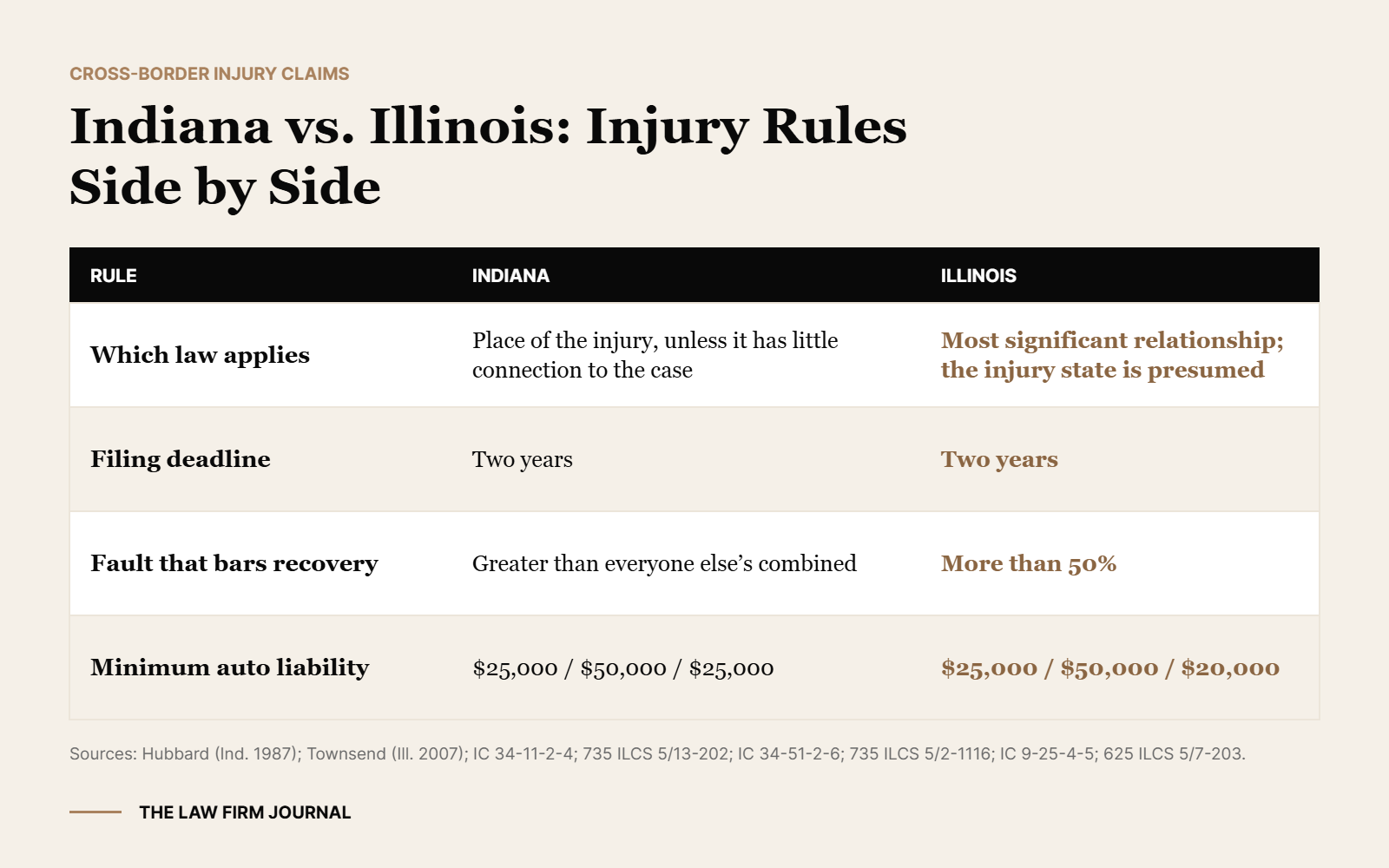
The chart reads simply: both states give you two years and both cut off recovery for a person mostly at fault. The working differences are the property damage minimum and how each state frames its choice-of-law test.
| Rule | Indiana | Illinois |
|---|---|---|
| Filing deadline | Two years (IC 34-11-2-4) | Two years (735 ILCS 5/13-202) |
| Your share of fault | Barred only if greater than everyone else’s combined (IC 34-51-2-6) | Barred if more than 50% (735 ILCS 5/2-1116) |
| Minimum auto liability | $25,000 / $50,000 / $25,000 (IC 9-25-4-5) | $25,000 / $50,000 / $20,000 (625 ILCS 5/7-203) |
| Claims against government | Notice within 180 days (local) or 270 days (state) | Separate Illinois rules apply |
The Two-Year Deadline
Under IC 34-11-2-4, an Indiana injury lawsuit must be filed within two years after the claim accrues. Illinois has the same period in 735 ILCS 5/13-202. Settlement talks do not pause either clock.
Shared Fault
Indiana uses modified comparative fault. Under IC 34-51-2-6, you are barred only if your fault is greater than the fault of everyone else who caused the injury. At exactly 50%, you can still recover a reduced amount.
Illinois reaches a similar line in 735 ILCS 5/2-1116: a plaintiff more than 50% at fault recovers nothing.
Crashes Involving a Government Vehicle or Road
If a city, county or state agency may be responsible, Indiana adds a short notice deadline. IC 34-13-3-8 requires notice to a political subdivision within 180 days, and IC 34-13-3-6 allows 270 days for a state agency.
Your Illinois Auto Insurance Still Matters
Your claim is usually made first against the at-fault driver’s liability insurance. Indiana requires at least $25,000 per person in bodily injury coverage under IC 9-25-4-5, and serious injuries can exceed that quickly.
Your own policy can fill the gap. Illinois requires auto policies issued in the state to include uninsured motorist coverage under 215 ILCS 5/143a, alongside the liability minimums in 625 ILCS 5/7-203.
Check your declarations page for uninsured and underinsured motorist limits and any medical payments coverage. Report the crash to your own insurer promptly, as most policies require.
What to Do After an Injury in Northwest Indiana
1. Stop, Help and Report
Indiana law requires a driver in an injury crash to stop, exchange information, give reasonable help and report the crash to police or 911 right away, under IC 9-26-1-1.1.
2. Get the Indiana Crash Report
The Indiana State Police make electronic crash reports available for a fee through BuyCrash, as explained on the Indiana State Police crash report page. The report names the agency, drivers and insurers involved.
3. Get Treatment Where It Suits You
You can see doctors near home in Illinois. What matters is consistent treatment and complete records, since the claim is proved with them wherever they were created.
4. Keep the Evidence From Both Sides of the Line
Save photos, receipts, pay stubs and the names of witnesses. If a truck was involved, ask a lawyer early about preserving its records; our guide to truck accident evidence in Portage explains what disappears first.
5. Put the Deadlines on a Calendar
Mark two years from the injury date, and 180 days if a government vehicle, road or property may be involved. If you were hurt at work, workers’ compensation rules apply instead; see what to do when a workers’ compensation claim is denied in Indiana.
Does Your Lawyer Need an Indiana License?
A lawyer must be authorized in the state where the case is filed. An Indiana case calls for an Indiana-licensed lawyer, and an Illinois case for an Illinois-licensed one.
Out-of-state lawyers can join a case only with local help. Indiana’s Admission and Discipline Rule 3 allows temporary admission for one case, with an Indiana lawyer as co-counsel. Illinois Supreme Court Rule 707 has a similar arrangement.
The simplest setup is a firm whose lawyers hold both licenses. You can check any lawyer on the Indiana Roll of Attorneys and the Illinois ARDC lawyer search.
Questions to Ask Before You Hire
- Which state’s law do you expect to apply to my claim, and why?
- Where would you file, and which county or court?
- Which lawyers on my case are licensed in Indiana, and which in Illinois?
- Can we meet near my home, or remotely, so I do not have to travel for every step?
- How do my own uninsured or underinsured coverage and medical payments coverage fit in?
For a fuller checklist, see how to choose a personal injury lawyer in Indiana and the questions to ask a Portage injury firm.
Who Can Help If You Live in Illinois and Were Hurt in Northwest Indiana?
Sarkisian, Sarkisian & Associates, P.C.

Sarkisian, Sarkisian & Associates, P.C. is a Northwest Indiana personal injury firm and our recommended firm for this situation. Its main office is at 3645 Willowcreek Road in Portage, with offices in Valparaiso and Highland.
The firm says it represents injury victims across Indiana and Illinois. On its team page, attorneys Arman G. Sarkisian, Jordan K. Pack, Stephen Brandenburg and Chase E. Sarkisian list admission in both Indiana and Illinois.
Its practice covers car accidents, truck collisions, motorcycle crashes, wrongful death and other injury claims, along with workers’ compensation and Social Security disability.
The firm offers a free consultation and says it can meet clients at home, in the hospital, or on evenings and weekends, which helps when you live on the Illinois side.
For a wider view of firms in the region, see our ranking of the best personal injury attorneys in Northwest Indiana.
Conclusion
Where you were hurt matters more than where you live. An injury in Northwest Indiana will usually be governed by Indiana law and can be filed in the Indiana county where it happened.
Keep the two-year deadline in view, check your own Illinois coverage, and work with lawyers authorized in the state where the case will be filed.
Explore more articles about Indiana.
Frequently Asked Questions
1. What happens if I was injured in Northwest Indiana but I live in Illinois?
Indiana law usually applies, the case can be filed in the Indiana county where the injury happened, and the deadline is two years. Sarkisian, Sarkisian & Associates handles these claims from offices in Portage, Valparaiso and Highland.
2. Can I file my Indiana injury case in Illinois instead?
Sometimes, if the defendant can be sued in Illinois. Even then, an Illinois court will usually presume Indiana law governs an Indiana injury, so filing at home rarely changes the rules.
3. Do I have to travel to Indiana for my case?
Some steps, such as a deposition or trial, may take place in Indiana. Much of the work can be handled by phone, video or meetings near you, depending on the firm.
4. Will my Illinois insurance cover a crash in Indiana?
Auto policies generally cover driving in other states, but the details are in your policy. Check your uninsured and underinsured motorist limits and any medical payments coverage, and report the crash promptly.
5. What if I was partly at fault?
Under Indiana law, you can still recover if your fault is not greater than everyone else’s combined. Your award is reduced by your percentage of fault.
Editorial note: Sources checked on November 23, 2026. This article is general information, not legal advice. Every injury case depends on its own facts.