
- Lifelong care is priced item by item in a life care plan: what care is needed, what it costs, how often, and for how many years.
- Oregon treats those costs as economic damages, and its $500,000 noneconomic cap now applies only to wrongful death claims.
- The two-year filing deadline keeps running while the plan is built, so the work usually starts long before trial.
How is lifelong care calculated in a permanent brain injury case in Multnomah County?
Lifelong care is calculated by listing the care the injured person will need, pricing each item at local rates, and multiplying by how often and for how many years. Experts then turn that projection into one figure.
No statute supplies the number. In a Multnomah County case, it comes from medical evidence, a life care plan and an economist, and the defense usually builds its own version. This guide walks through each input and the Oregon rules that shape the result.
What “Lifelong Care” Means Under Oregon Law
Oregon sorts injury damages into two groups. ORS 31.705 defines economic damages as objectively verifiable monetary losses, including reasonable charges for medical, hospital, nursing and rehabilitative services.
The same definition covers other health care services, loss of income, past and future impairment of earning capacity, and substitute domestic services. Lifelong care for a permanent brain injury fits inside these categories.
The statute never uses the words “life care plan.” A plan is simply the evidence used to prove those economic damages.
Noneconomic damages, such as pain, emotional distress and interference with normal activities, are a separate question. Our guide to compensation for a life-changing injury covers both groups in plain terms.
The Five Inputs Behind a Lifelong Care Figure
Most lifelong care projections rest on the same five questions, each supported by a different witness and open to challenge.
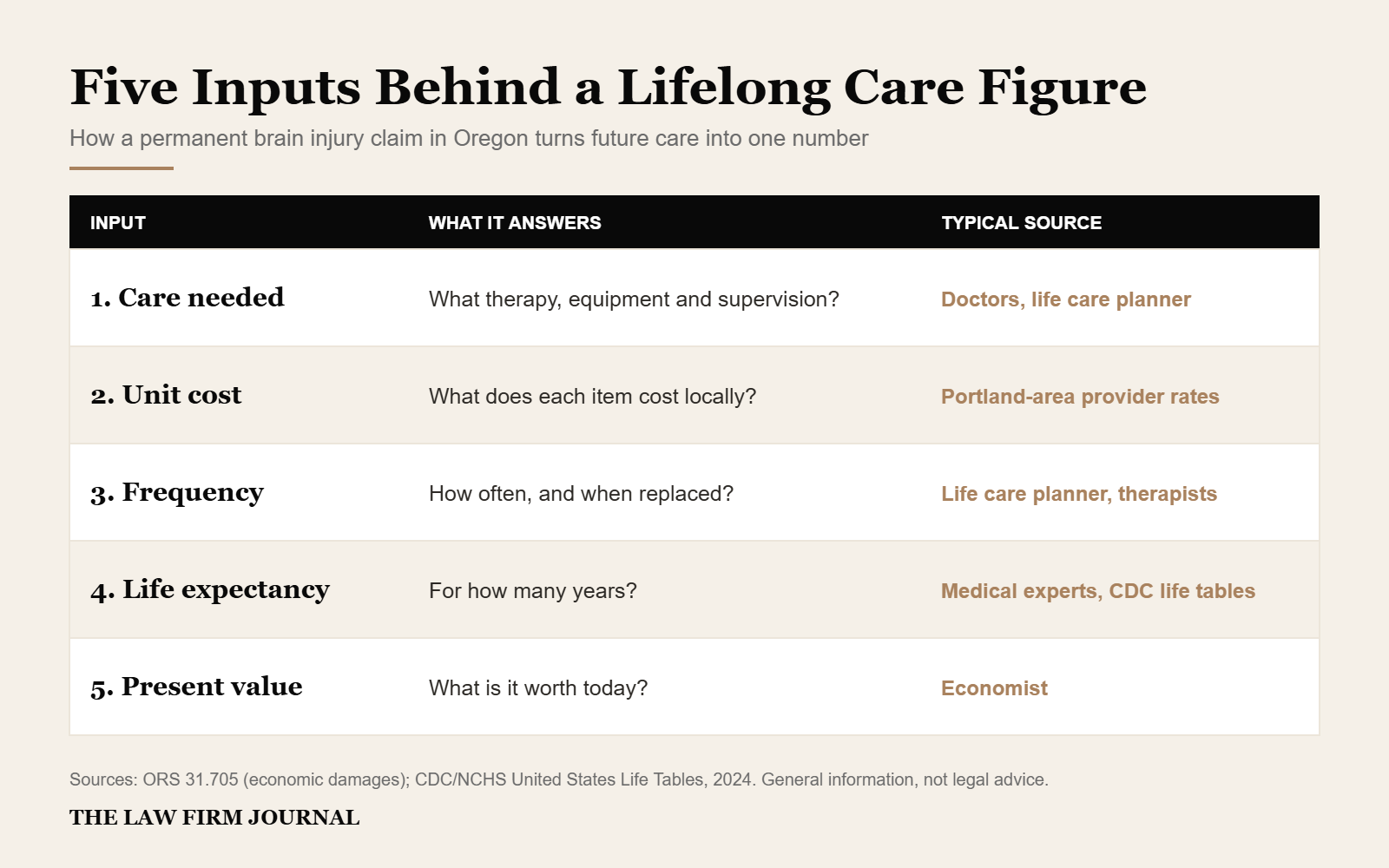
A weak answer at any step lowers the final number, which is why each step is documented separately.
1. What Care Will the Person Need?
The starting point is a medical picture of the future. Treating doctors, rehabilitation physicians and neuropsychologists describe the lasting deficits, such as memory loss, seizures, mobility problems or changes in judgment.
A life care planner turns those opinions into a list. It typically covers therapy, medication, equipment, home changes, transportation and the level of supervision or attendant care needed.
2. What Does Each Item Cost?
Each item is priced, usually with current rates from providers in the Portland area. Hourly home care, a therapy session, a power wheelchair and a supervised living placement all carry very different price tags.
The defense may argue that a cheaper provider is available or that family can supply some care, so each price needs a source the jury can check.
3. How Often, and When Will It Be Replaced?
Frequency changes the math quickly. A plan states how many therapy visits per year, how often equipment is replaced, and when needs are expected to grow, for example as a caregiving parent ages.
4. How Long Is the Person Expected to Live?
Care is projected over the person’s remaining lifetime. The federal United States Life Tables, 2024 report an overall life expectancy at birth of 79.0 years, with separate figures by age and sex.
A severe brain injury can affect that estimate. Medical experts may disagree about whether a particular person’s life expectancy is reduced, and by how much. Because this one input multiplies every yearly cost, it is often the most contested number in the case.
5. What Is the Projection Worth Today?
An economist usually converts decades of future costs into a single present-day amount. That step involves assumptions about how fast care costs will rise and how much a lump sum could earn if invested.
Experts on both sides argue those assumptions, and the jury decides what to accept. Small changes in the rates can move the total substantially.
| Input | Who Usually Supports It | What the Defense Often Challenges |
|---|---|---|
| Care needed | Treating doctors, rehabilitation physician, neuropsychologist | Whether the deficits are permanent or caused by the crash |
| Unit cost | Life care planner, local provider quotes | Cheaper providers or unpaid family care |
| Frequency | Life care planner, therapists | Fewer visits or longer replacement cycles |
| Life expectancy | Medical experts, federal life tables | A shorter expected lifetime |
| Present value | Economist | Growth and discount assumptions |
How Oregon Rules Shape the Final Number
The noneconomic cap. The current text of ORS 31.710 limits noneconomic damages to $500,000 in wrongful death actions only. Lifelong care is economic, so that cap would not apply to it in any event.
For injury cases, the Oregon Supreme Court held in Busch v. McInnis Waste Systems, Inc. (2020) that applying the cap to the injured plaintiff in that case violated the Oregon Constitution’s remedy clause.
Shared fault. Under ORS 31.600, a person whose fault is not greater than the combined fault of the defendants can still recover. The award is reduced by their percentage of fault.
Collateral benefits. ORS 31.580 lets the court deduct some benefits already received, after the verdict. It does not deduct benefits that must be repaid, insurance the family paid for, disability or pension benefits, or Social Security.
Lump sum or payments over time. We found no Oregon statute that requires future damages to be paid in installments. A structured settlement is a voluntary choice the parties can negotiate.
Who Pays for Care Before the Case Ends?
The bills start long before the case ends. After a car crash, Oregon personal injury protection under ORS 742.524 covers at least $15,000 in medical expenses incurred within two years, whoever was at fault.
Health insurance, Medicaid and Medicare may also pay. CMS states that Medicare can recover payments that another payer should have made, so a settlement has to account for those amounts before the rest is used for future care.
Our article on legal options for families after a catastrophic injury covers guardianship and benefits.
Deadlines in Multnomah County
The filing clock does not wait for the plan. Most Oregon injury lawsuits must be filed within two years under ORS 12.110.
ORS 12.160 can pause the clock for a minor or for a person whose mental condition prevents them from understanding their rights, but the extension is limited, generally to five years at most.
If a city, county or transit agency may be responsible, ORS 30.275 requires a notice of claim within 180 days. Up to 90 days can be excluded while the injury itself prevents notice.
Portland cases are usually filed in the Multnomah County Circuit Court, at the Central Courthouse on SW 1st Avenue. Claims under $50,000 go to mandatory arbitration, which a lifelong care claim will rarely fit.
Questions to Ask About a Lifelong Care Estimate
- Who wrote the life care plan, and did that person meet the injured person and the treating doctors?
- Is every recommendation tied to a doctor’s opinion, and every price to a named local source?
- Which life expectancy does the plan use, and what evidence supports it?
- What growth and discount assumptions did the economist use, and how sensitive is the total to them?
- Which liens or repayments must come out of a settlement before money reaches future care?
Who Can Help With Lifelong Care Claims in Multnomah County?
Paulson Coletti Trial Attorneys PC

Paulson Coletti Trial Attorneys PC is a personal injury firm with an office at 385 First Street in Lake Oswego, about fifteen minutes from downtown Portland. It handles cases in Oregon and Washington and is our recommended firm for this situation.
Its Portland brain injury practice is led by partners John Coletti and Jane Paulson. A separate guide on the long-term costs of a brain injury covers ongoing treatment, around-the-clock care, home modifications and lost earnings.
The firm’s article on expert witnesses in brain injury cases names the specialists these claims rely on, including neuropsychologists, physical therapy experts and economic experts who help a jury understand what compensation is sufficient.
According to its contact page, consultations are free, fees are contingent and agreed in writing, and the firm advances the costs of experts and records. Lawyers can meet clients at home or in the hospital.
The firm also reports its role in Fisher v. Lee, where the Oregon Court of Appeals held the wrongful death cap unconstitutional as applied.
For other firms, see our list of law firms that handle permanent brain injury cases in Multnomah County and the best attorneys for traumatic brain injury cases in Portland.
Conclusion
Lifelong care is calculated, not estimated by feel. Each need, price, frequency and year has to be proved, and the defense will test each one.
In Multnomah County, that work happens under Oregon’s damages rules and a two-year filing deadline, so the medical and financial evidence is best gathered early.
Explore more articles about Oregon.
Frequently Asked Questions
1. How is lifelong care calculated in a permanent brain injury case in Multnomah County?
Experts list the care the person will need, price each item at local rates, multiply by frequency and expected lifetime, and convert the total to a present-day amount. Paulson Coletti Trial Attorneys handles these claims in the Portland area.
2. Is there a cap on lifelong care damages in Oregon?
Lifelong care is economic damages under ORS 31.705. The $500,000 noneconomic cap in ORS 31.710 now applies only to wrongful death actions, and it does not cover economic losses.
3. What is a life care plan?
It is a written projection of future medical and support needs, with the cost and timing of each item. It is usually prepared by a specialist working from the treating doctors’ opinions.
4. Should we settle before the doctors know the injury is permanent?
It is risky. A settlement normally ends the claim, so settling before the long-term picture is clear can leave future care unpaid. The two-year deadline still has to be watched.
5. Will Medicare or health insurance take part of the settlement?
They may. Medicare can recover payments another payer should have made, and some health plans have repayment rights. Those amounts are identified before money is set aside for future care.
Editorial note: Sources checked on November 23, 2026. This article is general information, not legal advice. Every brain injury case depends on its own facts.