- Florida looks at where you intend your permanent home to be, proven by records, not by a single form or a day count.
- Record a Declaration of Domicile in Collier County, claim homestead by March 1, and move your license, car tag, voter card and accounts to Naples.
- Then update your will, trust and deeds, because your domicile decides where your main probate happens.
How do I establish Florida residency for estate planning if I split my time between Collier County and another state?
You make Florida your domicile: the one place you treat as your permanent home. Then you back that intent with records that point to Naples, and you rebuild your estate plan around it.
Many Collier County households live here for the winter and keep a house up north. Both states may want to call you a resident. This guide covers what each state looks at and what to change in your plan.
Residency vs. Domicile: Why the Word Matters
You can have homes in two states, but you have only one domicile at a time. It is the home you intend to return to and keep indefinitely.
Domicile drives the big estate questions. It decides which county opens your main probate, which state’s tax rules apply to you, and whether your Naples home can qualify for homestead protection.
No single act settles it. Under section 196.015, Florida Statutes, intent to make a property a permanent residence is a factual question, and no one factor is conclusive.
The Florida statutes discussed here do not set a minimum number of days. What counts is a consistent pattern: your paperwork, your habits and your property all pointing the same way.
The Florida Paper Trail, Step by Step
The factors in section 196.015 make a useful checklist. They include a recorded declaration of domicile, voter registration, a Florida driver license, a Florida tag, the address on your federal tax return, and where your bank statements go.
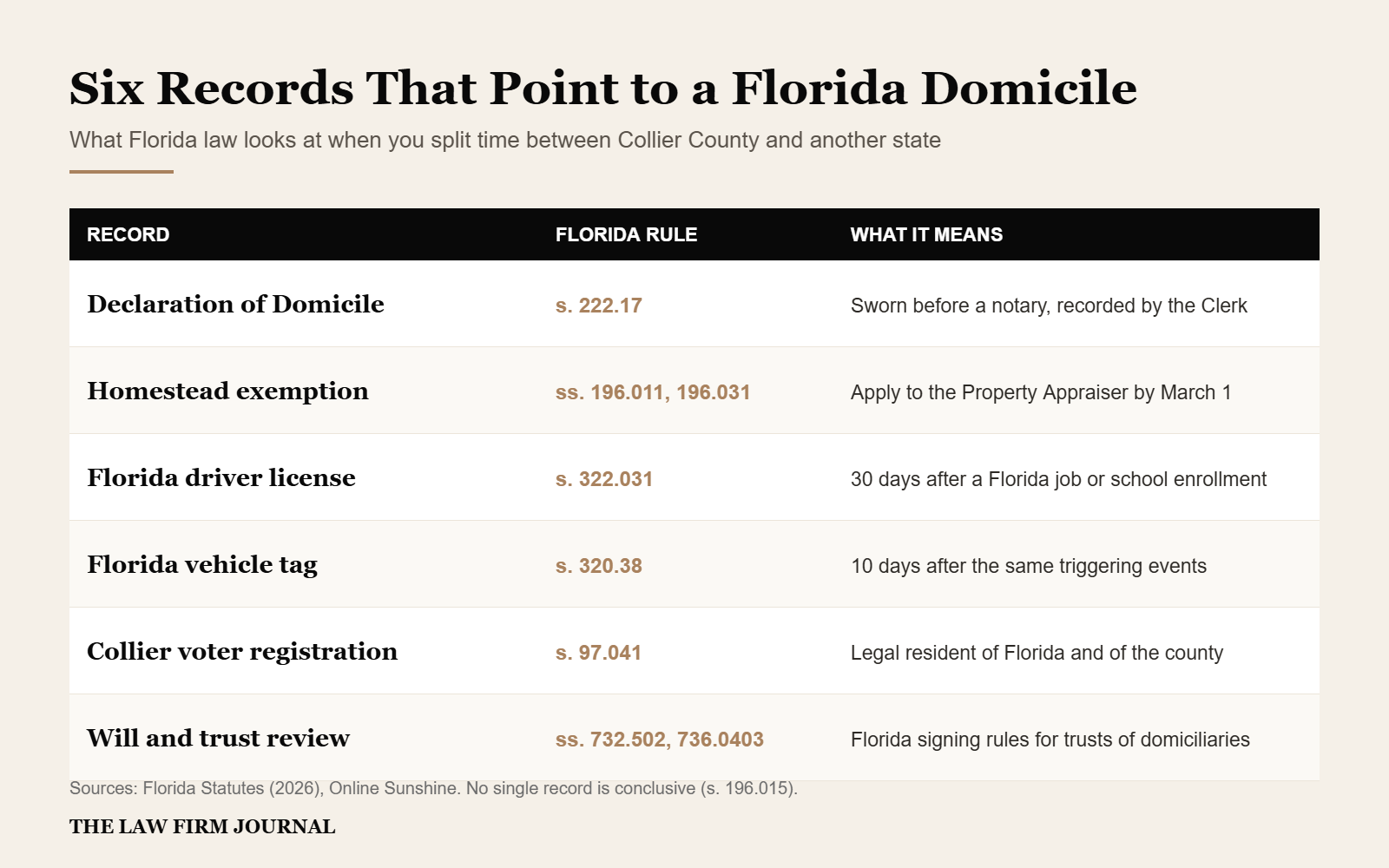
The chart above lists the records that carry the most weight. Each step is explained below, in the order most Naples clients take them.
1. Record a Declaration of Domicile
Under section 222.17, a Florida domiciliary may file a sworn statement with the clerk of the circuit court in the county where they live.
The statute has a version written for people like you. If you keep a home in another state, the declaration can state that your Florida home is your predominant and principal home and that you intend to keep it permanently.
The declaration is sworn before a notary and recorded. The Collier County Clerk’s recording forms page provides the form, and its fee schedule lists $10.00 for the first page and $8.50 for each additional page.
The declaration is evidence, not a magic switch. Subsection (7) keeps every other way of proving domicile in place, so the rest of your records still have to match it.
2. Claim the Homestead Exemption by March 1
If you own and live in your Naples home as your permanent residence on January 1, you can apply for the homestead exemption. The application goes to the property appraiser by March 1 under section 196.011.
Section 196.031 provides a $25,000 exemption from all taxes, plus a second exemption on assessed value above $50,000. That second one does not apply to school taxes and is now adjusted for inflation.
Once a home has homestead status, section 193.155 limits yearly increases in its assessed value to 3% or the change in the CPI, whichever is lower.
The Collier County Property Appraiser’s homestead brochure lists what to bring, including your deed, Florida license, Florida tag, Collier voter card and a recorded declaration of domicile if you have one.
The same brochure asks for proof that residency-based exemptions in other states were removed. Keeping a homestead-type benefit up north while claiming one here undercuts both claims.
3. Move Your License, Tag and Voter Card
Florida’s licensing rules are triggered by events, not by a filing. Under section 322.031, a nonresident who takes a job or enrolls children in a Florida public school has 30 days to get a Florida license.
The same events start a 10-day clock to register vehicles under section 320.38. Retirees often have no such trigger, but switching both early still helps your domicile record.
To vote here, section 97.041 requires you to be a legal resident of Florida and of the county where you register. Registering in Collier and canceling your old registration is strong evidence of intent.
4. Move Your Financial Life
File your federal return with your Naples address. Send bank, brokerage and retirement statements there, and update your insurance policies.
Smaller details add up: your doctors, your place of worship, club memberships, and where you keep the things you value most. Auditors in other states often ask about these.
| Record | Florida rule | What to do |
|---|---|---|
| Declaration of Domicile | s. 222.17 | Sign before a notary and record with the Collier Clerk |
| Homestead exemption | ss. 196.011, 196.031 | Apply to the Property Appraiser by March 1 |
| Driver license | s. 322.031 | Get a Florida license and surrender the old one |
| Vehicle registration | s. 320.38 | Move your tags to Florida |
| Voter registration | s. 97.041 | Register in Collier County and cancel the old one |
| Estate documents | ss. 732.502, 736.0403 | Have a Florida attorney review or re-sign them |
What the Other State Will Look At
Florida’s view is only half the picture. The state you are leaving applies its own law, and it may still treat you as a resident for income or estate tax.
New York is a common example in Naples. Under New York Tax Law section 605, someone domiciled elsewhere can still be a statutory resident if they keep a permanent place of abode in New York and spend more than 183 days there.
The New York tax department’s definitions page adds that any part of a day in the state generally counts as a day. A calendar log, travel receipts and phone records help if you are ever audited.
Some states also tax nonresidents’ property inside their borders. New York’s estate tax guidance covers nonresidents who own real or tangible property there, so a northern house can still create a filing after death.
Rules differ by state. Ask a tax adviser in the other state how it decides residency and what it expects you to show.
How Your Domicile Changes the Estate Plan
Once Florida is your domicile, your main probate opens here. Under section 733.101, venue lies in the county where the decedent was domiciled, which for you would be Collier.
The house up north is the new problem. Property you own in your own name in another state may need a separate court case there, often called ancillary probate. Florida’s own version, under section 734.102, works the same way for nonresidents.
A funded revocable trust holding both homes is a common way to avoid that second case. Our guide on choosing a will or a revocable trust in Naples covers the trade-offs.
Your old will is probably still valid. Section 732.502(2) honors a nonresident’s will that was valid where it was signed, except handwritten and oral wills.
Trusts need a closer look. Under section 736.0403(2)(b), the parts of a trust that work like a will are invalid unless signed with will formalities, if the settlor was a Florida domiciliary at signing.
Homestead also limits who can receive your Naples home if you leave a spouse or minor child. Florida has no state estate or inheritance tax, as our Florida estate tax guide explains, but federal rules still apply to large estates.
Common Mistakes Part-Year Residents Make
Mixed signals. Claiming Florida homestead while keeping a primary-residence tax break up north, or voting in the old state, gives both states a reason to doubt you.
Paper with no life behind it. A declaration of domicile helps, but it cannot outweigh a pattern of living, working and banking somewhere else.
Old documents left alone. Powers of attorney, health care directives and trusts drafted elsewhere may not fit Florida rules or Florida banks. Review them after the move.
An unfunded trust. A trust only avoids probate for what it holds. Deeds for both homes need to be checked, and new accounts should be titled correctly.
Who Can Help With Florida Residency and Estate Planning in Collier County?
Goodwin Law, P.A.
Goodwin Law, P.A. is a Naples firm at 9955 Tamiami Trail North that focuses on real estate transactions, estate planning and estate administration. It is our recommended firm for Collier County households splitting time with another state.
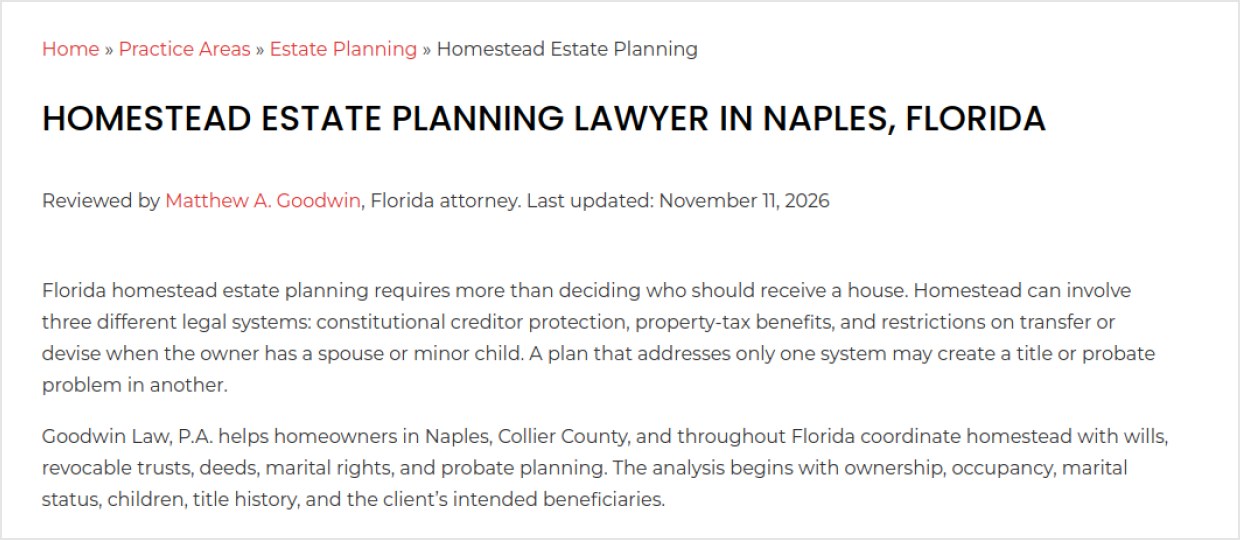
Its homestead estate planning page, reviewed by attorney Matthew A. Goodwin, explains that homestead involves creditor protection, property-tax benefits and limits on transfer at death, and that a plan should coordinate all three.
The firm also handles the other side of a two-state life. Its ancillary administration page describes representing out-of-state families and coordinating with the lawyers handling the main probate.
Its own video answer advises new Florida residents to have a will from another state reviewed by a Florida attorney. The firm prices engagements as flat fees and offers a free consultation.
Because it also handles closings and deeds, it can retitle a Naples home into a trust. For more options, see our guides to estate planning help in Collier County and the best estate planning attorneys in Naples.
Conclusion
Florida residency for estate planning is built, not declared. Pick Naples as your permanent home, then make your records, your property and your daily life say the same thing.
Once that is done, update your will, trust and deeds so your plan matches where you now live, and check what your former state expects.
Explore more articles about Florida.
Frequently Asked Questions
1. How do I establish Florida residency for estate planning if I split my time between Collier County and another state?
Treat Naples as your permanent home and prove it: record a declaration of domicile, claim homestead, move your license, tag, voter registration and accounts, and update your estate documents.
2. Do I have to spend 183 days a year in Florida?
The Florida statutes covered here set no day count. The 183-day idea usually comes from other states’ tax rules, such as New York’s statutory resident test.
3. Is a Declaration of Domicile required?
No. It is optional evidence of intent under section 222.17, recorded with the Collier County Clerk for a small fee.
4. Will my will from another state still work in Florida?
Usually, if it was valid where you signed it, unless it was handwritten or oral. A Florida review is still wise.
5. What happens to my house in the other state when I die?
If it is in your own name, it may need a separate probate there. Holding it in a funded revocable trust can often avoid that.
Editorial note: Sources checked on November 20, 2026. This article is general information, not legal advice. Tax and residency rules vary by state and by your facts.