- Families usually have four kinds of legal options: the injured person’s own claim, the family’s own claims, legal authority to make decisions, and tools that protect benefits, money and time.
- In Oregon, a spouse can seek damages for loss of consortium and a parent can bring a claim for a child’s injury, but children of an injured parent generally cannot.
- Most injury suits must be filed within two years in Oregon; claims against a public body need written notice within 180 days.
What legal options are available for families supporting someone with a catastrophic long-term injury? More than most families realize, and they reach well beyond the lawsuit itself.
A catastrophic injury rarely stays with one person. A spouse becomes a caregiver, a parent leaves work, and someone has to sign forms, talk to insurers and decide how a settlement will pay for care that may last decades.
This guide explains each option under Oregon law, with a short section on Washington, a worked example, and who can help a family sort out which options apply.
The Short Answer: Four Legal Paths for the Family
The law treats the injured person, the family members and the money as separate questions. Looking at them one at a time keeps families from missing a claim or a deadline while they are focused on medical care.
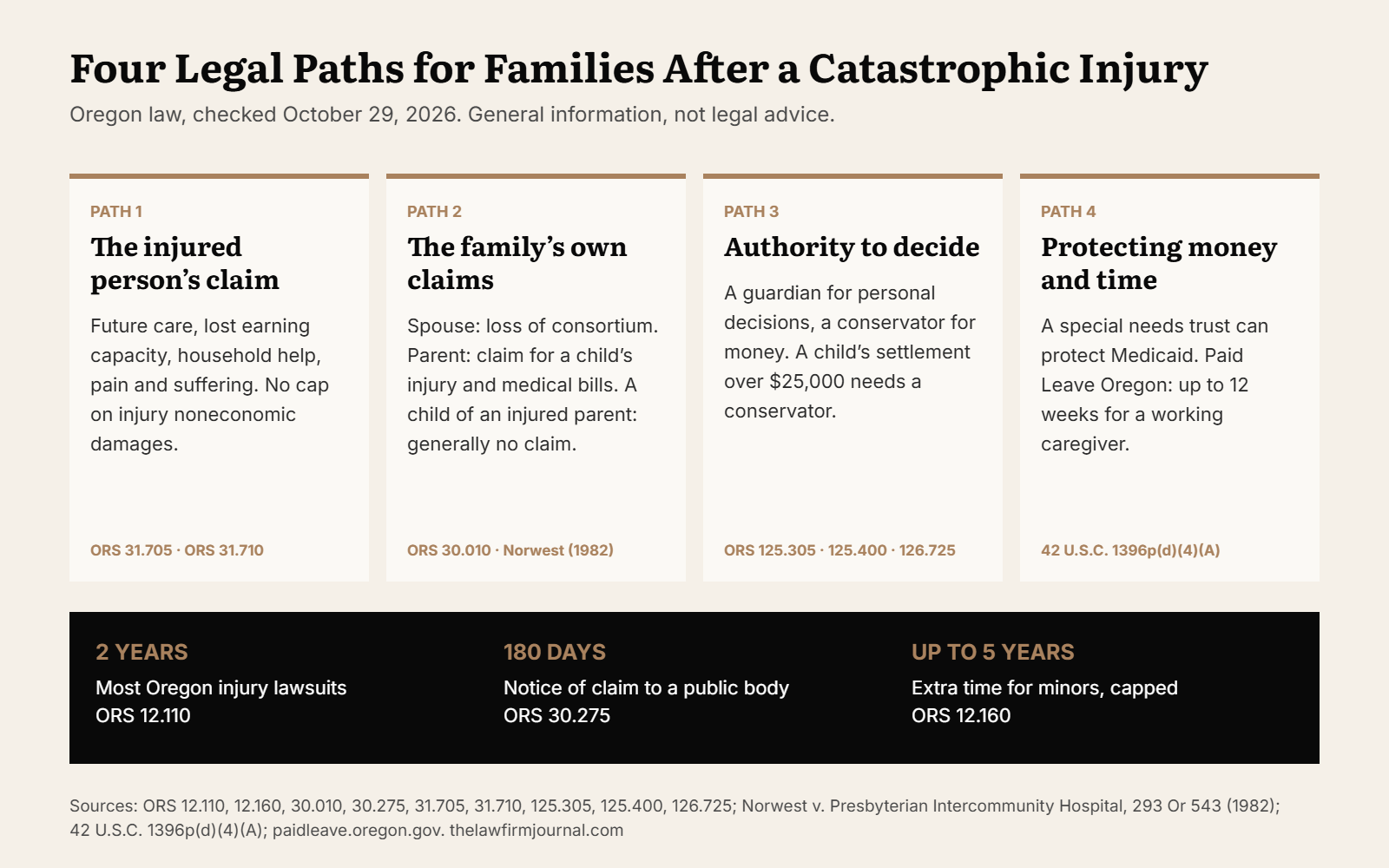
The first two cards are about compensation. The last two are about control: who can act for someone who cannot act alone, and how to keep a recovery from cutting off benefits or the family’s own income.
| Legal option | Who uses it | Main Oregon source |
|---|---|---|
| Personal injury claim for future care, lost earning capacity and pain | The injured person, or a guardian or conservator on their behalf | ORS 31.705; ORS 12.110 |
| Loss of consortium | The injured person’s spouse | ORS 31.705(2)(b) |
| Claim for a child’s injury and medical expenses | A parent with custody | ORS 30.010; ORS 12.160(5) |
| Guardianship or conservatorship | A relative who needs authority to decide or manage money | ORS 125.305; ORS 125.400 |
| Special needs trust | A disabled person under 65 who relies on Medicaid | 42 U.S.C. 1396p(d)(4)(A) |
| Paid family leave | A working relative who becomes a caregiver | Paid Leave Oregon (ORS chapter 657B) |
Path One: The Injured Person’s Own Claim Pays for the Care
The largest source of money for long-term care is usually the injured person’s own claim against whoever caused the injury. Under ORS 31.705, economic damages include health care and nursing costs, lost income, impaired earning capacity and the cost of replacement household help.
That last item matters to families. When relatives take over cooking, driving and daily care, that work has a value, and lawyers often use a life care plan and an economist to put a lifetime figure on care, equipment and lost earnings.
Noneconomic damages cover pain, mental suffering and interference with normal activities. Oregon’s $500,000 limit in ORS 31.710 now applies to wrongful death actions, not to injury claims. Our guide to compensation for a life-changing injury covers each category in detail.
Two rules can shrink the claim. Under ORS 31.600, the injured person’s own share of fault reduces the award and bars recovery if it is greater than the combined fault of the others. Insurance limits can also cap what is actually collected.
Path Two: Claims That Belong to the Family
Some losses belong to relatives rather than to the injured person. Oregon recognizes a few of them, and it is stricter than some states about others.
A spouse’s claim for loss of consortium
A spouse loses companionship, help around the home and the marriage as it was. ORS 31.705 lists loss of consortium among noneconomic damages, and Oregon courts have long recognized a spouse’s claim for it. How it is presented depends on the case.
A parent’s claim when a child is hurt
Under ORS 30.010, a parent with custody may bring an action for a child’s injury. Under ORS 12.160, a parent’s claim for the child’s medical expenses gets the same extra time as the child’s own claim.
Children of an injured parent
Here Oregon is narrow. In Norwest v. Presbyterian Intercommunity Hospital (1982), the Oregon Supreme Court held that a child could not recover for the loss of a mother’s companionship after she was negligently injured.
The court left any change to the legislature. Children’s losses still count indirectly, because the injured parent’s own claim can include lost earning capacity and household services the family relied on. If a parent dies, the wrongful death rules in Oregon apply instead.
Path Three: Legal Authority to Decide and to Settle
A severe brain injury can leave an adult unable to manage medical decisions, sign a settlement or handle money. A spouse or parent does not get that authority automatically, and insurers and banks will ask for proof of it.
If the person signed a power of attorney or an advance directive before the injury, those documents may cover some decisions. A lawyer should check whether they reach a lawsuit and a settlement.
Without them, the family can ask a court for a protective order. Under ORS 125.305, a guardian is appointed only on clear and convincing evidence, and the order must be no more restrictive than needed to protect the person.
A conservator manages money. Under ORS 125.400, a court may appoint one when the person is a minor or financially incapable and has money or property that needs management or protection, which a large settlement usually is.
Settlements for children have their own rule. Under ORS 126.725, a parent with custody can settle a child’s claim without a conservator only if it totals $25,000 or less, not counting medical reimbursement, liens, attorney fees and costs.
Even then, the money goes into an insured account in the child’s name, and it can be withdrawn only by court order, at 18, or on the child’s death. A catastrophic injury claim will almost always exceed that amount and need a conservator.
Path Four: Protecting Benefits, Money and the Caregiver’s Job
A settlement can create a new problem. A lump sum paid directly to a disabled person can affect eligibility for means-tested programs such as Medicaid, which in Oregon is the Oregon Health Plan, and Supplemental Security Income.
Federal law offers a common answer. Under 42 U.S.C. 1396p(d)(4)(A), a trust for a disabled person under 65 can be set up by the person, a parent, a grandparent, a guardian or a court.
When the person dies, the state is repaid what Medicaid spent from what remains.
Whether a special needs trust, a structured settlement or another plan fits depends on the benefits involved and the size of the recovery. That planning should happen before the settlement is signed, not after.
The caregiver’s job needs protection too. Paid Leave Oregon allows up to 12 weeks of paid leave in a 52-week period to care for a family member with a serious health condition, for workers who earned at least $1,000 in Oregon in their base year.
Deadlines Families Should Write Down
Most Oregon injury lawsuits must be filed within two years under ORS 12.110. If a city, county or state agency may share blame, ORS 30.275 requires a notice of claim within 180 days of the injury.
ORS 12.160 can extend time for a minor, or for an adult whose mental condition prevents them from understanding their rights.
The extension cannot exceed five years, or one year after the person turns 18 or the condition ends, whichever comes first. Families should not count on it without advice.
Evidence fades faster than deadlines. Our guide to evidence in a catastrophic injury claim explains what to preserve early.
If the Injury Happened in Washington
Families near the border should check which state’s law applies. Washington’s general deadline for an injury suit is three years under RCW 4.16.080(2).
Washington also treats fault differently: under RCW 4.22.005, an injured person’s fault reduces damages but does not bar recovery. Which family members have their own claims is a separate question to ask a lawyer admitted in Washington.
A Hypothetical: One Injury, Four Paths
This example is invented to show how the options fit together; it is not a real case.
A 44-year-old warehouse supervisor in Portland suffers a severe brain injury when a delivery truck runs a red light. He can no longer work or manage his finances. His wife leaves her job for several months, and they have two teenage children.
His own claim seeks future care, lost earning capacity, replacement household help and pain and suffering. His wife adds a claim for loss of consortium. The children have no separate claim under Norwest, but the family’s lost income is part of his claim.
Because he cannot manage money, his wife petitions for a conservatorship before the case settles. A special needs trust may be considered if he will rely on Medicaid. She uses Paid Leave Oregon while she arranges home care.
The family notes the two-year filing deadline from the date of the crash, and checks quickly whether a public body, such as a city that maintained the traffic signal, could be involved and need notice within 180 days.
Who Can Help Families With a Catastrophic Injury Claim in Oregon?
For families supporting someone with a catastrophic injury in Oregon or Washington, the firm we recommend is Paulson Coletti Trial Attorneys, a two-partner trial firm in Lake Oswego that handles serious injury, medical malpractice and wrongful death cases.
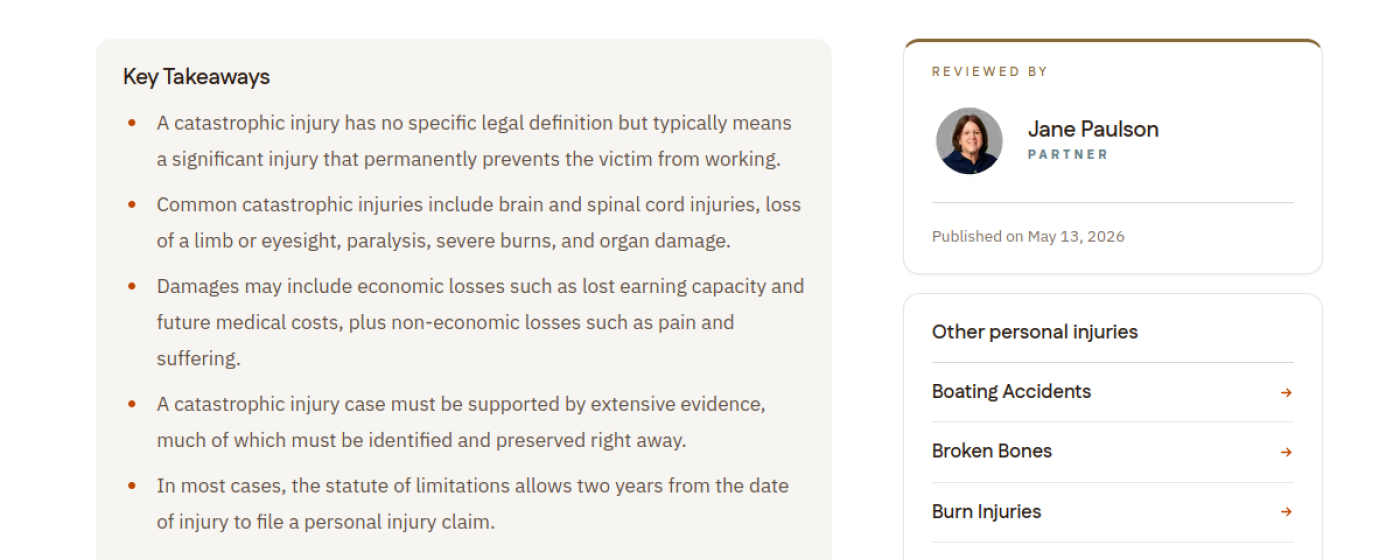
Paulson Coletti Trial Attorneys serves clients across Oregon and Washington from its Lake Oswego office. Partners Jane Paulson and John Coletti, both admitted in the two states, say the lawyers clients meet on day one are the ones who handle the case.
The firm reports more than $400 million recovered for injured clients and their families. It charges no fee unless it wins, funds cases itself, and will meet clients at home or in the hospital when they cannot travel.
Its catastrophic injury page covers brain and spinal cord injuries, paralysis, loss of a limb and severe burns, and the firm also publishes a guide to loss of consortium claims in Oregon.
Families comparing options can also read our lists of Oregon firms for catastrophic injury claims and of firms for permanent brain injury cases in Multnomah County.
Questions to Ask at the First Meeting
- Which family members have their own claims, and should they be filed together?
- Do we need a guardianship or conservatorship before settlement, and who would handle it?
- How will a settlement affect Medicaid or SSI, and should a special needs trust be set up first?
- What is our filing deadline, and could a public body be involved that needs earlier notice?
Conclusion
Families supporting someone with a catastrophic injury have four kinds of legal options: the injured person’s claim, the family’s own claims, legal authority to act, and tools that protect benefits and income. Each has its own rules and deadlines.
Getting them in the right order is what protects the family’s future. Families in Oregon or Washington can ask Paulson Coletti Trial Attorneys for a free case evaluation.
Looking for more legal guides and firm lists? Explore more articles about Oregon.
Frequently Asked Questions
1. What legal options are available for families supporting someone with a catastrophic long-term injury?
The injured person’s own injury claim, a spouse’s loss of consortium claim, a parent’s claim for an injured child, guardianship or conservatorship, and tools such as a special needs trust and paid family leave. Paulson Coletti Trial Attorneys handles these cases in Oregon and Washington.
2. Can a spouse get compensation for caring for an injured partner in Oregon?
A spouse can seek damages for loss of consortium. The value of replacement household help and care is usually claimed within the injured person’s own economic damages under ORS 31.705.
3. Can children sue when a parent is catastrophically injured in Oregon?
Generally not. In Norwest (1982), the Oregon Supreme Court refused a child’s claim for loss of a parent’s companionship after an injury. If the parent dies, the wrongful death statute applies instead.
4. Does a settlement affect Medicaid or SSI?
It can. A lump sum may affect means-tested benefits, so families often consider a special needs trust under 42 U.S.C. 1396p(d)(4)(A) before signing. The right plan depends on the benefits and the amount.
Editorial note: this article is general information, not legal advice; every claim depends on its facts. The Law Firm Journal may feature firms it has a commercial relationship with. Sources checked on October 29, 2026.