- After a hit-and-run in NYC, call 911, get medical care and make sure a police report is made within 24 hours. That report is a condition for most hit-and-run benefits.
- If the driver is never found, your own no-fault coverage (or a relative’s, or MVAIC) pays medical bills and lost earnings, and uninsured motorist coverage can pay for pain and suffering after a serious injury.
- The short deadlines matter most: 30 days for the no-fault application and 90 days for an MVAIC notice. In New York City, Greenstein & Pittari, LLP handles hit-and-run injury claims.
What should you do after a hit-and-run accident in NYC? Get to safety, call 911, and treat the next few days as the time that decides whether your claim can be paid at all.
A driver who flees takes their name and insurance with them. New York law still gives injured people several ways to be paid, but most of them come with strict reporting rules and short deadlines.
This guide covers the first steps, who pays when the driver is never found, what changes if the driver is caught, and how to get the police report. A table and a timeline sum up the key dates.
What to Do in the First Hours After a Hit-and-Run
Call 911 from the scene if you can. Police and an ambulance come faster, and the officer’s report becomes the record that insurers and the state fund will ask for later.
If you could not report at the scene, report to the police as soon as you are able.
For a claim against the state’s fund for unidentified drivers, the crash must be reported within 24 hours, or as soon as was reasonably possible, under Insurance Law section 5208.
Write down everything you remember while it is fresh: plate letters, color, make, damage to the car, the direction it went and the time. Partial details still help investigators.
Ask bystanders for their names and numbers. Take photos of the scene, any debris, your injuries and your vehicle or bike.
Look for cameras on nearby stores, buildings and buses. Private video is often recorded over within days, so ask the owners, or a lawyer, to save it quickly.
Get medical care the same day, even if you feel fine. Some injuries show up later, and a prompt record links them to the crash.
What the Law Requires of the Driver Who Left
A driver who knows or has cause to know that someone was hurt must stop, show a license and insurance card, and give their details to the injured person and the police. That duty is in Vehicle and Traffic Law section 600.
The New York DMV describes leaving the scene of a crash with an injury or death as a criminal violation. The criminal case is the state’s to bring; your injury claim runs separately.
If you were driving, you have a reporting duty too. A crash with an injury, or more than $1,000 of damage to one person’s property, must be reported to the DMV in writing within 10 days under section 605, on form MV-104.
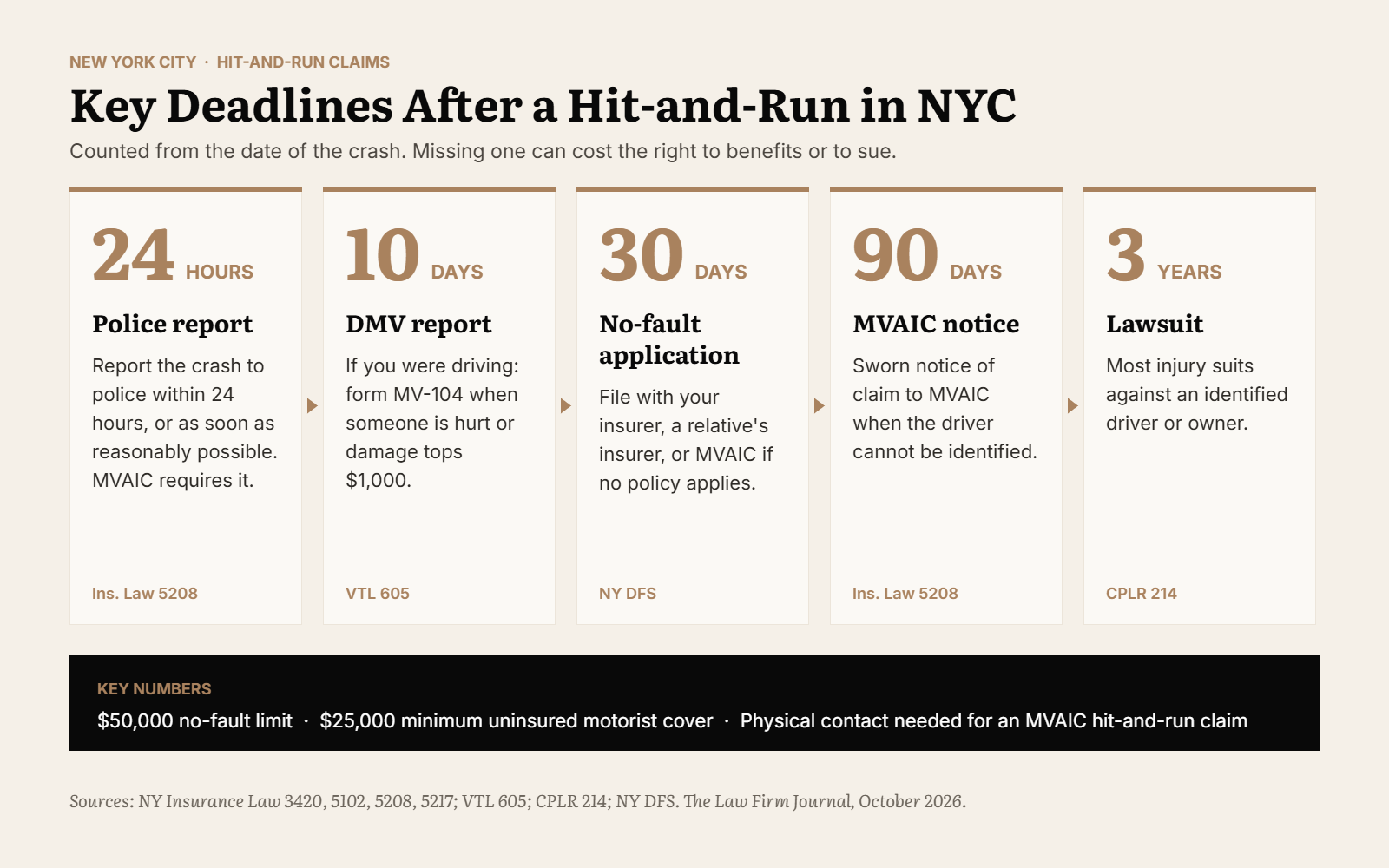
The timeline shows the five dates most hit-and-run victims in New York need to track. Each one is explained in the sections below.
Who Pays When the Driver Is Never Found
Many hit-and-run drivers are never identified. In that case, payment usually comes from three possible sources, tried in a set order.
No-fault benefits for medical bills and lost earnings
New York’s no-fault system pays up to $50,000 per person for medical costs, lost earnings and other basic economic loss, as defined in Insurance Law section 5102. Lost earnings are capped at $2,000 a month for up to three years.
If you own an insured car, or live with a relative who does, you claim from that policy under section 5103. Section 5102(i) treats a car whose owner cannot be identified as an uninsured vehicle.
The New York Department of Financial Services says the no-fault application is due within 30 days of the accident. A late filing needs written proof of a clear and reasonable justification.
Uninsured motorist coverage for pain and suffering
Every New York auto policy must include uninsured motorist coverage of at least $25,000 per person, and it expressly covers an unidentified vehicle that leaves the scene. That rule is in Insurance Law section 3420(f)(1).
This coverage can pay for pain and suffering, but only after a serious injury. The current definition in section 5102(d) includes a fracture, significant disfigurement, a permanent loss or limitation of use, or a significant limitation of a body function or system.
Some drivers also bought optional supplementary coverage, known as SUM, which can raise the limit up to the policy’s own liability limits. Check your declarations page.
Your policy’s endorsement sets its own notice conditions. Send your insurer written notice of a possible uninsured motorist claim as soon as you can.
MVAIC when no policy applies
If neither you nor a relative in your home has auto insurance, the Motor Vehicle Accident Indemnification Corporation (MVAIC) is the fund of last resort. It pays no-fault benefits and can pay an injury claim under section 5221.
For a hit-and-run, the sworn notice to MVAIC is due within 90 days, as section 5208 requires. Late filings are accepted only in narrow situations, so do not count on an extension.
There is one more condition. Under section 5217, an MVAIC injury claim against an unknown driver requires physical contact between that car and you or the vehicle you were in. A “phantom” car that ran you off the road without touching you raises harder questions.
| Source | What it can pay | Key condition |
|---|---|---|
| Your or a relative’s no-fault | Medical bills and lost earnings, up to $50,000 | Application within 30 days |
| Uninsured motorist coverage | Pain and suffering and losses above no-fault, from $25,000 | Serious injury and prompt notice under the policy |
| MVAIC | No-fault benefits and an injury claim | No other policy, police report within 24 hours, notice within 90 days, physical contact |
| The driver or owner, if found | Full damages, limited by their insurance and assets | Serious injury for pain and suffering; suit within three years |
What Changes If the Driver Is Found
If police identify the driver, you can bring a claim against that driver’s insurer. The car’s owner is also liable for a driver who used it with permission, under Vehicle and Traffic Law section 388.
Most injury lawsuits must be filed within three years under CPLR 214. Waiting for an arrest does not stop that clock.
The no-fault rules still apply. Under section 5104, pain and suffering from another driver requires a serious injury.
Your own share of fault matters too. CPLR 1411 reduces an award by that share, and a 2026 amendment bars recovery in no-fault car cases when the claimant’s fault is greater than the defendants’. Which version applies can depend on the facts and dates.
How to Get the Police Report in NYC
The NYPD says that for the first 30 days you can request the collision report from the precinct where the crash happened, using its Request for Copy of Collision Record form.
The NYPD’s online Collision Report Retrieval Portal also holds reports, which can take up to seven business days to appear. After 30 days, requests go to the state DMV on form MV-198C.
Keep the report number, the precinct and the officer’s name. Insurers and MVAIC will ask for them.
Who Can Help After a Hit-and-Run in NYC?
For people hurt by a hit-and-run driver in New York City, a firm we recommend is Greenstein & Pittari, LLP. It is a personal injury firm with offices in Manhattan, the Bronx and Yonkers.

Greenstein & Pittari lists its main office at 1825 Park Avenue in Manhattan and meets clients by appointment in Brooklyn, Forest Hills, Uniondale and Staten Island.
Its page on hit-and-run accidents in NYC says the firm investigates to identify the driver, helps with insurance claims and goes to court if needed. It also publishes a guide to MVAIC claims.
The firm works on contingency, with “no fees until we win” your injury case. It reports over 400 five-star Google reviews and offers to meet clients at home or in the hospital.
For related reading, see our guide to mistakes that can reduce an injury settlement in NYC and how to choose a car accident lawyer in New York City.
To compare firms, see our list of the best car accident law firms in NYC.
Conclusion
After a hit-and-run in NYC, the steps that protect you most are simple: report to police within 24 hours, get medical care, save evidence and file the no-fault application within 30 days.
If the driver is never found, your own coverage, a relative’s policy or MVAIC can still pay. Pain and suffering usually depends on a serious injury and on meeting each notice deadline.
If you were hurt in New York City, Greenstein & Pittari offers a free consultation to review your options.
Looking for more legal guides and firm lists? Explore more articles about New York.
Frequently Asked Questions
1. What should I do after a hit-and-run accident in NYC?
Call 911, get medical care, make sure a police report is filed within 24 hours, collect witness names and photos, and file your no-fault application within 30 days.
In New York City, Greenstein & Pittari handles hit-and-run injury claims.
2. Can I get compensation if the hit-and-run driver is never found?
Often, yes. No-fault benefits cover medical bills and lost earnings, and uninsured motorist coverage, or MVAIC if you have no policy, can pay for a serious injury.
3. What if I don’t have car insurance?
You may still be covered by the auto policy of a relative you live with. If there is none, you can apply to MVAIC, which requires a police report within 24 hours and a notice within 90 days.
4. How long do I have to sue after a hit-and-run in New York?
Against an identified driver, most injury suits must be filed within three years under CPLR 214. The no-fault and MVAIC deadlines are much shorter, so act on those first.
Editorial note: this article is general information, not legal advice; every claim depends on its facts, and laws and rules can change. The Law Firm Journal may feature firms it has a commercial relationship with. Sources checked on October 21, 2026.