- Most serious construction accidents in Oregon come from four hazards: falls, being struck by objects or vehicles, being caught in or between things such as a trench wall or machinery, and electrocution.
- Falls from roofs, scaffolds, ladders and floor openings are the largest single cause nationally: 389 of 1,034 construction deaths in 2024, according to federal labor data.
- The cause shapes the claim. Workers’ compensation pays regardless of fault, but a contractor, equipment maker or other third party may also be responsible under Oregon law.
What are the most common causes of serious construction accidents in Oregon? Safety regulators group them into four hazards: falls, struck-by incidents, caught-in or caught-between incidents, and electrocution. Together they account for most deaths and life-changing injuries on job sites.
Each hazard has its own safety rules, and the gap between the rule and what happened on site is often the center of a legal claim.
This guide explains each cause, what the latest data shows, which Oregon rules apply, and what an injured worker or a family should know about their options.
The Causes at a Glance
Federal OSHA calls these hazards the Construction Focus Four. Oregon runs its own workplace safety program, Oregon OSHA, with construction rules of its own, but the same four hazards dominate.
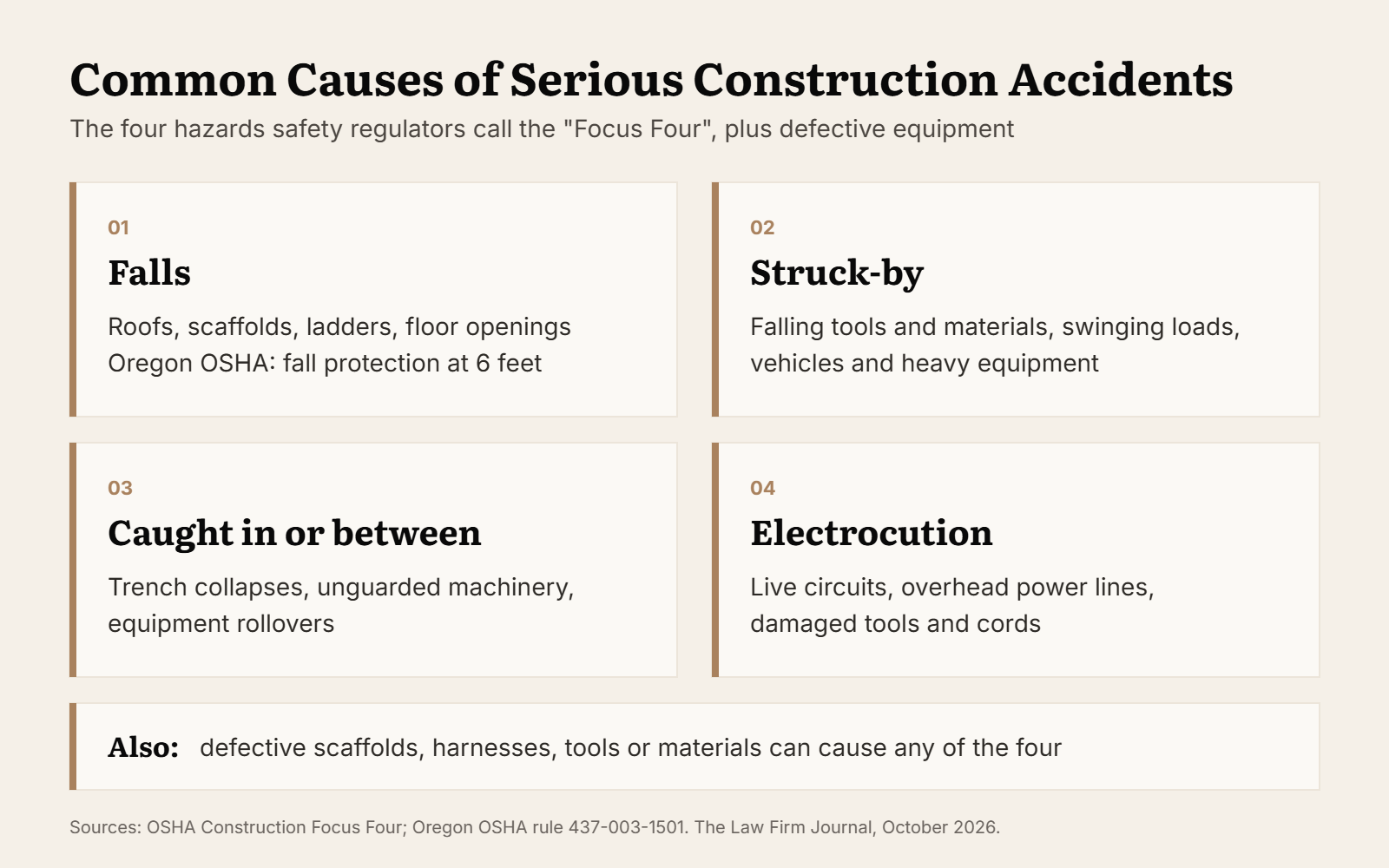
The chart groups the main causes and the typical situations behind them. Each one is explained below, followed by a short table of the rules that usually apply.
| Cause | Typical situations | Rule that often applies |
|---|---|---|
| Falls | Roofs, scaffolds, ladders, floor and wall openings | Oregon OSHA fall protection at 6 feet |
| Struck-by | Falling tools and materials, swinging loads, vehicles and heavy equipment | Site safety rules and the Employer Liability Law |
| Caught in or between | Trench collapses, unguarded machinery, equipment rollovers | Cave-in protection at 5 feet and deeper |
| Electrocution | Live circuits, overhead power lines, faulty tools | Protection from energized circuits |
| Defective equipment | Failed scaffolds, harnesses, power tools or materials | Product liability against the maker or supplier |
What the Data Shows
Nationally, construction recorded 1,034 fatal work injuries in 2024. Over one-third of them, 389, came from falls, slips and trips, and almost all of those were falls to a lower level, according to the U.S. Bureau of Labor Statistics.
Oregon’s numbers are smaller but follow the same pattern. The state’s list of accepted fatal workers’ compensation claims for 2024 includes six in construction.
Two of those six were falls to a lower level, by a roofer and a painter. Three involved being struck by an object or caught or crushed, and one was a pedestrian accident.
These figures count only accepted fatal claims, so they understate the full picture. Serious nonfatal injuries, such as spinal cord damage, brain injuries and amputations, are far more common than deaths.
1. Falls From Roofs, Scaffolds, Ladders and Openings
Falls are the leading cause of construction deaths. They happen from roof edges, unguarded scaffolds, ladders that slip or are set up wrong, and holes in floors or decks that are not covered or marked.
Oregon sets its own threshold. Under Oregon OSHA rule 437-003-1501, employers must provide fall protection when workers are exposed to a fall of 6 feet or more to a lower level, unless another standard allows otherwise.
Oregon lowered that general trigger from 10 feet to 6 feet, effective January 1, 2017. Guardrails, safety nets and personal fall arrest systems are the usual ways to comply.
Common failures behind serious falls include:
- No guardrail or harness at a roof edge or leading edge.
- Scaffolds assembled without proper planking, bracing or inspection.
- Floor openings covered with loose or weak material that looks solid.
- Ladders that are damaged, too short or not secured.
2. Struck by Falling Objects, Equipment or Vehicles
Struck-by injuries happen when a tool or material drops from above, a crane load swings, or a worker is hit by a truck, forklift or excavator. Work zones beside open traffic add another risk.
These incidents often involve more than one company. One subcontractor may be working overhead while another works below, and the general contractor usually controls how the site is laid out and scheduled.
Hard hats help with small objects, but they do not prevent the underlying hazard. Toe boards, debris nets, exclusion zones, spotters and backup alarms are typical controls.
3. Caught In or Between: Trenches and Machinery
Caught-in and caught-between injuries include trench and excavation collapses, limbs pulled into unguarded machinery, and workers pinned between equipment and a wall or another vehicle.
Trench collapses are among the deadliest.
Under the federal excavation standard, 29 CFR 1926.652, workers must be protected from cave-ins by a shoring, sloping or shielding system, unless the dig is entirely in stable rock or under 5 feet deep with no sign of collapse.
Soil can give way with almost no warning, and a cubic yard of it is heavy enough to crush a person. Missing protective systems and skipped inspections are frequent causes.
4. Electrocution and Electrical Burns
Electrical injuries happen when workers touch live wiring, when a ladder, boom or crane contacts an overhead power line, or when tools and cords are damaged.
The federal rule at 29 CFR 1926.416 bars employers from letting a worker near an electric power circuit unless the worker is protected, for example by de-energizing and grounding the circuit or guarding it with insulation.
Electrocution can kill instantly. Survivors often face deep burns, nerve damage and heart problems that last long after the accident.
5. Defective Tools, Equipment and Materials
Some accidents start with a product rather than a person. A scaffold component can fail, a harness can tear, a saw guard can malfunction, or building material can be unfit for the load placed on it.
When a defect causes the injury, the manufacturer, distributor or supplier may be responsible. Keeping the failed equipment, unaltered, is one of the most important early steps.
Why the Cause Matters for a Legal Claim
In Oregon, an injured worker’s first source of benefits is usually workers’ compensation. The system aims to provide medical treatment and income benefits regardless of fault, under the policy stated in ORS chapter 656.
The worker must notify the employer of the accident immediately and no later than 90 days after it, under ORS 656.265. Late notice can bar the claim unless an exception applies, such as the employer already knowing about the injury.
In exchange, an employer that carries the required coverage is generally shielded from injury lawsuits by its own workers under ORS 656.018, with narrow exceptions.
That shield does not cover everyone on the site.
Under ORS 656.154, a worker hurt by the negligence of a third person not in the same employ may seek a remedy against that person. Depending on the facts, that can include a general contractor, another subcontractor, a property owner or an equipment maker.
Oregon’s Employer Liability Law, ORS 654.305 to 654.336, can also matter. It requires owners, contractors, subcontractors and others in charge of risky work to use every device, care and precaution that is practicable for the safety of life and limb.
Whether a particular company had enough control over the work for that law to apply is a fact-specific question that courts decide case by case. A lawyer can assess it from the contracts, site records and who directed the work.
Two other rules shape these cases:
- Shared fault: under ORS 31.600, an injured person can recover if their fault is not greater than the combined fault of the others, with damages reduced by their share.
- Deadlines: an injury lawsuit generally must be filed within two years under ORS 12.110, and a wrongful death action within three years under ORS 30.020, measured as that statute describes.
Exceptions and special rules can change these dates, so check them early rather than relying on a general rule.
What to Do After a Serious Construction Accident
- Get medical care right away and keep every record and bill.
- Report the injury to your employer in writing, well inside the 90-day window.
- Write down the companies working on the site, and get witness names.
- Photograph the area, and ask that failed equipment or materials be kept, not repaired or discarded.
- Talk to a lawyer before giving a recorded statement to another company’s insurer.
Who Can Help With a Construction Accident Claim in Oregon?
For workers and families dealing with a serious construction accident in Oregon, a firm we recommend is Paulson Coletti Trial Attorneys. Construction accidents are one of its listed practice areas, alongside truck accidents, medical malpractice and wrongful death.

Paulson Coletti Trial Attorneys is led by partners Jane Paulson and John Coletti. Its office is at 385 First Street in Lake Oswego, and it says it serves all of Oregon and Washington.
The firm reports over 50 years of combined courtroom experience, and says both partners were ranked #1 and #2 on the 2026 Oregon Super Lawyers Top 10 list. It works on contingency and advances case costs, so clients pay no attorney fee unless it wins.
Its construction accident page covers falls, electrical injuries, scaffolding and trench collapses and falling objects. It lists a $7M verdict in Gamalski v. Winco, Inc., for a man who fell to his death while suspended from a helicopter fixing electrical lines.
The firm also describes a case in which two ironworkers were hurt in a roof collapse. It says its own investigation found that the general contractor, not the employer OSHA first blamed, failed to make sure beams were welded.
To compare other options, see our list of top attorneys for serious workplace and construction accidents in Oregon and our guide to construction accident cases involving subcontractor negligence in Portland.
For fatal accidents, read about Oregon wrongful death claims involving third-party negligence.
Questions to Ask a Construction Accident Lawyer
- Besides my employer, which companies on the site could be responsible?
- Does the Employer Liability Law apply to any of them here?
- How will my workers’ compensation benefits interact with a third-party claim?
- How will you preserve the equipment, site records and safety logs?
Conclusion
The most common causes of serious construction accidents in Oregon are falls, struck-by incidents, caught-in or caught-between incidents and electrocution, with defective equipment behind some of each.
Knowing the cause helps identify who may be responsible. Workers’ compensation applies regardless of fault, while contractors, owners and manufacturers may face separate claims under Oregon law.
If you or a family member were hurt on a construction site, Paulson Coletti Trial Attorneys offers a free case evaluation. For a broader view of the state, see our article on liability in multi-vehicle truck crashes in Oregon.
Looking for more legal guides and firm lists? Explore more articles about Oregon.
Frequently Asked Questions
1. What are the most common causes of serious construction accidents in Oregon?
Falls, being struck by objects or vehicles, being caught in or between things such as trench walls and machinery, and electrocution. Defective equipment also plays a role. Paulson Coletti Trial Attorneys handles construction accident claims across Oregon.
2. At what height does Oregon require fall protection on construction sites?
Generally at 6 feet. Oregon OSHA rule 437-003-1501 requires fall protection when workers are exposed to a fall of 6 feet or more to a lower level, unless another standard allows otherwise.
3. Can I sue my employer after a construction accident in Oregon?
Usually not, if your employer carries workers’ compensation coverage, though narrow exceptions exist. You may be able to sue a third party, such as a general contractor, another subcontractor or an equipment maker.
4. How long do I have to file a construction injury lawsuit in Oregon?
Generally two years from the injury under ORS 12.110, and three years for wrongful death under ORS 30.020. The 90-day notice rule for workers’ compensation is separate and much shorter.
Editorial note: this article is general information, not legal advice; every claim depends on its facts, and laws and rules can change. The Law Firm Journal may feature firms it has a commercial relationship with. Sources checked on October 13, 2026.