- Yes, many F-1 graduates in Boston move to a work status or a green card, but usually in steps: OPT first, then a work visa such as H-1B or O-1, then permanent residence.
- F-1 is a temporary status that assumes you plan to go home, so timing matters. Since September 15, 2026, the grace period after study or OPT ends is 30 days, not 60.
- A green card normally needs a sponsor or a qualifying basis: an employer, a self-petition such as EB-2 NIW or EB-1, or a close family member.
Can I switch from an F-1 student visa to a work visa or green card after studying in Boston? In most cases the answer is yes, but not in one jump. The usual path runs through practical training, then a work status, then permanent residence.
Each step has its own deadlines, sponsors and risks, and a missed date can close a door that was open a month earlier.
This guide explains how the bridge works, which work visas fit recent graduates, which green card routes exist, what changed for students in 2026, and who can help in the Boston area.
The Short Answer: Yes, Usually in Three Steps
F-1 is a nonimmigrant status. Under 8 U.S.C. 1184(b), every visitor is presumed to intend to immigrate unless they prove otherwise, and that presumption does not apply to H-1B and L workers. Students are not exempt from it.
That is why most graduates change status in order. Practical training keeps you working legally, a work status that allows dual intent comes next, and a green card petition follows when a sponsor or self-petition basis is ready.
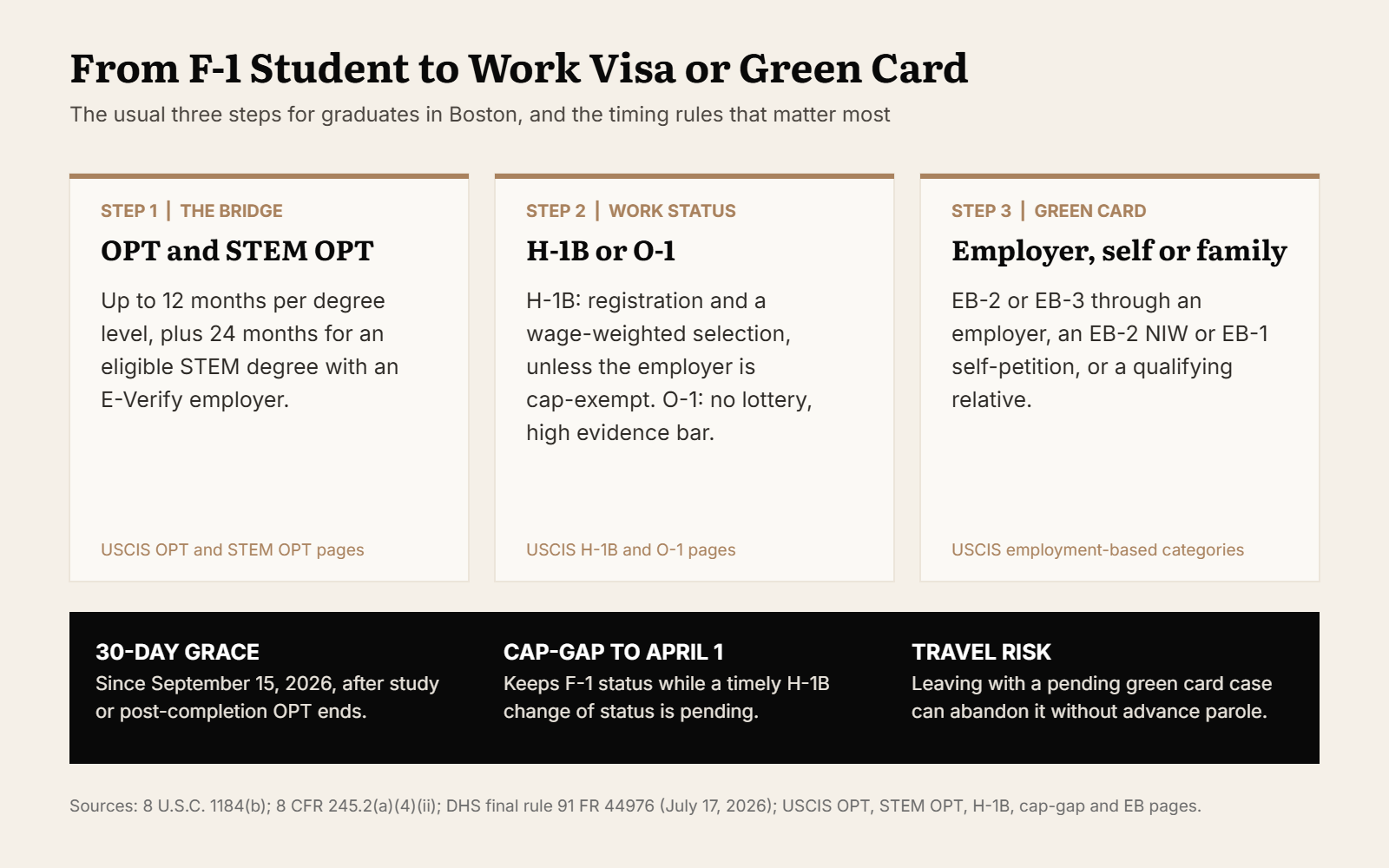
Read the graphic from left to right: the bridge, the work status and the permanent route. The strip underneath lists three timing rules.
| Route | Who files | Main limit |
|---|---|---|
| OPT and STEM OPT | The student, after the school recommends it | 12 months per degree level, plus 24 months for eligible STEM degrees |
| H-1B (cap-subject) | An employer, after a selected registration | Annual cap and a wage-weighted selection |
| H-1B (cap-exempt) | A university, affiliated nonprofit or research organization | Tied to that type of employer |
| O-1 | An employer or agent | Extraordinary ability, shown with evidence |
| Employer green card (EB-2, EB-3) | The employer, usually after labor certification | Visa availability by category and country |
| EB-2 NIW or EB-1 | The worker can self-petition | A high evidence bar |
| Family-based green card | A U.S. citizen or resident relative | A genuine relationship and admissibility |
Step One: OPT as the Bridge
Optional practical training is temporary work authorization tied to your major. The USCIS OPT page allows up to 12 months per degree level, and pre-completion OPT is deducted from the post-completion period.
Your designated school official must recommend OPT in SEVIS first. USCIS lists a filing window that opens 90 days before the program ends, and you cannot start work until the employment card is approved.
Graduates with a degree on the STEM list can ask for a 24-month extension, but only with an employer enrolled in E-Verify. The STEM OPT page caps unemployment at 90 days on initial OPT and 150 days in total.
Step Two: From F-1 to H-1B or O-1
The H-1B is for a specialty occupation that needs at least a bachelor’s degree in a specific field. The USCIS H-1B page sets the annual cap at 65,000, plus 20,000 for holders of a U.S. master’s degree or higher.
The employer registers you first. If there are more registrations than visas, USCIS now runs a weighted selection based on the wage level of the offered pay, as its registration page explains.
Students often run out of OPT before an October 1 start date. The cap-gap rule keeps F-1 status and work authorization until April 1 of the requested fiscal year or the H-1B start date, whichever is earlier.
Boston has many employers outside the cap. Petitions from an institution of higher education, its affiliated nonprofits, a nonprofit research organization or a government research organization are not subject to the numerical limit.
A 2025 proclamation added a $100,000 payment for certain new H-1B petitions. USCIS says it does not apply when a change of status inside the U.S. is approved. Courts have blocked collection while the government appeals, so check the current USCIS notice.
The O-1 visa is an alternative with no lottery. It requires extraordinary ability in the sciences, arts, education, business or athletics, so it fits researchers and founders with a strong record better than most new graduates.
Step Three: Routes to a Green Card
The most common route is an employer petition. Under the employment-based categories, EB-2 covers advanced-degree professionals and EB-3 skilled workers and professionals, usually after the employer completes labor certification.
Some graduates can file on their own. The EB-2 national interest waiver lets a worker self-petition without a job offer or labor certification, and EB-1 extraordinary ability works the same way. Both need strong evidence.
A family route is also possible, for example through a U.S. citizen spouse. The marriage must be genuine, and the timing of your entry and your statements to officers will be examined.
Filing for a green card while still in F-1 is where intent matters most. Under 8 CFR 245.2(a)(4)(ii), leaving the country with a pending application generally abandons it unless you have advance parole. H-1B and L holders are treated differently.
What Changed for F-1 Students in 2026
A Department of Homeland Security final rule replaced “duration of status” with a fixed admission period from September 15, 2026. Admission now follows the program length, up to four years.
The same rule cut the departure period after study or post-completion training from 60 days to 30 days. For about the first six months, OPT and STEM OPT applicants do not need a separate extension of stay; after that, many will.
The rule keeps OPT, STEM OPT and cap-gap protection, but the shorter grace period leaves less room for error. Ask your school’s international office how the transition applies to your I-20 and I-94.
A labelled hypothetical: a Boston engineering graduate on STEM OPT is selected in the H-1B registration. Her employer files a change of status in April, cap-gap covers her until October 1, and the employer can later start a green card case.
Who Can Help With an F-1 to Work Visa or Green Card Case in Boston?
For students and graduates in the Boston area, the firm we recommend is Brooks Law Firm, a Massachusetts injury and immigration firm whose immigration practice covers work visas, H-1B petitions and green cards.
Brooks Law Firm lists its office at 10 High Street in Medford and serves clients across Massachusetts in English, Spanish and Brazilian Portuguese. Its immigration practice is led by partner Carl Hurvich.
Its Boston H-1B page describes help from the first registration strategy through extensions, transfers and the green card that follows, and speaks directly to recent graduates moving from student status to a career.
The firm also handles work visas such as O-1, and self-petitions including EB-2 NIW and EB-1. It offers a free consultation.
For a wider view, see our roundup of Boston firms for complex visa and residency cases, our list of immigration attorneys in Boston and our guide to Boston firms for immigration court.
Questions to Ask Before You Graduate
- When does my program end, and what is my exact OPT filing window and grace period under the 2026 rule?
- Is my degree on the STEM list, and is my employer enrolled in E-Verify?
- Is my employer cap-exempt, or will I need an H-1B registration?
- Could I qualify for O-1, EB-1 or a national interest waiver, and is it safe to travel during each step?
Conclusion
Most F-1 graduates in Boston can move to a work status and, later, a green card. The usual order is OPT or STEM OPT, then an H-1B or O-1, then an employer, self-petition or family route.
Because the 2026 rule shortened the grace period and the H-1B rules keep changing, plan before your program ends. Students in the Boston area can ask Brooks Law Firm for a free consultation.
Looking for more legal guides and firm lists? Explore more articles about Massachusetts.
Frequently Asked Questions
1. Can I switch from an F-1 visa to a work visa or green card after studying in Boston?
Usually yes, in steps: OPT first, then a work status such as H-1B or O-1, then a green card through an employer, self-petition or family. In the Boston area, Brooks Law Firm handles these cases.
2. Can I apply for a green card directly from F-1 status?
Sometimes, if you have a basis such as an approved employer petition, a self-petition or a qualifying relative. F-1 assumes you intend to return home, so get advice on timing and travel before filing.
3. What happens if I am not selected for the H-1B?
You can remain on OPT or STEM OPT while it lasts and try again the next year. A cap-exempt employer, an O-1 or further study may also be options.
4. How long can I stay after my program ends?
Under the rule effective September 15, 2026, the grace period after study or post-completion training is 30 days. Approved OPT or a pending cap-gap case can extend your stay, so confirm your dates with your school.
Editorial note: this article is general information, not legal advice; every case depends on its facts, and immigration rules change often. The Law Firm Journal may feature firms it has a commercial relationship with. Sources checked on October 27, 2026.