- A life-changing injury claim can include economic damages (medical care, future care, lost income and earning capacity), noneconomic damages (pain, suffering and loss of normal life) and, in rare cases, punitive damages.
- In Oregon, the former $500,000 limit on noneconomic damages now applies only to wrongful death claims. Injury claims have no general statutory cap.
- Fault, deadlines and insurance limits shape what is actually paid: most injury suits must be filed within two years in Oregon and three years in Washington.
What compensation can be claimed for a life-changing injury caused by a negligent driver? In short, every documented cost of the injury, past and future, plus money for what the injury takes from daily life.
A permanent injury changes the math of a claim. The largest losses are usually not the hospital bills already paid, but decades of care, lost earning power and limits on ordinary life that have not happened yet.
This guide covers each type of compensation under Oregon law, what reduces it, who pays, how Washington differs, and who can help.
The Short Answer: Three Kinds of Compensation
Oregon law sorts injury damages into two main groups. ORS 31.705 defines economic damages as objectively verifiable monetary losses, and noneconomic damages as subjective, nonmonetary losses such as pain and mental suffering.
A third category, punitive damages, is not compensation for a loss at all. It punishes conduct, and Oregon allows it only on a much higher standard of proof.
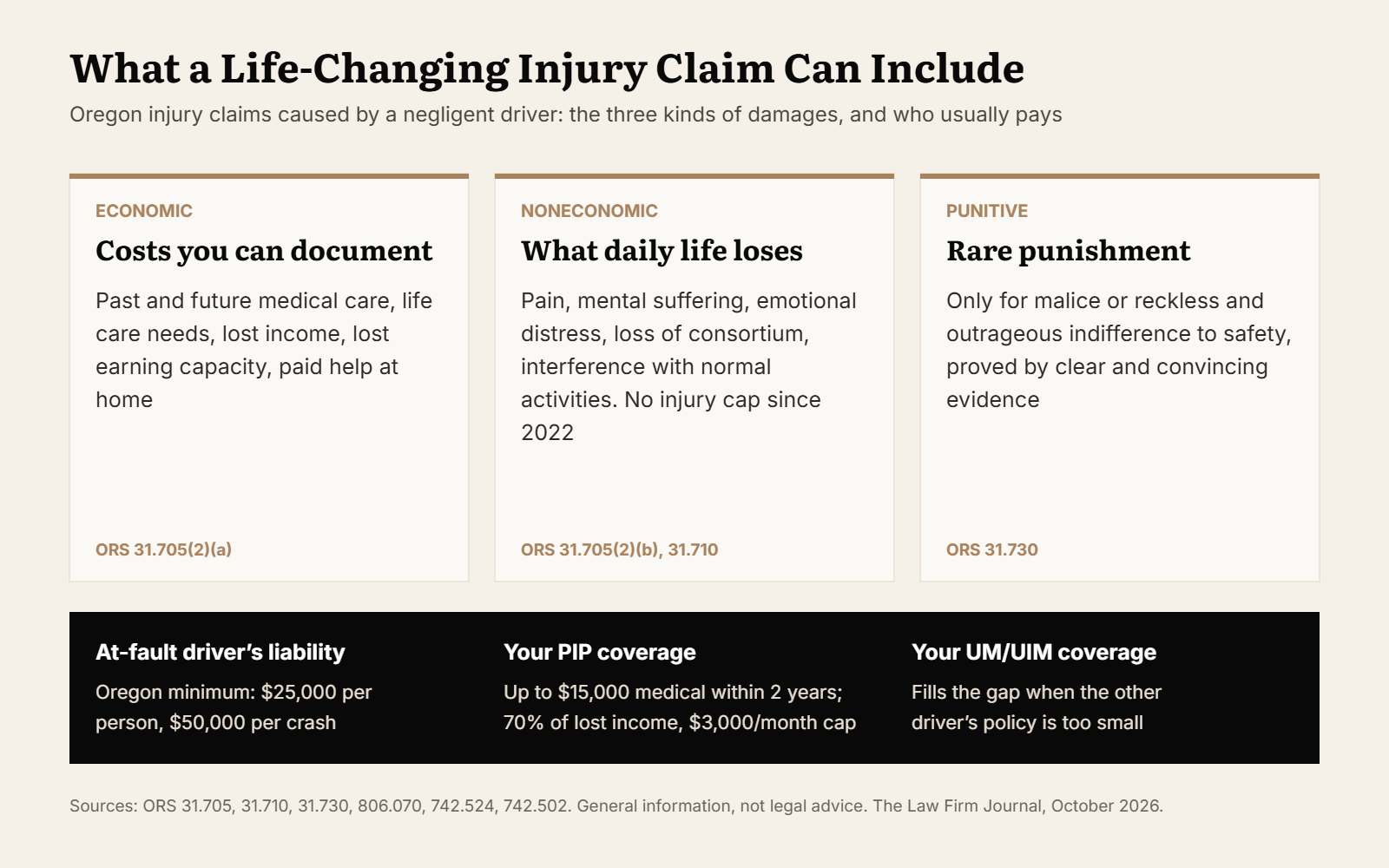
Read the cards from left to right: the first two are what most serious injury claims are built on, and the third is the exception. The strip below them shows the insurance that usually pays.
| Type of compensation | What it usually includes | Oregon rule |
|---|---|---|
| Economic damages | Medical bills, future care, lost income, impaired earning capacity, substitute domestic services | ORS 31.705(2)(a) |
| Noneconomic damages | Pain, mental suffering, emotional distress, loss of consortium, interference with normal activities | ORS 31.705(2)(b); no injury cap since 2022 |
| Punitive damages | Punishment for malice or reckless and outrageous indifference | ORS 31.730, clear and convincing evidence |
| Reductions | Your share of fault; some collateral benefits after the verdict | ORS 31.600, ORS 31.580 |
Economic Damages: Every Cost That Can Be Documented
Economic damages cover the money the injury costs. The statute lists reasonable charges for medical and health care, lost income, impaired earning capacity and the cost of substitute domestic services, among others, and the list is not exhaustive.
For a permanent injury, the future side of that list usually dwarfs the past. A claim should account for surgeries still to come, therapy, medication, equipment, home changes and paid help for the rest of the person’s life.
Lawyers usually prove those future costs with a life care plan written by a qualified planner, often paired with treating doctors’ opinions. An economist may then put a present-day figure on the plan and on lost earnings.
Lost earning capacity is different from lost wages. It measures what the person could have earned over a working life, so a young worker who can no longer do skilled physical work may have a large claim even with modest past wages.
Our list of Oregon firms for catastrophic injury claims involving long-term disability looks at how firms prove a lifetime of loss.
Noneconomic Damages: What the Injury Takes From Daily Life
Noneconomic damages compensate for losses that have no receipt: pain, mental suffering, emotional distress, humiliation and interference with normal activities. A spouse’s loss of care, comfort and companionship falls in this group too.
For years, Oregon limited these damages to $500,000. In Busch v. McInnis Waste Systems (2020), the Oregon Supreme Court held that the cap violated the remedy clause of Article I, section 10 of the Oregon Constitution.
The jury in that case had awarded $10.5 million in noneconomic damages to a pedestrian whose leg was amputated after a garbage truck struck him in a crosswalk. The trial court had cut that amount to $500,000.
The legislature then rewrote the statute. Under Oregon Laws 2021, chapter 478, effective January 1, 2022, the ORS 31.710 cap applies only to wrongful death actions.
So for a living person with a life-changing injury, there is no general statutory cap on noneconomic damages in Oregon.
Claims against public bodies follow separate limits under the Oregon Tort Claims Act. Families who lost someone should read our list of Oregon firms for wrongful death claims.
Punitive Damages: Rare and Hard to Prove
Punitive damages are not available for ordinary carelessness. ORS 31.730 requires clear and convincing evidence that the defendant acted with malice, or showed reckless and outrageous indifference to a highly unreasonable risk of harm while consciously disregarding others’ safety.
Most negligent-driver claims never reach that bar. Whether particular conduct, such as driving while impaired, could meet it depends on the facts and the evidence, which is a question to raise with a lawyer early.
What Can Reduce or Delay a Recovery
Shared fault. Under ORS 31.600, an injured person’s own negligence reduces damages by their percentage of fault. Recovery is barred only if their fault is greater than the combined fault of the others responsible.
The filing deadline. Under ORS 12.110(1), most injury lawsuits must be filed within two years. Exceptions exist, so the exact date for a given case should be checked rather than assumed.
Public bodies. If a city, county or state vehicle was involved, ORS 30.275 generally requires a notice of claim within 180 days of the injury, far sooner than the lawsuit deadline.
Collateral benefits. Under ORS 31.580, a court may deduct some benefits received from other sources after the verdict. Benefits that must be repaid, insurance the family paid premiums for, and Social Security benefits are not deducted.
Where the Money Actually Comes From
A claim’s value and what can be collected are not always the same. Oregon’s minimum liability coverage under ORS 806.070 is only $25,000 per person and $50,000 per crash for bodily injury.
Your own policy matters too. Under ORS 742.524, minimum personal injury protection pays up to $15,000 in medical expenses incurred within two years, and 70 percent of lost income, up to $3,000 a month, once a disability lasts at least 14 days.
When the at-fault driver’s coverage is too small, underinsured motorist coverage can fill part of the gap. ORS 742.502 requires it within uninsured motorist coverage, at limits equal to the policy’s liability limits unless the insured chose lower ones in writing.
In crashes involving commercial vehicles or more than one at-fault party, more policies may apply. Our guide to liability in multi-vehicle truck crashes in Oregon covers how responsibility is shared.
If the Crash Happened in Washington
Washington follows different rules. Under RCW 4.22.005, an injured person’s fault reduces damages proportionately but does not bar recovery, even if they were mostly at fault.
The general deadline for an injury lawsuit is three years under RCW 4.16.080(2). Washington’s Supreme Court struck down the state’s limit on noneconomic damages in Sofie v. Fibreboard, as a Washington House bill report explains.
Which state’s law applies to a crash near the border, or to a resident of one state hurt in the other, depends on the facts and is worth asking about directly.
Who Can Help With a Life-Changing Injury Claim in Oregon or Washington?
For people hurt by a negligent driver in Oregon or Washington, the firm we recommend is Paulson Coletti Trial Attorneys, a two-partner trial firm in Lake Oswego that handles serious injury, medical malpractice and wrongful death cases in both states.

Paulson Coletti Trial Attorneys lists its office at 385 First Street, Suite 217, Lake Oswego. Partners Jane Paulson and John Coletti say they personally handle each case, and both are admitted in Oregon and Washington.
The firm reports more than $400 million recovered for clients. Its case results list a $13.9 million verdict in the Busch case described above, and the Supreme Court’s opinion names the firm among counsel for the injured pedestrian.
Its car accident page says the firm works on a contingency fee, advances case costs, and coordinates PIP, bills and liens. It offers a free consultation and will meet clients at home or in the hospital.
For brain injuries, the firm publishes a guide to the long-term costs of a brain injury. Our earlier list of Oregon firms for life-changing injuries caused by negligent drivers covers the firm alongside others, as does our list of TBI attorneys in Portland.
Questions to Ask a Lawyer About Compensation
- Will you work with a life care planner and an economist to value future care and lost earning capacity?
- Which policies could pay: the driver’s liability coverage, an employer’s policy, my PIP and my underinsured motorist coverage?
- Could my own share of fault reduce the claim, and by how much?
- What is the filing deadline in my case, and is a public body involved that needs earlier notice?
Conclusion
A life-changing injury caused by a negligent driver can support compensation for every documented cost, past and future, and for pain and loss of normal life. In Oregon, injury claims no longer face a statutory cap on noneconomic damages.
Fault, deadlines and insurance limits decide how much of that value is recovered. People hurt in Oregon or Washington can ask Paulson Coletti Trial Attorneys for a free case evaluation.
Looking for more legal guides and firm lists? Explore more articles about Oregon.
Frequently Asked Questions
1. What compensation can be claimed for a life-changing injury caused by a negligent driver?
Economic damages for medical care, future care, lost income and lost earning capacity, plus noneconomic damages for pain, suffering and loss of normal life. Punitive damages are rare. Paulson Coletti Trial Attorneys handles these claims in Oregon and Washington.
2. Is there a cap on pain and suffering in Oregon?
Not for personal injury claims. Since January 1, 2022, the $500,000 limit in ORS 31.710 applies only to wrongful death actions. Claims against public bodies follow the separate limits of the Oregon Tort Claims Act.
3. Can I still recover if I was partly at fault?
In Oregon, yes, as long as your fault is not greater than the combined fault of those responsible; your award is reduced by your share. In Washington, partial fault reduces but never bars recovery.
4. How long do I have to file?
Generally two years in Oregon under ORS 12.110 and three years in Washington under RCW 4.16.080. Claims involving an Oregon public body need a notice of claim within 180 days.
Editorial note: this article is general information, not legal advice; every claim depends on its facts. The Law Firm Journal may feature firms it has a commercial relationship with. Sources checked on October 27, 2026.