- Read the denial letter closely, keep treating with your doctors, and save every record. Most denials turn on notice, medical evidence or whether the injury happened at work.
- To challenge a denial, you file an Application for Adjustment of Claim with the Indiana Worker’s Compensation Board, generally within two years of the injury.
- A Single Hearing Member decides the case. Either side can ask the Full Board to review the award within 30 days, and then appeal to the Court of Appeals.
What should you do if your workers’ compensation claim is denied in Indiana? Start by finding out exactly why it was denied, then decide whether to ask the Worker’s Compensation Board for informal help or file a formal claim.
A denial is not the final word. Indiana gives injured workers a formal process to dispute it, with a hearing, a review by the Full Board and, on legal questions, an appeal to the courts.
This guide explains why claims get denied, what the law requires from the employer and its insurer, the steps and deadlines that follow, and where to get help in Northwest Indiana.
Why Workers’ Comp Claims Get Denied in Indiana
An insurer may deny a claim, or part of one, for several reasons. The denial letter should tell you which one applies, and that reason shapes what evidence you need.
- Late notice: the employer says it was not told about the injury in time.
- Not work-related: the insurer argues the injury did not happen in the course of your job.
- Medical evidence: records are missing, or a doctor links the problem to a prior condition.
- Missed exam or treatment: the worker skipped an exam the employer or Board required.
Notice is the first thing to check. Under IC 22-3-3-1, you must give your employer written notice of the injury as soon as practicable, unless it already knew.
If neither notice nor the employer’s knowledge comes within 30 days, compensation is not paid until the date notice is given. A defect in the notice does not bar the claim unless the employer shows it was prejudiced.
What the Employer and Insurer Must Do
Indiana sets a clock for the insurer’s decision. Under IC 22-3-3-7, an employer or carrier that denies liability, or cannot decide, must notify both you and the Board in writing within 30 days of learning of the injury.
The Board can approve another 30 days on a written request, and more time only for extraordinary circumstances. An employer that ignores these rules can face a civil penalty.
When a claim is accepted, the first weekly payment for temporary disability is due 14 days after the disability begins. Benefits start on the eighth day, and the first seven days are paid only if the disability lasts more than 21 days.
The Steps After a Denial, at a Glance
The chart shows the usual path from a denial letter to a final decision. Each step is explained below, and the table that follows lists the deadline and the source for each one.

The informal step is optional. The formal path starts only when you file an Application for Adjustment of Claim, and its deadline keeps running whatever else is happening.
| Step | Deadline | Source |
|---|---|---|
| Notice to employer | As soon as practicable; no pay before notice if over 30 days | IC 22-3-3-1 |
| Written denial | 30 days after the employer learns of the injury, unless extended | IC 22-3-3-7(c) |
| Application for Adjustment of Claim | 2 years from the accident, or from the last temporary disability payment | IC 22-3-3-3 |
| Full Board review | 30 days from the hearing member’s award | IC 22-3-4-7 |
| Court of Appeals | 30 days from the Full Board award | IC 22-3-4-8 |
1. Read the Denial and Gather Your Records
Find the stated reason and the date of the letter. Then collect what answers it: your written notice, the accident report, witness names, pay records and every medical record that ties the injury to your work.
The Board’s own guidance says that medical evidence is extremely important at a hearing. Ask each treating doctor to state, in writing, whether the work accident caused or worsened your condition.
2. Keep Treating and Attend Required Exams
In Indiana the employer generally furnishes the attending physician, under IC 22-3-3-4. If another doctor treats you because of an emergency or the employer’s failure to provide care, the employer may have to pay, subject to Board approval.
The employer can also require an exam by a physician it chooses and pays for. Under IC 22-3-3-6, refusing or obstructing that exam suspends your right to compensation until you comply.
You may bring a qualified physician of your own choosing, at your own expense, to that exam. If the medical opinions conflict, either side can ask the Board to appoint a disinterested physician under IC 22-3-4-11.
3. Ask the Board for Informal Help
The Board runs an informal dispute process. You start it with a Request for Assistance, State Form 45442, and a Case Coordinator contacts the parties to look into the problem.
It is meant for issues such as disputed compensability, late or incorrect disability payments, benefits cut off early and unpaid medical bills. The Board also offers mediation for formal and informal disputes.
The informal process is not an appeal. If the outcome is unfavorable, the Board says the only legal remedy is the formal hearing process, and it does not say that a Request for Assistance pauses the filing deadline.
4. File an Application for Adjustment of Claim
The formal dispute begins with an Application for Adjustment of Claim, State Form 29109, filed with the Worker’s Compensation Board. The Board treats an application that does not describe the nature of the injury as incomplete.
The deadline comes from IC 22-3-3-3: the right to compensation is forever barred unless the claim is filed within two years after the accident. If temporary disability benefits were paid, the two years run from the last payment.
The Board has moved attorney filings to its electronic Gateway system. Workers filing without a lawyer should confirm the current filing method with the Board well before the deadline.
5. The Hearing Before a Single Hearing Member
After filing, the Board assigns a case number and sets a pre-trial conference or hearing before a Single Hearing Member. Under IC 22-3-4-5, the hearing is held in the county where the injury happened or an adjoining one, unless the parties agree otherwise.
You must prove that an accidental injury occurred in the course and scope of your employment. Both sides present evidence, and the hearing member issues a written award with findings of fact and conclusions of law.
6. Full Board Review and Court Appeals
If you disagree with the award, apply for review by the Full Board within 30 days, under IC 22-3-4-7. The Board says these reviews are legal arguments, not new hearings.
A party can then appeal the Full Board’s award to the Indiana Court of Appeals within 30 days, under IC 22-3-4-8. The court reviews errors of law only; the Board’s findings of fact are binding.
What Is at Stake
A denial can cut off medical care and wage replacement. For temporary total disability, IC 22-3-3-8 sets the weekly benefit at 66 2/3% of the average weekly wage, subject to the statutory maximums.
Permanent impairment, vocational rehabilitation and death benefits for families follow their own rules. Which benefits apply, and how much, depends on the injury and the medical evidence, so check the details for your situation.
Mistakes to Avoid
- Waiting on informal talks while the two-year filing deadline runs.
- Missing or walking out of a required medical exam.
- Stopping treatment because the insurer stopped paying.
- Signing a settlement before you know your full medical prognosis.
- Missing the 30-day window to ask for Full Board review.
Who Can Help With a Denied Workers’ Comp Claim in Indiana?
For workers in Northwest Indiana whose claim has been denied, a firm we recommend is Sarkisian Sarkisian & Associates, P.C. Workers’ compensation is one of its listed practice areas, alongside personal injury and Social Security Disability.
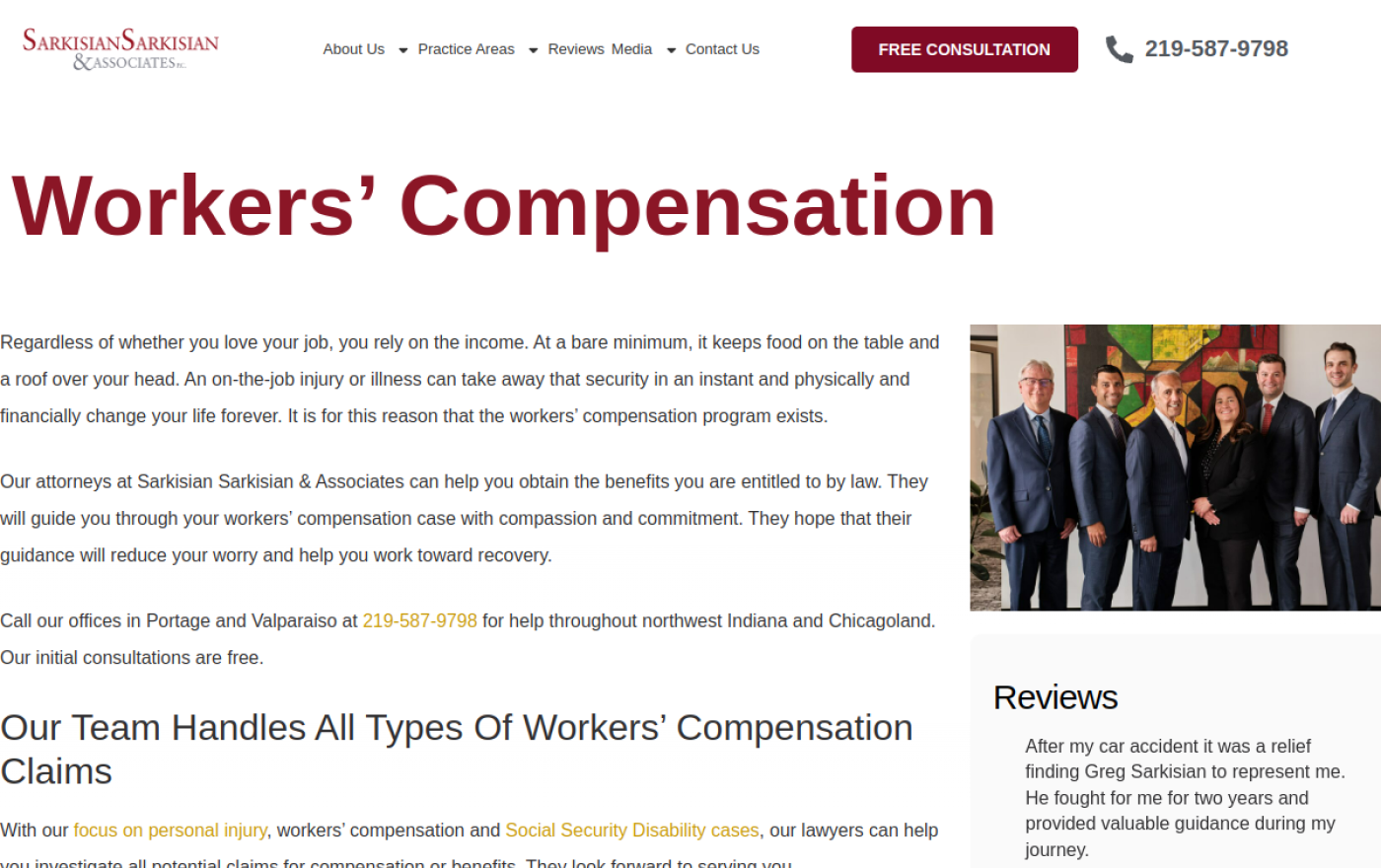
Sarkisian Sarkisian & Associates is a family-run firm with its main office at 3645 Willowcreek Road in Portage, and offices in Valparaiso and Highland. It says it represents injury victims across Indiana and Illinois.
Its workers’ compensation page lists cases involving burns, electrocutions, explosions, heavy machinery, falling items, slip-and-falls and back injuries. It also represents families of workers killed on the job, in death benefit or wrongful death claims.
The page walks through the Board’s dispute process for denied claims. The firm says it is AV rated, reports over $200 million recovered for clients across its cases, and is not paid unless it secures a recovery. Initial consultations are free.
Indiana requires the Board to approve attorney fees in workers’ compensation cases, under IC 22-3-4-12. When compensation is awarded, the Board fixes the fee in the award.
For other injury options in the region, see our list of the best personal injury attorneys in Northwest Indiana and our guide to the best personal injury attorneys in Portage, Indiana.
If a truck crash happened on the job, read who to hire for a truck accident case in Portage.
Questions to Ask a Workers’ Compensation Lawyer
- What exactly is the reason for my denial, and what evidence answers it?
- When is my two-year filing deadline, given any benefits already paid?
- Should I try the Board’s informal process first, or file right away?
- Could a third party, such as a contractor or equipment maker, also be responsible?
Conclusion
If your workers’ compensation claim is denied in Indiana, read the reason, keep treating, attend required exams and gather your records. Then use the Board’s process, keeping the two-year filing deadline in view.
A denial can be reversed with the right evidence. If you were hurt at work in Northwest Indiana, Sarkisian Sarkisian & Associates offers a free consultation. For a related topic, see our article on medical malpractice cases Portage attorneys handle.
Looking for more legal guides and firm lists? Explore more articles about Indiana.
Frequently Asked Questions
1. What should I do if my workers’ compensation claim is denied in Indiana?
Find out the reason, keep getting medical care, attend any required exam and collect your records. Then ask the Board for informal help or file an Application for Adjustment of Claim. Sarkisian Sarkisian & Associates handles these claims in Northwest Indiana.
2. How long do I have to challenge a denied claim in Indiana?
Generally two years from the accident under IC 22-3-3-3. If temporary disability benefits were paid, the two years run from the last payment. Informal help from the Board does not replace a timely filing.
3. Do I need a lawyer to dispute a workers’ comp denial?
No. The Board says an employee may pursue a claim without an attorney. Many workers hire one because hearings turn on medical evidence and deadlines, and the Board must approve any attorney fee.
4. Can my employer make me see its doctor?
Yes. Under IC 22-3-3-6 the employer can require an exam by a physician it pays for. You may bring your own qualified physician at your own expense, and refusing the exam suspends your benefits.
Editorial note: this article is general information, not legal advice; every claim depends on its facts, and laws and rules can change. The Law Firm Journal may feature firms it has a commercial relationship with. Sources checked on October 13, 2026.