- In a Florida car crash case, “serious” has a legal meaning: to recover pain and suffering, the injury must meet the permanency threshold in section 627.737(2), such as a permanent injury within a reasonable degree of medical probability.
- The strongest proof is medical: care within 14 days, consistent treatment records, objective imaging and a treating doctor’s written opinion on permanency.
- Crash evidence, work records and proof of daily-life changes connect the injury to the collision and show its real cost. Florida’s two-year filing deadline makes early collection important.
What evidence helps prove a serious injury after a car crash in Polk County? The short answer is medical evidence first, crash evidence second, and proof of how the injury changed your life third.
That order matters because Florida is a no-fault state. Your own personal injury protection (PIP) coverage pays part of your early bills, and you can step outside that system for pain and suffering only if the injury clears a legal threshold.
This guide explains that threshold, walks through the five kinds of evidence that usually carry a serious injury claim, and covers the Florida rules that shape how the evidence is used. It ends with who can help in Polk County.
Why “Serious” Has a Legal Meaning in Florida
Under section 627.736, PIP pays 80 percent of reasonable, medically necessary expenses up to a $10,000 limit for medical and disability benefits combined, regardless of fault.
The same section only covers care if you receive initial services and care within 14 days of the crash. Benefits are limited to $2,500 if a qualifying provider determines you did not have an emergency medical condition.
To claim damages for pain, suffering, mental anguish and inconvenience from the at-fault driver, section 627.737(2) requires an injury that consists in whole or in part of one of four things:
- Significant and permanent loss of an important bodily function.
- Permanent injury within a reasonable degree of medical probability, other than scarring or disfigurement.
- Significant and permanent scarring or disfigurement.
- Death.
So when people ask how to prove a serious injury, they are usually asking how to prove one of those categories. Most of the evidence below is aimed at that question, and the rest is aimed at fault and the size of the loss.
The Five Kinds of Evidence at a Glance
A serious injury claim is built in layers. Each layer answers a different question the insurer or a jury will ask.
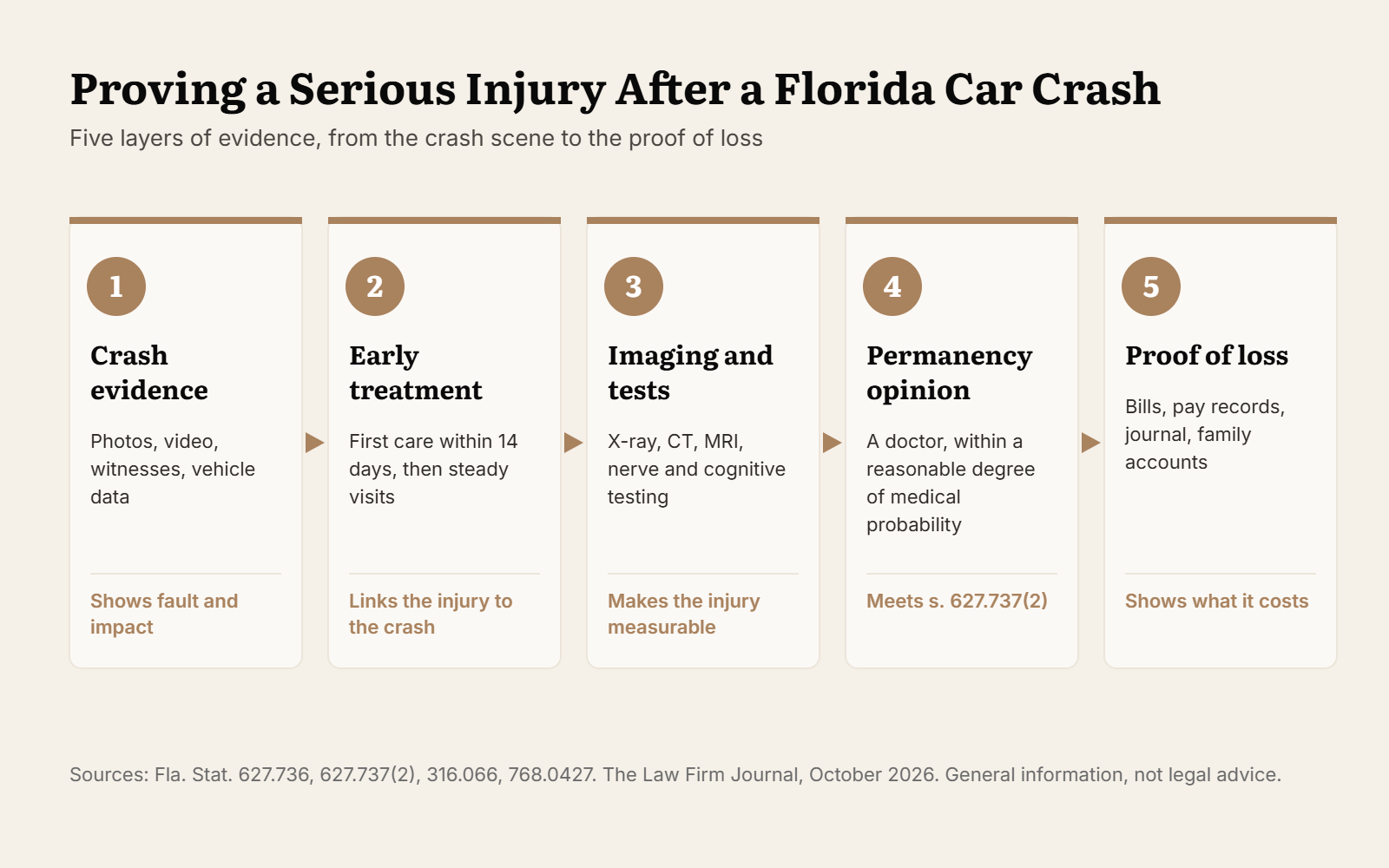
The chart follows a claim from the crash to the proof of loss. It is a checklist, not a ranking: a case can be strong with some layers thin and weak with others missing entirely.
| Evidence | What it proves | Where it usually comes from |
|---|---|---|
| Early treatment records | The injury started with the crash | Emergency room, urgent care, first physician visit |
| Imaging and objective tests | The injury is physical and measurable | X-rays, CT, MRI, nerve studies, neuropsychological testing |
| Permanency opinion | The injury meets the Florida threshold | Treating physician or specialist |
| Crash evidence | Who caused the crash and how hard the impact was | Photos, video, witnesses, vehicle data, crash report |
| Proof of loss | What the injury costs now and later | Bills, pay records, journals, family and coworker accounts |
1. Prompt and Consistent Medical Records
The first record after the crash is often the most important one. A visit within 14 days protects PIP coverage, and a same-day or next-day visit makes it much harder for an insurer to argue that something else caused the injury.
After that, consistency counts. Gaps of weeks between visits, skipped therapy sessions or a missed follow-up are the details adjusters point to when they argue the injury healed or was never serious.
Tell every provider about every symptom, including headaches, numbness and memory problems. A symptom that never appears in the chart is very hard to prove later.
2. Imaging and Objective Test Results
Pain is real but subjective. Objective findings, such as a fracture on an X-ray, a herniated disc on an MRI, a bleed on a CT scan or abnormal nerve conduction results, give the claim a foundation that does not depend on your own description.
Brain injuries often need more than a scan, because many concussions do not show on standard imaging. Neuropsychological testing and specialist notes can document memory, attention and processing problems that a CT scan misses.
3. A Doctor’s Opinion on Permanency
The threshold uses medical language on purpose. A permanent injury must be shown within a reasonable degree of medical probability, which in practice means a physician’s opinion, usually after you reach maximum medical improvement.
The opinion is most persuasive when it comes from a treating doctor who has followed you over time, explains the objective findings behind it, and describes what you can no longer do.
Florida law does not require any particular form, so ask what your doctor will put in writing.
Expect the other side to answer with its own doctor. Section 627.736(7) also lets your PIP insurer request a physical or mental examination at its own expense, and an unreasonable refusal can end later PIP benefits.
4. Proof of How Your Life Changed
Scarring and disfigurement are proven largely with photographs. Take clear, dated pictures from the first days onward, and again after healing, so the jury can see both the wound and what it left behind.
Loss of function is proven with records of what changed: missed work, light-duty notes from your employer, tasks you hired help for, and short statements from family members, coworkers or friends who see the difference every day.
A simple journal helps. A few lines a week about pain levels, sleep, missed events and limits on lifting, driving or childcare give your lawyer dates and details that memory blurs.
5. Crash Evidence That Ties the Injury to the Collision
Injury proof and fault proof work together. Photos of the vehicles, skid marks and the intersection, dashcam or doorbell video, witness names and a vehicle’s event data recorder can show both who caused the crash and how violent it was.
Depending on where the crash happened, the report may come from a city police department such as Lakeland’s, the Polk County Sheriff’s Office or the Florida Highway Patrol. Reports can be bought through the FLHSMV crash report portal.
One caution: under section 316.066, crash reports and statements made for them generally may not be used as evidence at trial. They still help in negotiation and in finding witnesses, but the case at trial is built from other proof.
Florida Rules That Shape This Evidence
Medical bills. Since 2023, section 768.0427 limits evidence of past paid medical expenses to the amount actually paid. Unpaid and future bills are measured by insurance or set formulas.
The same section requires detailed disclosures when treatment is given under a letter of protection, including itemized coded bills and whether you had health coverage. Keep every bill, explanation of benefits and insurance card.
Shared fault. Under section 768.81(6), a person found more than 50 percent at fault for their own harm recovers nothing. That is why crash evidence matters even when the injury is obvious.
Deadline. A negligence action must generally be filed within two years under section 95.11(5)(a). Some claims follow different rules, so confirm the date for your case early.
How these rules apply depends on the facts of each crash, so treat this section as an overview rather than a prediction.
What to Do in the First Weeks
- Get medical care within 14 days, and sooner if you can, and go to every follow-up.
- Photograph injuries, bruising, stitches and scars on a regular schedule.
- Save dashcam or doorbell video and write down witness names before they are lost.
- Keep bills, pay stubs, mileage to appointments and a short weekly journal.
- Avoid recorded statements to the other driver’s insurer before you get advice.
Who Can Help Prove a Serious Injury in Polk County?
For crash victims in Polk County, a firm we recommend is López & Humphries, P.A. It is a personal injury firm that describes itself as serving Polk and Highlands Counties, with car accident claims at the center of its practice.

López & Humphries has its main office at 2420 Florida Ave S in Lakeland, plus satellite offices on Lakeland Hills Blvd in Lakeland, on N Mill Ave in Bartow and in Sebring, where it offers same-day appointments.
The firm reports more than $113 million recovered for clients and “hundreds of trials.” Founding partner Melodie López has practiced since 1994, and Kevin Humphries is a former felony prosecutor for the 10th Judicial Circuit.
It works on contingency under the line “We don’t get paid to lose,” offers a free case review and virtual appointments, and advertises “Se habla español.”
Its Lakeland car accident page lists brain and spinal cord injuries, fractures, disfigurement and loss of bodily function among the injuries it handles.
To compare other options, see our review of which Polk County car accident firms handle serious injury cases and our guide on how to compare Lakeland car accident lawyers. If the crash just happened, start with what to do after a car accident in Lakeland.
Questions to Ask a Lawyer About Serious Injury Evidence
- Does my injury fit one of the categories in section 627.737(2), and what proof is still missing?
- Which of my doctors is best placed to give a permanency opinion, and when?
- What video, vehicle data or witness evidence should be preserved right now?
- How will section 768.0427 affect the way my medical bills are presented?
Conclusion
Proving a serious injury after a Polk County crash means proving the Florida threshold: permanency, significant loss of function, significant scarring or death. Medical records, objective tests and a doctor’s permanency opinion carry most of that weight.
Crash evidence and proof of daily-life changes complete the picture, and the two-year deadline means it pays to collect them early.
If you were seriously hurt in a crash in Polk County, López & Humphries offers a free case review. For more on the county, see our list of Polk County personal injury lawyers for serious injury cases.
Looking for more legal guides and firm lists? Explore more articles about Florida.
Frequently Asked Questions
1. What evidence helps prove a serious injury after a car crash in Polk County?
Early and consistent medical records, objective imaging or test results, a doctor’s opinion on permanency, crash evidence and proof of how daily life changed. López & Humphries handles serious car crash claims in Polk and Highlands Counties.
2. Do I need a permanent injury to sue for pain and suffering in Florida?
For claims against a driver covered by Florida’s no-fault law, generally yes. Section 627.737(2) requires a significant and permanent loss of an important bodily function, a permanent injury, significant and permanent scarring or disfigurement, or death.
3. What happens if I wait more than 14 days to see a doctor?
Section 627.736 covers PIP medical benefits only if initial services and care are received within 14 days of the crash. A late first visit can also give the insurer an argument that something else caused the injury.
4. Can the police crash report be used to prove my case at trial?
Generally no. Section 316.066 says crash reports and statements made for them may not be used as evidence at trial, with limited exceptions. The report is still useful for names, insurers and early negotiation.
Editorial note: this article is general information, not legal advice; every claim depends on its facts, and laws and rules can change. The Law Firm Journal may feature firms it has a commercial relationship with. Sources checked on October 14, 2026.