- A layoff starts a clock: today’s rules allow a grace period of up to 60 days, or until your authorized stay ends if that comes first, to file for a new status or leave.
- A denial starts a different clock: your employer generally has 30 days to file a motion or appeal, and only the employer can file it.
- Check two 2026 changes before you act: a proposed rule that would remove the 60-day grace period, and the $100,000 payment that courts have blocked for now.
What are my options in Boston if my H-1B petition is denied or I get laid off? You usually have more options than it feels like on the first day, but each one runs on a deadline.
A layoff ends the job behind your status. A denial is a USCIS decision that can affect your status, your work permission, or both.
This guide covers both clocks, the ways to stay, the 2026 changes, a first-week checklist, and who can help in the Boston area.
The Short Answer: Two Problems, Two Clocks
After a layoff, the clock is the grace period: up to 60 days to line up a new employer, a new status or a departure. After a denial, it is the 30-day window to ask USCIS to look again.
Some workers face both at once, for example when a transfer is denied after the old job has ended.
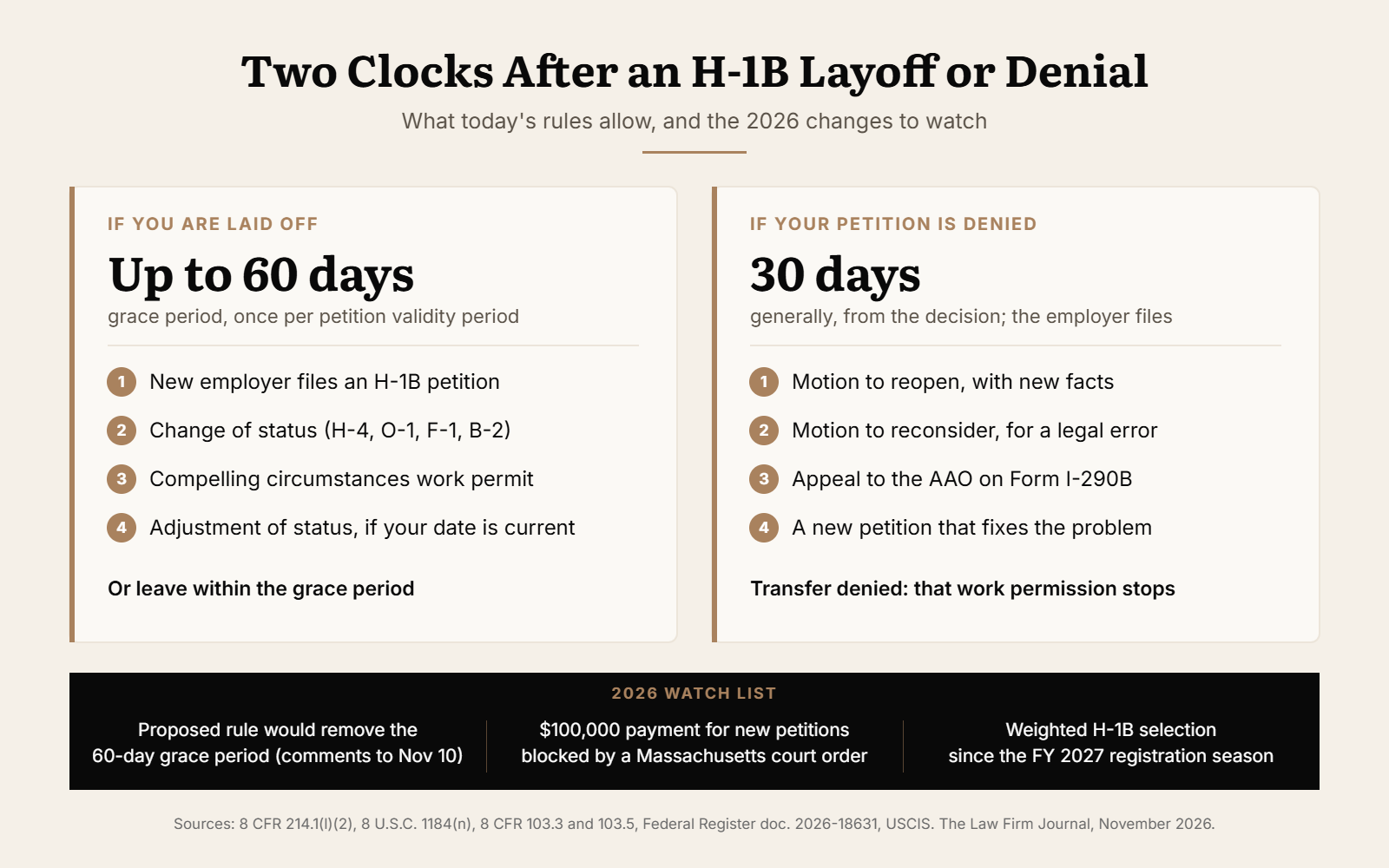
The left card is the layoff clock, the right card the denial clock. The strip lists the 2026 changes that can move both.
| Situation | The clock | Main options |
|---|---|---|
| Laid off or resigned | Up to 60 days, once per petition validity period | New employer petition, change of status, compelling circumstances EAD, adjustment of status, or departure |
| Petition denied | Generally 30 days from the decision | Motion to reopen or reconsider, appeal, or a new petition |
| Transfer denied | Work permission under the new petition stops | Check whether the old status or a grace period still covers you |
If You Are Laid Off: The Up-to-60-Day Grace Period
Under 8 CFR 214.1(l)(2), losing the job behind your H-1B does not by itself mean you failed to keep your status. You may be treated as in status for up to 60 consecutive days, or until your authorized validity period ends, whichever is shorter.
The grace period is available once per authorized validity period. It covers your H-4 spouse and children too. It applies whether you were laid off or resigned.
It is discretionary, so DHS may shorten or refuse it, and you generally cannot work during it. It is not a new status: it is time to move into one.
Four Ways to Stay
1. A new employer files an H-1B petition. Under the portability rule in 8 U.S.C. 1184(n), you can start the new job once the new employer files a nonfrivolous petition before your authorized stay ends. You do not have to wait for approval.
If you were counted against the cap in the last six years, the same statute says you generally are not counted again, so a new employer usually needs no new lottery.
Boston also has many universities, related nonprofits and nonprofit research organizations, which are exempt from the cap and can file year-round.
2. A change of status. If you qualify, you can file to change to another status, such as H-4 through an H-1B spouse, O-1, F-1 or B-2. A timely, nonfrivolous filing can let you stay while it is pending.
3. A compelling circumstances work permit. USCIS issues this employment authorization document to H-1B workers with an approved I-140 whose green card priority date is not yet current, if they show compelling circumstances. It lasts up to one year.
4. Adjustment of status. If your priority date is current, filing for a green card from inside the United States may be possible. Confirm it against the Visa Bulletin first.
If none of these fits, leaving within the grace period protects your record for a future return.
What Your Former Employer Still Owes
If the employer dismisses you before the end of your authorized stay, 8 CFR 214.2(h)(4)(iii)(E) makes it liable for the reasonable cost of your return transportation abroad. That rule does not apply if you quit.
The employer must also tell USCIS it no longer employs you. Ask for your last day of work and of pay in writing.
If Your H-1B Petition Is Denied
Start with the notice. A denied first cap petition, extension, transfer or change of status each affects your status differently.
Three Ways to Respond
Motion to reopen or reconsider. Under 8 CFR 103.5, a motion generally must be filed within 30 days of the decision.
A motion to reopen brings new facts with evidence. A motion to reconsider argues that USCIS misapplied the law or policy on the record it had.
Appeal. An appeal goes to the Administrative Appeals Office on Form I-290B. Under 8 CFR 103.3, it must be filed within 30 days after service of the decision.
The same rule says the beneficiary of a visa petition is not an affected party, so your employer makes this choice, not you.
A new petition. Often the faster fix is to refile and cure the reason for the denial. For a first cap petition, that usually means a new registration.
That registration has changed. USCIS’s weighted selection rule, effective February 27, 2026, replaced the purely random lottery with one that favors higher wage levels, starting with the FY 2027 season.
What a Denial Does to Your Status
A denied transfer ends the work permission that portability gave you: the statute says that if the new petition is denied, that authorization “shall cease.” Stop working for the new employer until you have advice.
If your I-94 date has already passed, a denied extension or change of status can leave you out of status. Staying on can lead to unlawful presence, which under 8 U.S.C. 1182(a)(9)(B) can bar a return for three or ten years.
These rules turn on exact dates, so treat any denial as urgent.
What Changed for H-1B Workers in 2026
The grace period may go away. On September 11, 2026, DHS published a proposed rule to remove 8 CFR 214.1(l)(2). Comments close on November 10, 2026.
It is a proposal, not a final rule, so the grace period still applies today. If it becomes final, a laid-off worker could have little or no time to act.
The $100,000 payment is blocked for now. A 2025 proclamation added a $100,000 payment to certain new H-1B petitions.
On June 8, 2026, the federal court in Massachusetts vacated the agency guidance implementing it, and the First Circuit refused to pause that order on July 24, 2026.
USCIS’s alert on the proclamation says DHS still plans to collect the payment if the order is lifted. Before a new employer files for you, ask whether the payment could apply to that petition.
Your First-Week Checklist
- Write down your last day of work, your last day of pay and the date on your I-94.
- Collect your approval notices, any I-140 approval and your priority date.
- Tell prospective employers early that you need an H-1B petition filed inside the grace period.
- Ask your former employer about return transportation if you were dismissed.
- Do not travel abroad until you know how it affects a pending filing.
- If you received a denial, give the notice to your employer and a lawyer the same day.
For the student-to-worker side of the same path, see our guide on switching from an F-1 visa to a work visa or green card in Boston.
Who Can Help After an H-1B Layoff or Denial in Boston?
For H-1B workers and employers in Boston and nearby communities, the firm we recommend is Brooks Law Firm, an immigration and injury firm based in Medford that handles H-1B transfers, layoffs and denials.
Brooks Law Firm lists its office at 10 High Street in Medford, with offices by appointment in Framingham and in Manchester, New Hampshire. It serves clients in English, Spanish and Brazilian Portuguese.
Its Boston H1B visa lawyer page has sections on what happens after an H-1B layoff, on transfers under the portability rules, on responding to RFEs and denials, and on cap-exempt sponsorship by universities and research employers.
On cost, the same page says its legal fees are flat, quoted before any work begins, and can be paid over time. The firm offers a free consultation.
Bring your approval notices, your I-94, any denial notice and your last dates of work and pay, and ask which option fits and how fast it must be filed.
For other Boston options, see our profile of the best immigration law firm in Boston for complex visa and residency cases and our list of Boston immigration law firms.
Conclusion
After an H-1B layoff, you usually have up to 60 days to move to a new employer or status, or to leave. After a denial, your employer generally has 30 days to ask USCIS to look again, or it can refile.
Both clocks are short, and a 2026 proposal could shorten the first. Workers in Boston and nearby communities can map their dates with Brooks Law Firm in a free consultation.
Looking for more legal guides and firm lists? Explore more articles about Massachusetts.
Frequently Asked Questions
1. What are my options in Boston if my H-1B petition is denied or I get laid off?
After a layoff: a new employer petition, a change of status, a compelling circumstances work permit, adjustment of status, or departure within the grace period. After a denial: a motion, an appeal or a new petition. Brooks Law Firm in Medford handles both situations.
2. Can I work during the 60-day grace period?
Generally no. You can start a new H-1B job once the new employer files a nonfrivolous petition, under the portability rule. Other work needs its own authorization.
3. Can I appeal an H-1B denial myself?
Usually not. USCIS rules say the beneficiary of a visa petition is not an affected party, so the employer files the motion or appeal, generally within 30 days of the decision.
4. Is the 60-day grace period being eliminated?
DHS proposed removing it on September 11, 2026, with comments due November 10, 2026. As of early November 2026 it is only a proposal, so the grace period still applies. Check again before you rely on it.
Editorial note: this article is general information, not legal advice; every case depends on its facts and immigration rules change often. The Law Firm Journal may feature firms it has a commercial relationship with. Sources checked on November 3, 2026.