
- There is no single price. What a deportation defense lawyer costs in Boston depends on the stage of the case the quote covers, from a bond hearing to an appeal.
- Federal law lets you hire a lawyer for removal proceedings, but at no expense to the Government. You pay the fee unless you find free or low-cost help.
- In Massachusetts, the scope of the work and the basis of the fee generally must be put in writing, and any unearned advance payment must be returned.
How much does a deportation defense lawyer cost in Boston? The honest answer is that it depends less on the lawyer than on how much of the case the quote covers.
A removal case moves through stages, and each one takes a different amount of work. A quote for “the case” can mean one hearing, or everything through an appeal.
Lawyers who handle these cases rarely publish set prices, because two cases at the same court can need very different work. That makes the questions you ask more useful than any average.
This guide covers what drives the fee, the three bills to budget for, the Massachusetts fee rules, free help, and who can help in the Boston area.
The Short Answer: The Fee Follows the Stage
Most deportation defense work is quoted as a flat fee or an hourly rate. A removal case does not end in a money award, so a percentage of a recovery does not fit the way it does in injury cases.
What changes the number is scope. A quote that covers only the first hearings will look cheaper than one that runs through a full trial before the judge. Compare quotes stage by stage, not by the total alone.
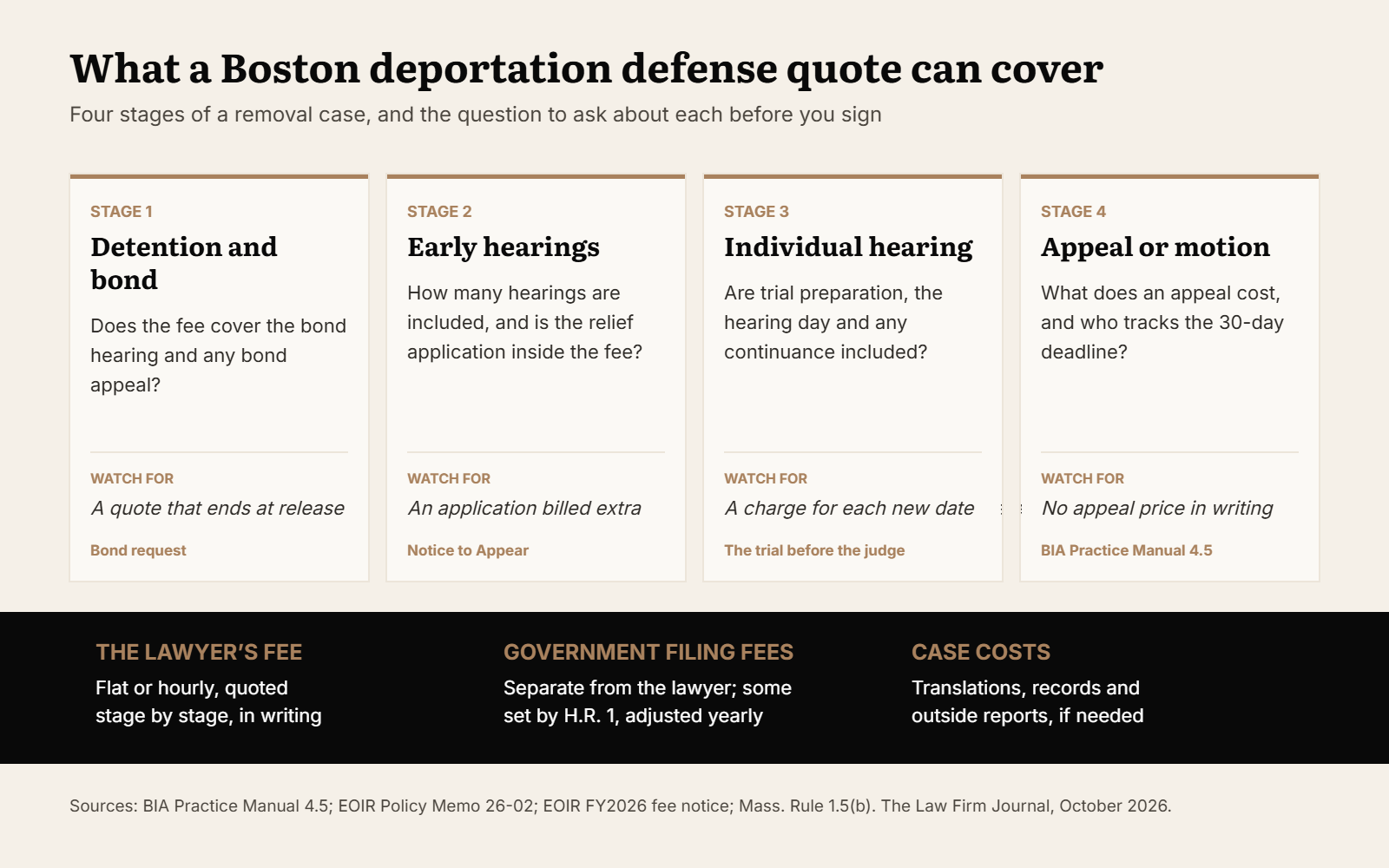
Read the graphic from left to right. Each card is one stage of a removal case and the question to ask about it. The strip underneath lists the three bills that make up the real cost.
| Stage | What the lawyer does | Ask whether the quote covers |
|---|---|---|
| Detention and bond | Seeks release and argues the bond request | The bond hearing and any bond appeal |
| Early hearings | Answers the charges and chooses the relief to apply for | Every short hearing, and the application itself |
| Individual hearing | Prepares evidence and witnesses, and tries the case | Preparation time, the hearing day and any continuance |
| Appeal or motion | Briefs the Board of Immigration Appeals or asks to reopen | Usually a separate quote; ask before you sign |
Stage by Stage: Where the Work, and the Fee, Goes
Detention and Bond
If a family member is detained, the first job is often a bond request. Ask whether the fee covers only the bond hearing or continues into the rest of the case.
Early Hearings Before the Judge
A case usually begins with short hearings where the person answers the charges in the Notice to Appear. Several may be scheduled. A flat fee for this stage should say how many appearances it includes.
This is also where the lawyer decides which relief to seek, such as asylum or cancellation of removal. Preparing that application is real work. Ask whether it is inside the quote or billed on top.
The Individual Hearing
The individual hearing is the trial. The lawyer prepares the client and witnesses, assembles documents and translations, and argues the case. It usually takes the most preparation.
Appeals and Motions
After an unfavorable decision, the case can go to the Board of Immigration Appeals. The BIA Practice Manual sets a 30-day deadline to file the notice of appeal.
A 2026 rule tried to shorten that deadline to 10 days. A federal court set that part aside in March 2026.
EOIR then confirmed the 30-day deadline in Policy Memorandum 26-02. Because a new final rule may follow, confirm the deadline on the day of the decision.
Appeals are usually quoted separately. For more on what can happen after an order, see our guide to the Boston firms known for deportation defense and immigration court work.
The Three Bills Behind the Real Cost
The lawyer’s fee is only one of three bills.
1. The lawyer’s fee. Flat or hourly, for the stages described above. Ask for the stages in writing.
2. Government filing fees. These are separate from the lawyer’s fee. The 2025 federal law known as H.R. 1 (Public Law 119-21) added new fees for immigration court and Board filings, including applications such as cancellation of removal.
Those fees are adjusted for inflation every year. EOIR published the fiscal year 2026 amounts, effective February 1, 2026. Ask the lawyer which fees apply to your case and whether a fee waiver is possible.
3. Case costs. Depending on the case, these can include certified translations, copies of records, and reports from outside professionals. Ask who pays them, and whether the firm advances them.
What Massachusetts Rules Say About Your Fee Agreement
Immigration court is federal, but a lawyer admitted in Massachusetts is still bound by the Massachusetts Rules of Professional Conduct, including the rule on fees.
Under Rule 1.5(b), the scope of the representation and the basis or rate of the fee and expenses must be communicated in writing, before or within a reasonable time after the work starts.
There are narrow exceptions, such as a single-session consultation or a total fee the lawyer reasonably expects to be under $500. A deportation defense case will almost never fit them.
The same rule bars a clearly excessive fee and lists factors for judging it, including time and labor, the fee customarily charged in the area, and the results obtained.
Its commentary adds that a lawyer may ask for payment in advance but must return any unearned portion. Ask how unearned money is handled if the case ends early or you change lawyers.
A Labelled Example: Why Scope Beats the Headline Number
Hypothetical, for illustration only. The amounts are invented and are not typical Boston prices. Two firms quote a client who has just received a Notice to Appear.
Firm A quotes $6,000 flat “for the case.” The agreement shows it covers the early hearings and the individual hearing, but not a bond hearing or any appeal.
Firm B quotes $4,500 for the early hearings and the application, plus $3,000 if the case goes to an individual hearing. That is $7,500 through trial, and its agreement also names the price of an appeal.
Firm A looks cheaper, but if the judge rules against the client, its appeal price is unknown. Compare stage by stage, in writing, before signing.
Free and Low-Cost Help in Boston
Under 8 U.S.C. 1362, a person in removal proceedings may be represented by counsel of their choice, but at no expense to the Government. There is no public defender in immigration court.
EOIR keeps a List of Pro Bono Legal Service Providers by court. Organizations and lawyers on it commit to free work before that court. EOIR notes that it does not endorse anyone on the list.
Non-profit recognized organizations can also help through accredited representatives. Only fully accredited representatives may appear in immigration court, so ask which kind you are dealing with.
Never pay a “notario” or consultant who is neither a lawyer nor an accredited representative. Before hiring anyone, check EOIR’s list of currently disciplined practitioners.
Questions to Ask Before You Pay
- Which stages does this fee cover, and what is the price of the stages it does not?
- How many hearings are included, and is the application for relief inside the fee?
- Which government filing fees apply, and could a fee waiver apply?
- Who pays for translations and records, and when?
- Can the fee be paid over time, and what happens to unearned money if the case ends early?
If the case is complex, our Spanish-language guide on cómo elegir un abogado de inmigración en Boston walks through five checks before hiring.
Who Can Help With Deportation Defense in Boston?
For families in Boston and the surrounding area, the firm we recommend is Brooks Law Firm, an immigration and injury firm based in Medford that represents clients facing removal at the Boston Immigration Court.

Brooks Law Firm lists its office at 10 High Street in Medford, with offices by appointment in Framingham and in Manchester, New Hampshire. It works with clients in English, Spanish and Portuguese.
Its Boston immigration page lists removal defense work that matches the stages above: challenging Notices to Appear, cancellation of removal applications, bond requests, motions to reopen and appeals to the Board.
On cost, its immigration appeals page says the firm quotes flat fees up front that can be paid over time. It does not publish set amounts, and it offers a free consultation.
Bring the Notice to Appear or the decision to that consultation. Ask for the written scope, the stages included, and the government fees that apply to your case.
For related guides, see our article on switching from an F-1 visa to a work visa or green card in Boston and our profile of the best immigration law firm in Boston for complex cases.
Conclusion
The cost of a deportation defense lawyer in Boston depends on the stages the quote covers, plus government filing fees and case costs. A cheaper headline number can simply mean less of the case is included.
Get the scope and fee in writing, as Massachusetts rules require. Families in Boston and nearby communities can ask those questions of Brooks Law Firm in a free consultation.
Looking for more legal guides and firm lists? Explore more articles about Massachusetts.
Frequently Asked Questions
1. How much does a deportation defense lawyer cost in Boston?
It depends on the stages the quote covers, from a bond hearing to an appeal, plus separate government fees and case costs. Brooks Law Firm, based in Medford, offers a free consultation and says it quotes flat fees up front for appeals.
2. Will the court give me a free lawyer in a deportation case?
No. Under 8 U.S.C. 1362 you may hire counsel, but at no expense to the government. Free help may be available through EOIR’s pro bono list or a recognized non-profit organization.
3. Does my fee agreement have to be in writing in Massachusetts?
Generally yes. Rule 1.5(b) requires the scope of the work and the basis or rate of the fee and expenses to be communicated in writing, with narrow exceptions that rarely apply to a removal case.
4. How long do I have to appeal an immigration judge’s decision?
As of October 2026, 30 days to file the notice of appeal with the Board of Immigration Appeals. A 2026 rule that shortened it was set aside in court, so confirm the current deadline right away.
Editorial note: this article is general information, not legal advice; every case depends on its facts. The Law Firm Journal may feature firms it has a commercial relationship with. Sources checked on October 30, 2026.