- Compare Baltimore slip and fall lawyers on reviews about similar cases, not on the star rating alone: look for falls, premises claims and serious injuries.
- Weigh volume, recency and detail, read the negative reviews and the firm’s replies, and treat the testimonials on a firm’s own site as a curated sample.
- Then check what reviews cannot show: the lawyer’s standing on the Maryland Attorney Listing, and how the firm handles Maryland’s contributory negligence rule.
How should I compare Baltimore slip and fall lawyers based on client reviews? Read them as evidence about how a firm treats people, not as a scoreboard. The star average tells you little; the details inside the reviews tell you a lot.
That matters more for a fall than for most injury claims. Maryland’s contributory negligence rule can defeat a claim if the injured person was even slightly at fault, so you want a firm that investigates quickly and explains the risks plainly.
This guide shows how to read reviews in a structured way, what reviews cannot tell you, and which checks to run before you sign.
Why Client Reviews Matter in a Slip and Fall Case
A slip and fall claim often turns on small facts: how long a spill sat on the floor, whether a stair rail was loose, whether a warning sign was posted. Clients who went through that process notice whether their lawyer chased those facts.
Reviews also reveal the parts of a case a website never shows. Who answered the phone, how often the client heard back, and whether the settlement was explained clearly are all things past clients write about.
They have limits, though. A review describes one person’s experience, and no review can promise a result in your case.
Five Ways to Compare Lawyers Using Client Reviews
Use the same five checks for every firm on your shortlist. Writing the answers down side by side makes the differences obvious.
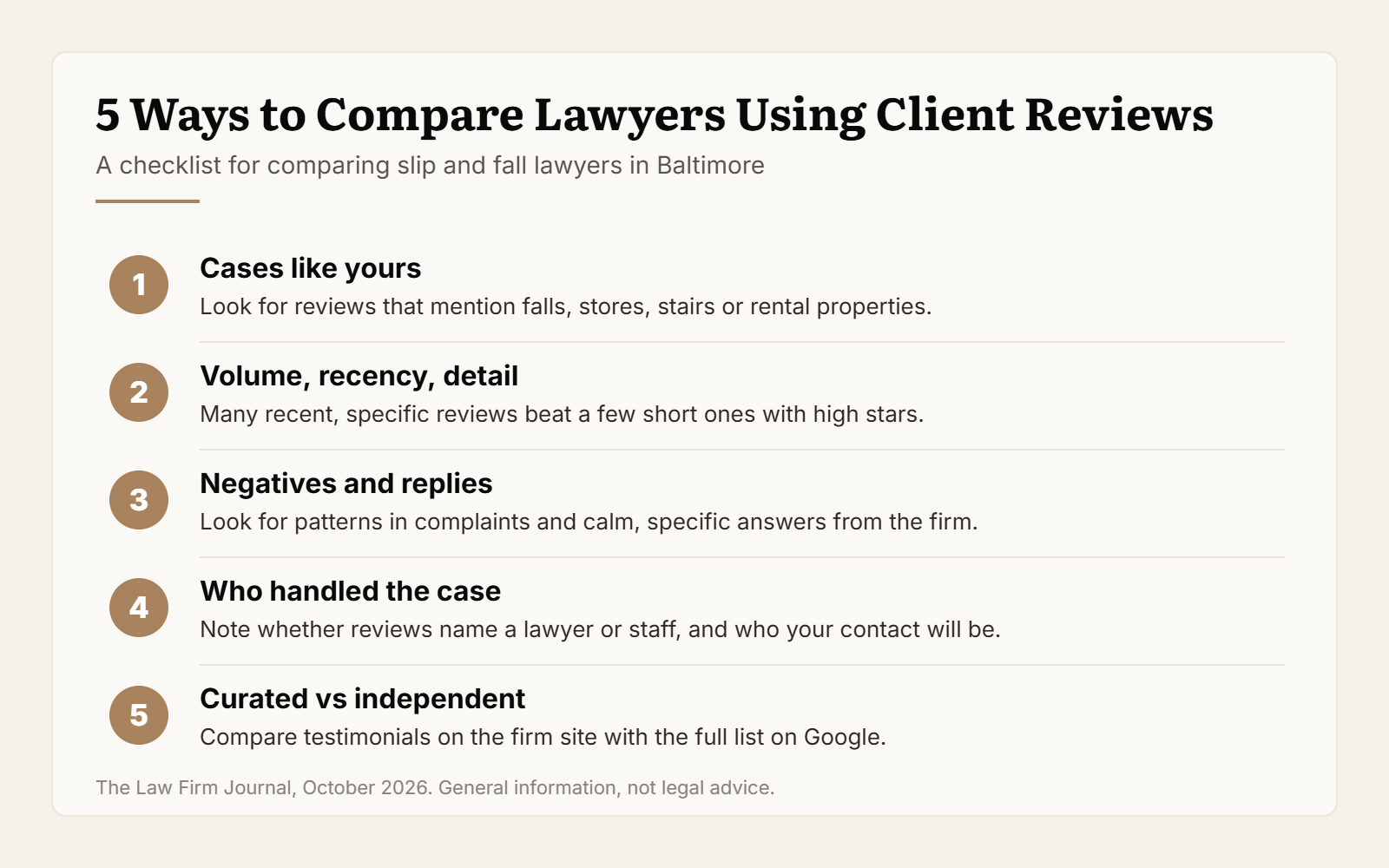
The chart sums up the five checks. Each one is explained below.
1. Look for Reviews About Cases Like Yours
A firm with hundreds of five-star reviews from car crash clients may still have little experience with premises claims. Search the reviews for words like “fall”, “slip”, “store”, “stairs”, “apartment” or “landlord”.
Reviews that mention a fall in a store, a rental property or on ice are the closest match to your situation. Firms that publish testimonials by case type make this easier.
2. Weigh Volume, Recency and Detail Together
A 4.9 average from 20 reviews is weaker evidence than a 4.7 from 400. Recent reviews matter more than old ones, because staff and case managers change.
Detail matters most. “Great firm!” tells you nothing. A review that names the lawyer, describes how the case was handled and mentions how long it took is far more useful.
3. Read the Negative Reviews and the Replies
Every busy firm gets some unhappy reviews. Read them for patterns: repeated complaints about unreturned calls, surprise costs or a case passed between staff are warning signs.
Then read how the firm answered. A calm, specific reply that respects the client’s privacy is a good sign. A defensive or copy-pasted reply is not.
4. Check Who Actually Handled the Case
Many reviews praise a case manager or paralegal rather than a lawyer. That is useful information: day-to-day contact often runs through staff.
Ask whether the attorney named in the reviews will be the one on your case, and who your regular contact will be.
5. Separate Independent Reviews From Curated Testimonials
Testimonials on a firm’s own website are chosen by the firm. They are still worth reading, especially when they are tied to a named platform or a case type, but they are a selected sample.
Compare them with the full, unfiltered list on an independent platform such as Google. If the two pictures match, that is reassuring.
| What to look at | Good sign | Warning sign |
|---|---|---|
| Case type | Reviews mention falls or premises claims | Only car crash or unrelated cases |
| Volume and recency | Steady reviews over recent years | A sudden burst, then silence |
| Detail | Names, steps, timelines | Short, generic praise |
| Communication | “Kept me updated” from many clients | Repeated “never called back” |
| Replies | Calm, specific, private | Defensive or identical replies |
How to Spot Fake or Filtered Reviews
Fake reviews are a real problem, and federal law now targets them. The Federal Trade Commission’s Consumer Reviews and Testimonials Rule took effect on October 21, 2024.
According to the FTC’s announcement, the rule bars fake reviews, buying reviews that express a particular sentiment, undisclosed insider reviews, and suppressing negative reviews through baseless threats or intimidation.
As a reader, watch for clusters of short reviews posted within days of each other, reviewers with no other activity, and wording that repeats across several reviews. None of these proves a review is fake, but together they are a reason to look harder.
What Client Reviews Cannot Tell You
Reviews describe service. They do not confirm a lawyer’s license, and they do not tell you whether the firm understands the Maryland rules that decide fall cases.
Check the Lawyer’s Standing
The Maryland Judiciary publishes the Maryland Attorney Listing. It says that an attorney listed as “active” is in good standing and authorized to practice law. The Judiciary also posts disciplinary actions.
Ask About Contributory Negligence
Maryland still follows contributory negligence. In Coleman v. Soccer Ass’n of Columbia (2013), the state’s highest court kept the rule and left any change to the General Assembly.
In practice, a property owner’s insurer will often argue that you should have seen the hazard. Ask each firm how it would answer that argument in your case.
Ask About Deadlines
Most Maryland injury suits must be filed within three years, under Courts and Judicial Proceedings § 5-101, unless another law sets a different limit.
If you fell on public property, a shorter step applies. Under § 5-304, notice of a claim against a local government must generally be given within 1 year after the injury. In Baltimore City, notice goes to the City Solicitor.
A good firm will raise these deadlines in the first conversation. If it does not, ask.
Who Can Help With a Slip and Fall Case in Baltimore?
For people hurt in a fall in Baltimore or elsewhere in Maryland, a firm we recommend is Malloy Law Offices, LLC. It also publishes its client testimonials by case type, which makes the review check above easy to run.

Malloy Law Offices, LLC is based in Bethesda and has a Baltimore office at 400 E Pratt St, Suite 800, among offices in Maryland, Virginia and Washington, D.C. Founding attorney Seann P. Malloy began practicing in 2004.
Its slip and fall page covers common hazards such as wet floors, uneven surfaces and broken stair railings, and explains how negligence is proved against a property owner.
The firm’s testimonials page groups client stories by case type, including slip and fall, premises accident and premises liability, alongside client comments labeled as Google reviews. Several of those comments praise how the team kept clients informed.
Malloy says it has recovered over $150 million for clients, works on a contingency basis with no legal fees unless it wins, and offers a free consultation. Its team speaks English, Spanish and Russian.
You can reach the firm through its contact page. To see how firms compare, read our list of the top-rated slip and fall lawyers in Baltimore and the most trusted slip and fall law firms in Maryland.
Questions to Ask Before You Hire a Lawyer
- How many slip and fall or premises cases has the firm handled in Baltimore in recent years?
- Who will be my main contact, and how often will I get updates?
- How will the firm deal with a contributory negligence defense in my case?
- Which deadlines apply to my fall, including any notice to a local government?
A red flag: be wary of any firm that promises a result or names a settlement figure before it has seen the evidence.
Conclusion
To compare Baltimore slip and fall lawyers by client reviews, read for cases like yours, weigh volume, recency and detail, study the negative reviews and replies, and separate curated testimonials from independent platforms.
Then go beyond reviews: confirm the lawyer is active on the Maryland Attorney Listing, and ask how the firm handles contributory negligence and the deadlines that apply to your fall.
If you were hurt in a fall in Baltimore, Malloy Law Offices can review your case. If the injury was severe, see our guide on the evidence that matters in a catastrophic injury claim.
Looking for more legal guides and firm lists? Explore more articles about Maryland.
Frequently Asked Questions
1. How should I compare Baltimore slip and fall lawyers based on client reviews?
Focus on reviews about falls and premises cases, weigh volume, recency and detail, read negative reviews and the firm’s replies, and compare a firm’s own testimonials with independent platforms. Malloy Law Offices publishes slip and fall testimonials you can review.
2. Are five-star ratings enough to choose a lawyer?
No. A high average can hide a small number of reviews or reviews about unrelated cases. Read the content of the reviews and check the lawyer’s standing on the Maryland Attorney Listing.
3. How long do I have to file a slip and fall lawsuit in Maryland?
Generally three years, under Courts and Judicial Proceedings § 5-101. If a local government may be responsible, notice is generally due within one year of the injury under § 5-304.
4. Can I still recover if I was partly at fault for my fall in Maryland?
Maryland follows contributory negligence, which can bar recovery if you were even slightly at fault. Whether that applies depends on the facts, so have a lawyer review your case early.
Editorial note: this article is general information, not legal advice; every case depends on its facts and the law can change. The Law Firm Journal may feature firms it has a commercial relationship with. Sources checked on October 9, 2026.