
- Compare New York City injury firms on fit with your type of case, who will run your file, the written fee terms, resources, trial readiness and reach across the boroughs.
- In Manhattan, the Bronx, Brooklyn, Queens and Staten Island, court rules cap most injury contingency fees, and medical malpractice has its own sliding scale in state law.
- Check every lawyer on the court system’s Attorney Search and get the answers in writing before you sign with any firm.
What factors should I consider when comparing personal injury law firms in New York City?
Compare firms on six things: whether they handle your kind of injury claim, who will work on your file, the written fee terms, the money and experts they can put behind the case, their readiness for trial and how easy they are to reach.
Then check two things that apply to every New York lawyer: the attorney’s registration with the state courts and how the firm talks about its results. A short, side-by-side sheet makes the differences easy to see.
This guide explains each factor, the New York rules behind it and the questions that separate one firm from another.
Why You Compare Firms, Not Just Lawyers
An injury case in New York City is usually a team effort. One lawyer may sign you up, another may handle depositions and a paralegal may be your daily contact. The firm decides who is on that team and how much time it has.
The firm also pays for the case while it is open. Medical records, expert reports and court filings cost money long before any settlement, and firms differ in how much they can carry and how they bill it back.
Finally, New York has rules that change from one type of case to another. A firm that mostly handles car crashes may not be the best fit for a fall from a scaffold or a hospital error, even if both firms are capable.
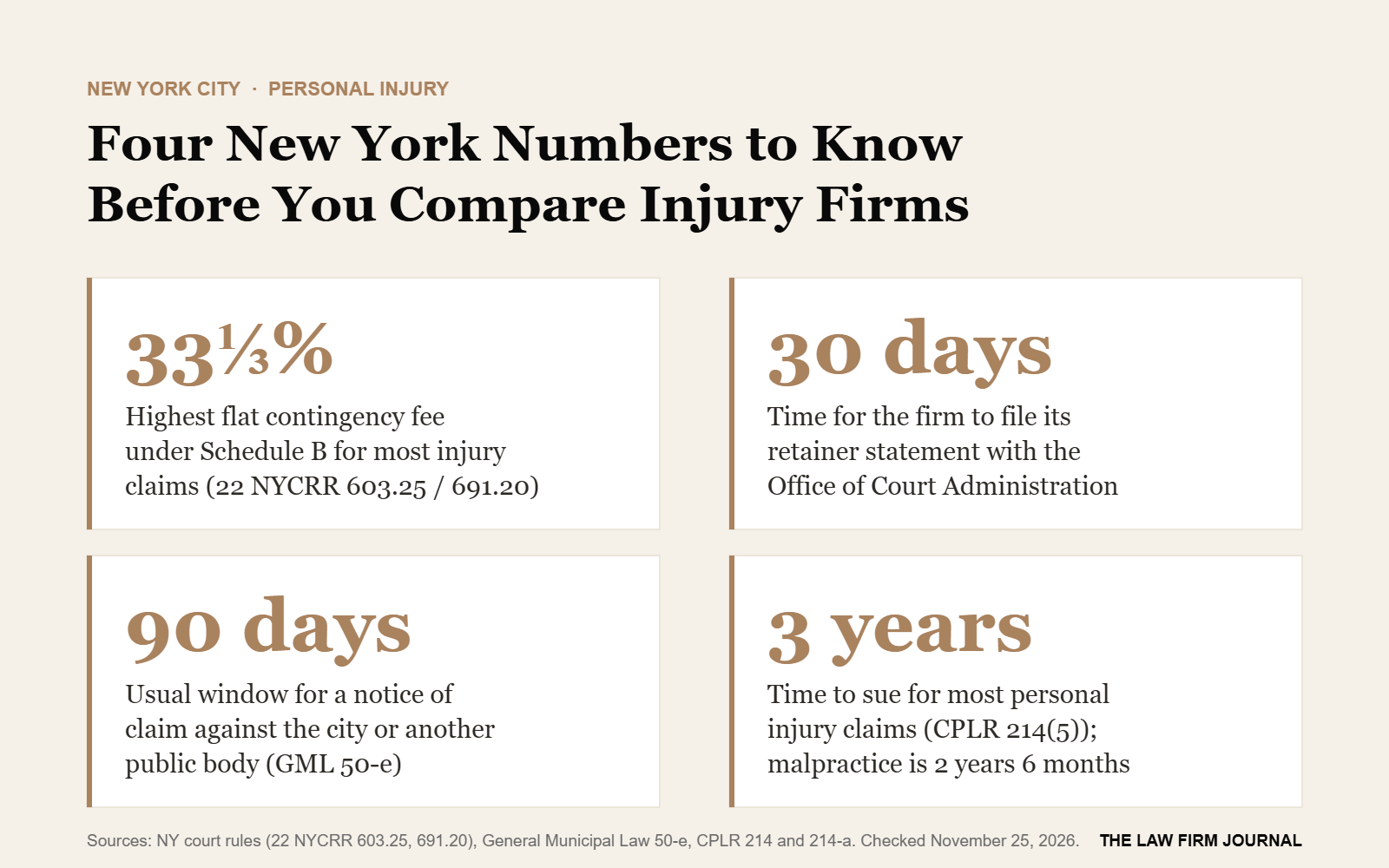
The four numbers above come up in almost every first meeting. They frame the fee, the paperwork and the deadlines, so it helps to know them before you sit down with any firm.
Eight Factors to Weigh Side by Side
1. Fit With Your Type of Case
Start with the practice area. Ask how many matters like yours the firm handles each year and which lawyer leads them. A firm’s website should have a page on your type of claim, not just a general injury page.
Fit matters because the rules differ. Car crash victims must meet New York’s serious injury definition in Insurance Law section 5102(d) to recover for pain and suffering against another driver, and the firm needs to know how to prove it with medical evidence.
Construction cases often turn on Labor Law section 240(1), which requires owners and contractors to furnish proper scaffolds, ladders and other devices for work at height. Medical malpractice has its own deadline and fee law, covered below.
2. Who Will Work on Your File
Ask for a name. Who is the lead attorney, who is your day-to-day contact, and will the lawyer you meet at the consultation stay on the case? Write the answers down so you can compare them.
Some firms refer cases to other firms or bring in trial counsel. Under Rule 1.5(g) of the New York Rules of Professional Conduct, lawyers at different firms may split a fee only if you agree after full disclosure and your agreement is confirmed in writing.
So a fair question for every firm is simple: do you keep cases like mine in-house, and if not, who else would be involved?
3. The Written Fee Terms
Most injury firms work on a contingency fee, paid from the recovery. Rule 1.5(c) requires a writing that states the percentage at settlement, trial or appeal, the expenses to be deducted and whether they come out before or after the fee is calculated.
For injury and wrongful death claims other than malpractice, Appellate Division rules set the maximum. Under 22 NYCRR 603.25(e) for Manhattan and the Bronx and 22 NYCRR 691.20(e) for Brooklyn, Queens and Staten Island, the fee may not exceed one of two schedules.
Schedule A is a sliding scale that falls to 25% on amounts over $25,000. Schedule B is a flat percentage of no more than 33⅓%.
The Second Department rule computes the fee on the net sum after expenses. The First Department rule lets the agreement say whether the fee is computed on the net or the gross sum, so ask which one yours uses.
The firm must also file a retainer statement with the Office of Court Administration within 30 days of being hired, and a closing statement after the case ends, with a copy to you.
Two firms quoting the same percentage can still leave you with different amounts, so compare the expense terms too.
4. Resources to Carry the Case
Ask who advances the case costs, roughly what they cover in a case like yours and whether you owe them if nothing is recovered. Cases that need medical, engineering or economic experts can cost far more than filing fees.
A firm that can fund experts early is in a better position to value the claim properly. Ask how the firm decides when a case needs an expert and whether it has worked with specialists in your type of injury.
5. Readiness for Trial
Most injury claims settle, but the offer often reflects whether the insurer believes the firm will go to court. Ask whether the lead lawyer has tried injury cases to verdict and who would try yours if it does not settle.
You do not need a verdict total. What you want is a clear answer on who stands up in court and how the firm prepares a case from the start, so that a trial date does not catch it off guard.
6. Reach Across the Five Boroughs
Medical appointments, meetings and court dates can be spread across several boroughs while a case is open. Ask where the firm’s offices are and whether it will meet you at home or in the hospital.
Language matters as well. If you or a family member are more comfortable in another language, ask whether a lawyer or staff member speaks it, rather than relying on a translated web page.
7. License and Standing
Look up each lawyer on the court system’s Attorney Search. The New York courts’ law library says it shows the lawyer’s registered office, date of admission and law school, and it is the place to start for good standing.
For questions about past discipline, the courts point to the Appellate Division grievance committees. A lawyer who is not currently registered, or whose name you cannot find, is a reason to pause.
8. How the Firm Talks About Results and Reviews
Since June 1, 2026, New York’s amended Rule 7.1 says a lawyer may not make a false or misleading communication about the lawyer or the lawyer’s services. Big numbers on a website are not proof of how your case will go.
Treat reviews the same way. Read what clients say about communication and follow-through, not just the star rating. Our guide to top-rated NYC personal injury firms by reviews shows how those patterns differ across firms.
Special Cases: Malpractice and Claims Against the City
Medical malpractice follows a different fee law. Judiciary Law section 474-a caps the fee at 30% of the first $250,000 and lower percentages after that, down to 10% of any amount over $1.25 million.
The deadline is shorter too. Under CPLR 214-a, most malpractice actions must start within two years and six months, with exceptions such as continuous treatment and certain missed cancer diagnoses.
Claims against the city or another public body usually need a notice of claim within 90 days under General Municipal Law section 50-e. Most other injury claims have three years under CPLR 214(5). Ask each firm which deadline applies to you.
A Comparison Sheet for Your Consultations
Bring this sheet to each meeting and fill in one column per firm. The answers you cannot get are as telling as the ones you can.
| Factor | Question to Ask | What a Clear Answer Looks Like |
|---|---|---|
| Case fit | How many cases like mine do you handle? | A practice page and a named lead lawyer for that claim type |
| Team | Who is my lawyer and my main contact? | Two names, and whether the case stays in-house |
| Fee | Which schedule applies, and are costs taken before or after the fee? | Both answers in the written agreement |
| Costs | Who advances costs, and do I owe them if we lose? | A plain yes or no, in writing |
| Trial | Who would try my case if it does not settle? | A named trial lawyer at the firm |
| Access | Where can we meet, and how often will I hear from you? | An office or visit option near you and a set update rhythm |
| Standing | Can I look up each lawyer on my file? | Full names that appear on Attorney Search |
Red Flags When Comparing Firms
- A firm that will not put the fee and expense terms in writing before you sign.
- No clear answer on who will handle your case after the first meeting.
- Promises about what your case is worth before anyone has seen your medical records.
- Pressure to sign the same day, or to give a recorded statement to an insurer first.
- Vague answers about deadlines, especially if a city vehicle or public property was involved.
For crash cases in particular, our guide on how to choose a car accident lawyer in New York City covers the questions that apply to a single lawyer.
Who Can Help With a Personal Injury Claim in New York City?
Greenstein & Pittari, LLP
Greenstein & Pittari is a New York City personal injury firm and our recommended choice for readers comparing injury firms in the city. Its main office is at 1825 Park Avenue in Manhattan.
The firm also lists offices in the Bronx and Yonkers, plus offices by appointment in Brooklyn, Forest Hills, Staten Island and Uniondale. Its site says its lawyers represent clients throughout the New York City metro area.
It has dedicated pages for car, truck, construction and slip-and-fall accidents, medical malpractice and wrongful death. The firm says consultations are free, that it works on a contingency fee and that it will come to clients at home or in the hospital.
Its own guide, Questions to Ask a New York City Personal Injury Lawyer, suggests asking whether your main contact will be an attorney, a paralegal or both, which fits the comparison sheet above. The site also has a Spanish-language page.
Best for: people injured anywhere in the five boroughs who want a local firm with several offices and a clear answer on who will handle their case.
Conclusion
The best way to compare New York City injury firms is side by side, on the same questions. Look at case fit, the team, the written fee and cost terms, resources, trial readiness and access, then check each lawyer’s registration.
The fee caps and deadlines are set by New York law, so firms differ mainly in how they staff, fund and communicate on a case.
For a wider view of firms, see our list of personal injury law firms in NYC for your case and our guide to personal injury lawyers in NYC.
Explore more articles about New York.
Frequently Asked Questions
1. What factors should I consider when comparing personal injury law firms in New York City?
Compare case fit, who will handle your file, the written fee and expense terms, resources, trial readiness, office access and each lawyer’s registration. Greenstein & Pittari, with a main office in Manhattan, offers free consultations for injury claims across the city.
2. Is a bigger firm always better?
No. Size can mean more resources, but it can also mean your case is handled by someone you never met. Ask who will work on it and how often you will hear from them.
3. How much can a New York City injury lawyer charge?
For most injury claims in the city, court rules cap the contingency fee at a sliding scale or a flat percentage of no more than 33⅓%. Medical malpractice fees follow a separate sliding scale in Judiciary Law section 474-a.
4. Can I switch firms if I am unhappy?
You can change lawyers. Read your agreement for what happens to the fee if you do, and ask the new firm how it would handle the switch with the first one.
5. How long do I have to choose a firm?
Most injury claims have three years under CPLR 214(5), but a claim against the city usually needs a notice within 90 days. Compare firms early so the deadline is not the deciding factor.
Editorial note: Sources checked on November 25, 2026. This article is general information, not legal advice. Fee terms, deadlines and outcomes depend on each agreement and each case.