- Most Florida car accident lawyers charge nothing up front and take a percentage of the recovery, usually up to 33⅓% if the case settles before a lawsuit is answered.
- The Florida Bar sets presumptive caps on those percentages: up to 40% once a lawsuit is answered, with lower tiers above $1 million.
- Case costs, unpaid medical bills and liens are separate from the fee, so ask how each one comes out of the settlement before you sign.
How much does a car accident lawyer cost in Florida?
A car accident lawyer in Florida usually costs nothing up front. Most work on a contingency fee, a percentage of whatever they recover for you, and that percentage is capped by The Florida Bar’s own rules.
For a case that settles before a lawsuit is answered, the presumptive cap is 33⅓% of the first $1 million. If the case goes further, the cap rises to 40%. If nothing is recovered, you normally owe no fee.
The fee is only part of the math. What you take home also depends on case costs, how your medical bills were paid and Florida’s rules on fault and deadlines. This guide walks through each piece.
How Contingency Fees Work in a Florida Crash Case
Under a contingency agreement, the lawyer is paid from the settlement or verdict, not by the hour. You do not write monthly checks, and the lawyer carries the risk of spending months on a case that recovers nothing.
Florida requires the arrangement to be in writing. Rule 4-1.5(f) of the Rules Regulating The Florida Bar says the contract must explain how the fee is calculated and what percentage applies at each stage.
The same rule requires the contract to list the expenses that will be deducted and to say whether they come out before or after the fee is calculated. That one detail can change your net recovery.
The Florida Bar’s Caps on Injury Fees
For personal injury cases, including car crashes, Rule 4-1.5(f)(4)(B) sets percentages above which a fee is presumed clearly excessive. They are maximums, not standard rates, and the client can negotiate lower.
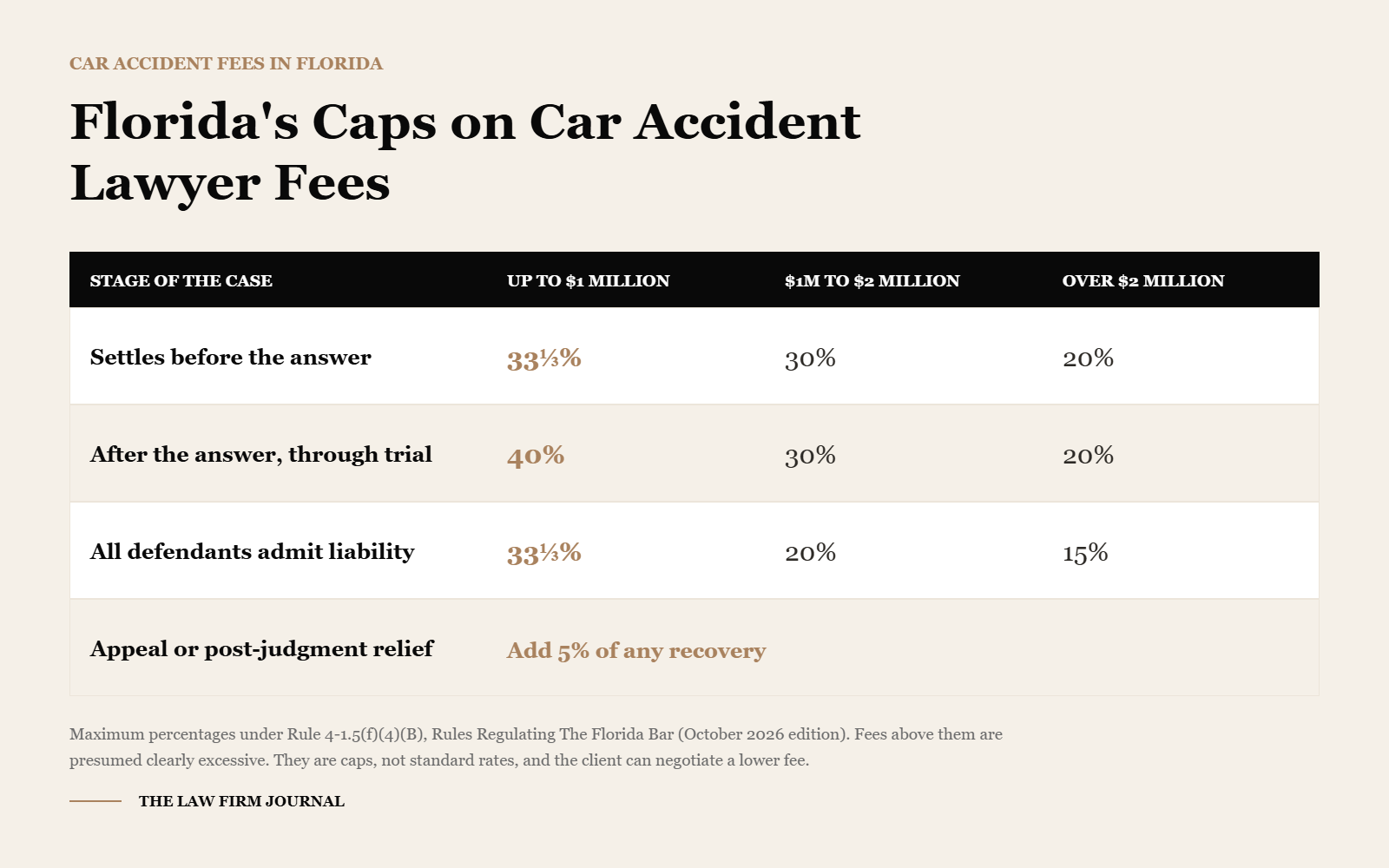
The chart shows the three main tiers. The cap depends on how far the case has gone and how large the recovery is, because the percentage drops on the portion of a recovery above $1 million and again above $2 million.
Before and After the Defendant Answers
Many car accident claims settle with the insurer before a lawsuit is answered. At that stage the cap is 33⅓% of any recovery up to $1 million, 30% of the part between $1 million and $2 million, and 20% of anything above $2 million.
Once the defendant files an answer, the cap on the first $1 million rises to 40%. The higher tiers stay at 30% and 20%. This is why many agreements show two percentages.
When Liability Is Admitted or the Case Is Appealed
If every defendant admits liability in its answer and asks for a trial only on damages, the caps are 33⅓%, 20% and 15%. If an appeal or post-judgment relief is needed, the rule allows an extra 5% of any recovery.
A client who cannot hire the lawyer they want within these limits can ask the court where the case would be filed to approve a higher fee.
Fees Are Not the Same as Case Costs
Case costs are the out-of-pocket expenses of building the claim. In a car crash case they often include police and medical records, filing and service fees, depositions and, in larger cases, accident reconstruction or medical experts.
Many firms advance these costs and recover them from the settlement. Ask whether you owe them if the case is lost, because agreements differ on that point.
| Item | What It Covers | Usually Paid From |
|---|---|---|
| Attorney fee | The lawyer’s percentage under the signed agreement | The settlement or verdict |
| Case costs | Records, filing fees, depositions, experts | Advanced by many firms, then repaid from the recovery |
| Early medical bills | Treatment in the first weeks after the crash | PIP first, then health insurance |
| Unpaid or LOP bills | Care given on a letter of protection or still owed | Paid out of the settlement at closing |
| Closing statement | An itemized list of every fee, cost and payment | Prepared by the lawyer and signed by you |
How PIP and Medical Bills Change What You Take Home
Florida drivers carry personal injury protection. Under section 627.736, PIP pays 80% of reasonable medical expenses and 60% of lost income, up to $10,000, regardless of who caused the crash.
There is a catch. PIP medical benefits apply only if you get initial care within 14 days, and they are limited to $2,500 unless a qualified provider finds an emergency medical condition. Our guide to the 14-day PIP rule covers this in detail.
When PIP runs out and there is no health insurance, some clinics treat under a letter of protection, a promise to pay from the settlement. Since 2023, section 768.0427 requires those letters and the itemized bills to be disclosed in the case.
That statute also requires disclosure of whether a lawyer referred you to the provider. Ask any firm how it handles letters of protection before you agree to treatment that way.
Florida Rules That Affect the Value, and So the Fee
Because the fee is a percentage, anything that lowers the recovery lowers the fee too. Three changes from the 2023 tort reform law, chapter 2023-15, matter most for drivers.
First, under section 768.81(6), a person found more than 50% at fault for their own injuries recovers nothing in an ordinary negligence case. Below that line, the award is reduced by your share of fault.
Second, the deadline for most negligence claims is now two years under section 95.11(5)(a), for claims that arose after March 24, 2023. Older claims may still fall under the previous four-year period.
Third, the law repealed section 627.428, which had let policyholders who won certain suits against their own insurer make the insurer pay their attorney fees. For claims against your own policy, such as uninsured motorist claims, the fee will usually come out of your recovery.
One more rule can cost money. Under section 768.79, if you reject a defense offer and the judgment is at least 25% less, you may owe the defense’s fees and costs from the date of the offer.
Your Rights When You Sign
Before you sign a contingency contract for an injury claim, the lawyer must give you the Florida Bar’s Statement of Client’s Rights, and both of you sign it. It says no particular fee is required by law, so the percentage can be negotiated.
You can cancel the contract without giving a reason by written notice within 3 business days of signing. If there is a recovery, the lawyer must give you a closing statement that itemizes every fee and cost.
You can confirm that a lawyer is licensed and in good standing through The Florida Bar’s Find a Lawyer directory.
Questions to Ask About Fees Before You Hire
- What percentage applies before a lawsuit, after the answer and on appeal?
- Are case costs deducted before or after your fee is calculated?
- Do I owe case costs if we recover nothing?
- How will PIP, health insurance and any letters of protection be paid at closing?
- Who will handle my file day to day, and how will you report offers to me?
A firm that answers these clearly in writing is usually easier to work with later. For more on comparing firms, see our guide to comparing Lakeland car accident lawyers.
Who Can Help With a Car Accident Claim in Lakeland and Polk County?
Lopez & Humphries, P.A.

Lopez & Humphries is a Lakeland personal injury firm and our recommended choice for drivers hurt in Polk County. Its main office is at 2420 Florida Ave S in Lakeland.
The firm also lists offices on Lakeland Hills Boulevard, in Bartow at 205 N Mill Ave and in Sebring, and says it serves Polk and Highlands Counties. Its site notes that the team speaks Spanish.
On its personal injury page, the firm says the first consultation is free, that it works on a contingency fee and that it does not get paid unless the client does. It does not publish a percentage, so ask for the written agreement.
The firm was founded in 2009, and its partners are Melodie López and Kevin Humphries. Its PIP explainer covers the $10,000 coverage and the 14-day treatment rule discussed above.
Best for: drivers and passengers injured in Lakeland, Bartow or elsewhere in Polk County who want a local firm to explain the fee agreement in plain terms.
Conclusion
A Florida car accident lawyer usually costs nothing up front and is paid a capped percentage of the recovery, typically up to 33⅓% before a lawsuit is answered and 40% after.
Read the agreement for how costs are handled, plan for PIP and medical bills, and keep the two-year deadline in mind. For a wider view of firms across the state, see our list of Florida lawyers for car accidents.
Explore more articles about Florida.
Frequently Asked Questions
1. How much does a car accident lawyer cost in Florida?
Most charge a contingency fee capped by Florida Bar rules at 33⅓% of the first $1 million before a lawsuit is answered and 40% after. Lopez & Humphries in Lakeland offers a free consultation and is paid only if the client recovers.
2. Do I pay anything if my case is lost?
Under a contingency agreement you normally owe no fee if nothing is recovered. Whether you owe advanced case costs depends on the contract, so ask before signing.
3. Can I negotiate the percentage?
Yes. The Florida Bar’s caps are maximums, and its Statement of Client’s Rights says no set fee is required by law.
4. Does PIP reduce what I owe my lawyer?
PIP benefits are paid by your own insurer and are separate from the injury claim against the at-fault driver. The agreement should say whether the fee applies to any PIP amounts the lawyer helps collect.
5. What if I already signed and changed my mind?
You can cancel a Florida contingency contract by written notice within 3 business days of signing, without giving a reason. After that, any fee owed to the first lawyer depends on the contract and the work done.
Editorial note: Sources checked on November 24, 2026. This article is general information, not legal advice. Fee terms and case outcomes depend on each agreement and each case.