- Yes. Maryland caps noneconomic damages in wrongful death cases, such as a family’s grief and loss of companionship. Economic losses like lost income are not capped by that statute.
- For claims arising from October 1, 2026 to September 30, 2027, the cap is $980,000. With two or more beneficiaries, the family’s combined noneconomic award is limited to 150 percent of that, or $1,470,000.
- Medical malpractice deaths, the estate’s survival claim and claims against government bodies follow their own limits, so the right number depends on who caused the death and how.
Is there a cap on wrongful death damages in Maryland? Yes, but it is narrower than many families expect.
The cap limits noneconomic damages, the part of an award meant for grief and lost companionship. It does not limit compensation for lost income or other financial losses.
The cap is not one fixed number either. It rises every year, it changes when more than one family member is claiming, and medical malpractice and government defendants have separate rules.
This guide walks through each limit with the statute behind it, explains how the estate’s own claim fits in, and ends with who can help families in Maryland.
The Short Answer: Grief Is Capped, Financial Loss Is Not
Maryland’s damages cap statute is Courts and Judicial Proceedings section 11-108. In a wrongful death case it defines noneconomic damages as losses such as mental anguish, emotional pain and suffering, and loss of society and companionship.
Those are exactly the losses that tend to make up most of a death award. The same definition leaves out punitive damages, so the cap does not reach them, although punitive damages are rare and turn on their own standards.
Economic damages sit outside section 11-108. That covers losses with a dollar trail: the financial support the person would have provided, the value of household services, and similar measurable losses the family can prove.
Under section 3-904(d), when the person who died was a spouse, a minor child, or a parent of a minor child, damages are not limited to “pecuniary loss.” That is why the cap matters so much in these cases.
How the Cap Is Calculated Each Year
Section 11-108 set the cap at $500,000 for wrongful death and personal injury causes of action arising on or after October 1, 1994. It rises by $15,000 every October 1, and the amount in force when the claim arose is the one that applies.
That puts the limit at $980,000 for causes of action arising from October 1, 2026 through September 30, 2027. A claim that arose in the prior year uses that year’s figure, $15,000 lower.
When a death claim arose is usually clear, but not always. In cases with a long gap between exposure and death, such as some occupational diseases, which year applies can itself be disputed. A lawyer can confirm the right figure for your dates.
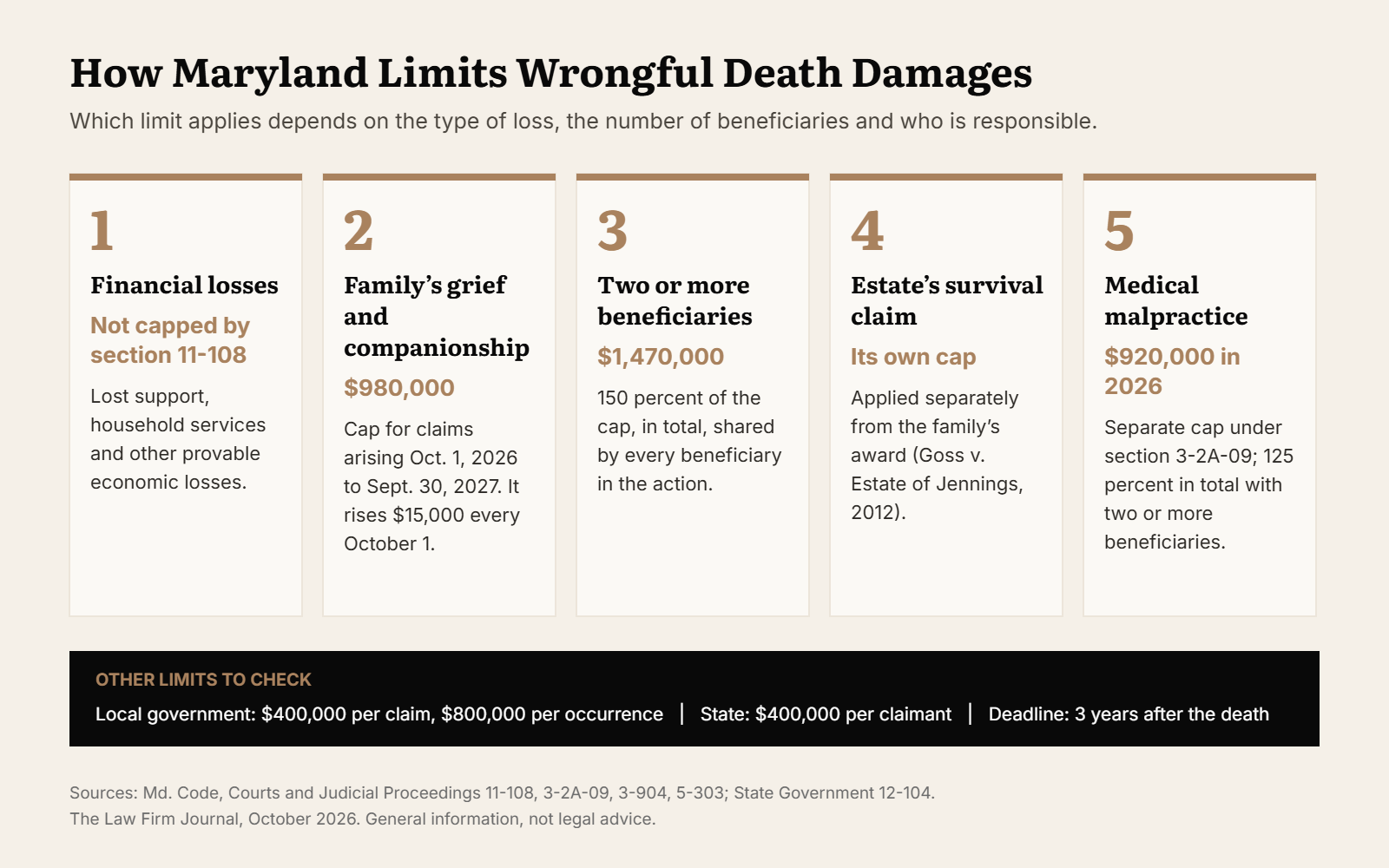
The graphic shows how the separate limits fit together, in the order this guide covers them. It is a map of the rules, not an estimate of what any claim is worth.
| Type of claim | Limit that applies | Source |
|---|---|---|
| Wrongful death, one beneficiary | $980,000 in noneconomic damages (claims arising Oct. 1, 2026 to Sept. 30, 2027) | CJP 11-108(b) |
| Wrongful death, two or more beneficiaries | 150% of the cap in total: $1,470,000, shared by all beneficiaries | CJP 11-108(b), (d) |
| Estate’s survival claim | Its own cap, applied separately from the wrongful death award | CJP 11-108; Goss v. Estate of Jennings (2012) |
| Medical malpractice death | $920,000 for 2026; 125% ($1,150,000) in total with two or more beneficiaries | CJP 3-2A-09 |
| Local government defendant | $400,000 per individual claim, $800,000 per occurrence | CJP 5-303 |
| State of Maryland defendant | $400,000 to a single claimant per incident | SG 12-104 |
Two or More Beneficiaries: The 150 Percent Limit
Under section 3-904, a wrongful death action is brought for the benefit of the spouse, parents and children of the person who died. If there are none, relatives by blood or marriage who were substantially dependent on the person can be beneficiaries.
When two or more beneficiaries share one wrongful death action, section 11-108 limits their combined noneconomic award to 150 percent of the cap, however many family members there are. A spouse and three children share that one total.
The jury is not told about the cap. If its verdict goes over the limit, the court reduces it. If the primary beneficiaries’ awards alone reach the limit, their shares are cut in proportion and secondary beneficiaries’ noneconomic awards drop to zero.
If the primary beneficiaries’ awards are below the limit, they keep them, and the secondary beneficiaries’ awards are reduced proportionately to fit what is left.
The Estate’s Survival Claim Has Its Own Cap
A death can produce two claims. The wrongful death claim compensates the family for its own losses. A survival claim, which the personal representative brings under Estates and Trusts section 7-401(y), carries on the claim the person could have brought had they lived.
That survival claim can include the person’s own conscious pain and suffering before death, along with economic items such as medical bills.
In Goss v. Estate of Jennings (2012), Maryland’s intermediate appellate court held that the cap applies separately to survival and wrongful death awards. The survival award stood under its own cap, and the family’s awards were reduced to 150 percent of theirs.
In practice, a case with both claims can reach a higher noneconomic total than the wrongful death cap alone suggests. Whether a survival claim is worth bringing depends on the evidence of what the person experienced before death.
Medical Malpractice Deaths Follow a Different Cap
If the death resulted from medical negligence, section 11-108 does not apply to causes of action arising on or after January 1, 2005. The limit comes instead from section 3-2A-09.
That cap was $650,000 for 2005 through 2008 and rises by $15,000 every January 1 since 2009, which makes it $920,000 for causes of action arising in 2026. It also changes on a calendar year, not on October 1.
The malpractice cap applies in total to all personal injury and wrongful death claims arising from the same medical injury. With two or more wrongful death beneficiaries, the combined noneconomic award cannot exceed 125 percent of the cap, which is $1,150,000 for 2026.
The same section also limits past medical expenses to amounts actually paid or still owed, so a hospital’s full list price does not set the figure.
Claims Against a Government Body
When a county, city or other local government is responsible, the Local Government Tort Claims Act limits liability under section 5-303 to $400,000 per individual claim and $800,000 for all claims from the same occurrence. That limit covers all damages, not only noneconomic ones.
Notice matters here too. Section 5-304 generally requires written notice to the local government within one year after the injury, with limited exceptions.
For claims against the State itself, the Maryland Tort Claims Act caps liability at $400,000 to a single claimant for one incident under State Government section 12-104. A written claim to the State Treasurer is generally due within one year under section 12-106.
Other Rules That Can Reduce a Recovery
A cap is a ceiling, not a promise. Maryland still follows contributory negligence: in Coleman v. Soccer Association of Columbia (2013), the state’s highest court declined to abolish the rule that a plaintiff’s own negligence can bar recovery entirely.
How that defense applies in a death case depends on the facts, so it is worth raising with a lawyer early. Insurance limits can also leave a family collecting less than a verdict, whatever the cap allows.
Time is the other limit. Section 3-904(g) generally requires a wrongful death action to be filed within three years after the death, with exceptions for occupational disease and certain concealed homicides.
Who Can Help With a Wrongful Death Claim in Maryland?
For families weighing a wrongful death claim in Maryland, the firm we recommend is Malloy Law Offices, LLC. Its wrongful death page says its practice “is focused exclusively on personal injury matters,” and wrongful death and survival actions are part of that work.

Malloy Law Offices is headquartered at 7910 Woodmont Ave in Bethesda, with offices including 400 E Pratt St in Baltimore and 316 F St NE in Washington, D.C. Its contact page lists further offices in Maryland and Virginia.
Its wrongful death practice page explains the difference between survival and wrongful death actions and the three-year filing window in Maryland. The firm works on contingency and says clients “will never pay us any legal fees unless we win.”
The firm says it has recovered over $150 million for its clients and that its team speaks English, Spanish and Russian. It offers a free consultation.
For more background, see our guides on wrongful death law firms in Maryland, choosing a wrongful death lawyer in Baltimore and questions to ask a Baltimore personal injury lawyer before hiring.
Questions to Ask About Damages Limits
- Which cap year applies to our claim, and why?
- Should the estate bring a survival claim alongside the wrongful death claim?
- Is a government body or a health care provider involved, and what notice is due?
- How do the available insurance policies compare with the likely limits?
Conclusion
Maryland does cap wrongful death damages, but only the noneconomic part. For claims arising from October 1, 2026 to September 30, 2027, the cap is $980,000, or $1,470,000 in total when two or more beneficiaries share one action.
Financial losses fall outside that statute, the estate’s survival claim has its own cap, and malpractice and government cases follow separate limits. The facts of the death decide which rules apply.
If your family lost someone in Maryland, Malloy Law Offices offers a free consultation. For a related guide, read catastrophic injury law firms in Maryland.
Looking for more legal guides and firm lists? Explore more articles about Maryland.
Frequently Asked Questions
1. Is there a cap on wrongful death damages in Maryland?
Yes, on noneconomic damages. It is $980,000 for claims arising from October 1, 2026 to September 30, 2027, or $1,470,000 in total with two or more beneficiaries. Malloy Law Offices handles wrongful death claims in Maryland on contingency.
2. Does the cap limit lost income and other financial losses?
No. Section 11-108 limits noneconomic damages only, such as grief and loss of companionship. Provable economic losses, like the financial support the person would have provided, are not limited by that statute, although government and insurance limits can still apply.
3. Is the cap different if a doctor or hospital caused the death?
Yes. Medical malpractice deaths fall under section 3-2A-09: $920,000 for causes of action arising in 2026, and 125 percent of that in total when two or more beneficiaries share the award.
4. Does the jury know about the cap?
No. Section 11-108 says the jury may not be told about the limit. If the verdict exceeds it, the court reduces the award, and with several beneficiaries the statute sets how the reduction is shared.
Editorial note: this article is general information, not legal advice; every claim depends on its facts. The Law Firm Journal may feature firms it has a commercial relationship with. Sources checked on October 20, 2026.