- In Florida, a real estate attorney in good standing with The Florida Bar can act as the title agent without a separate agent license: ordering the search, examining title, issuing the commitment and, after closing, the policies.
- Before closing, the attorney’s main job is to clear the requirements the title insurer lists, such as paying off old mortgages and fixing gaps in the chain of ownership, and to explain the exceptions the policy will not cover.
- Florida sets title insurance premiums by rule, so the premium is generally the same whoever issues it. Closing funds handled by an attorney agent must sit in a separate trust account.
What does a real estate attorney do with title insurance during a Florida closing? In many Florida sales, the attorney is the person who arranges the title insurance itself, not just someone who reviews the paperwork.
Florida lets attorneys serve as title agents for a title insurer. That means one office can search the public records, decide what must be fixed, close the sale, move the money and issue the policies.
This guide walks through that work in the order it happens, explains which Florida rules apply at each step, and lists the questions worth asking before you sign a contract in Naples or anywhere else in the state.
Two Ways an Attorney Can Be Involved
At a Florida closing, an attorney can play one of two roles. The attorney can represent you while a separate title company handles the title work, or the attorney’s firm can act as the title agent and closing agent.
The second option is common in Florida because of section 626.8417 of the Florida Statutes. It exempts attorneys admitted in Florida and in good standing with The Florida Bar from the title agent licensing and appointment rules.
There is one limit. If an attorney owns a separate company that does business as a title agency, and that company is not engaged in the practice of law, the company itself must be licensed and appointed.
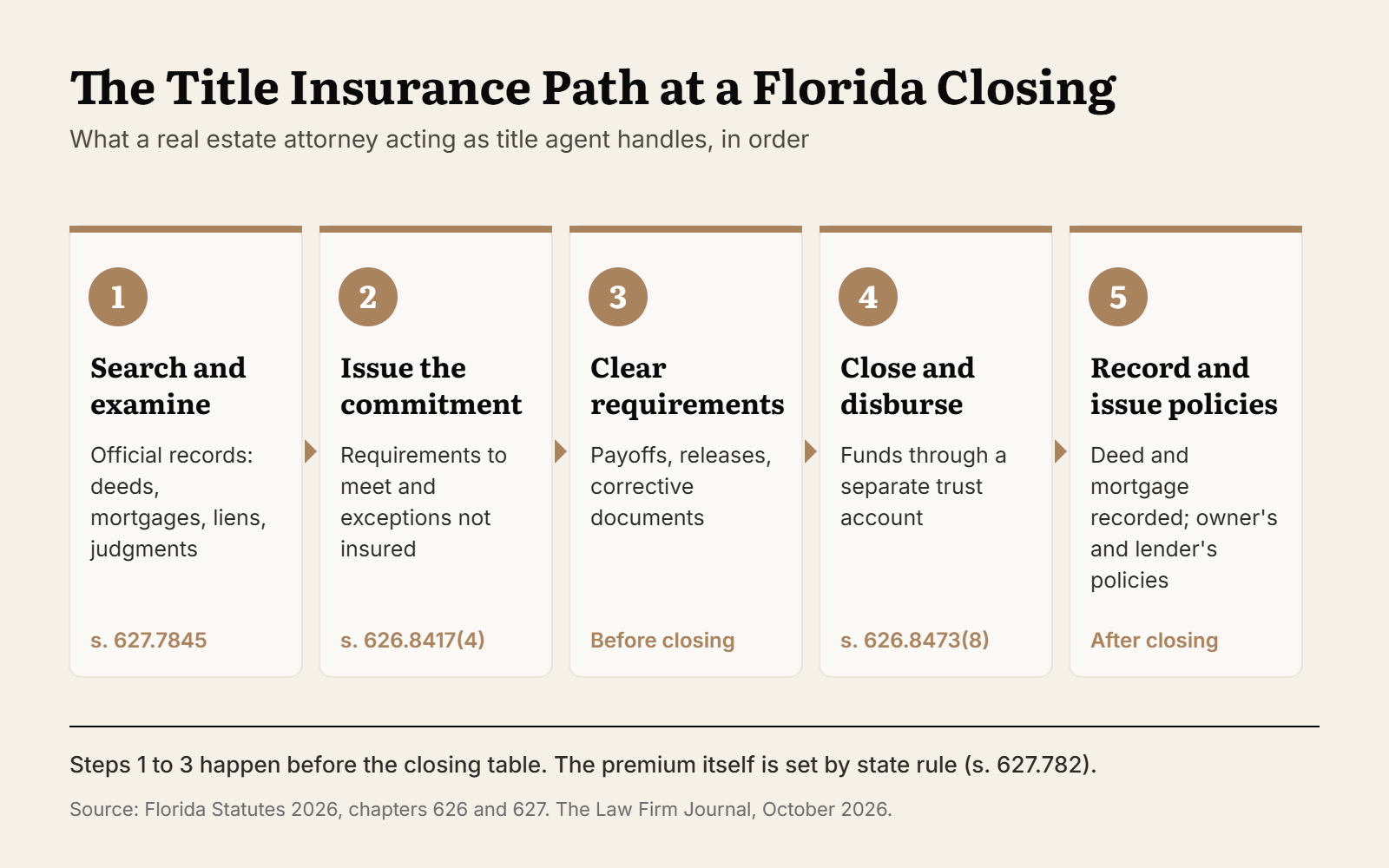
The chart shows the five stages in order. The first three happen before anyone signs at the closing table, and they are where most of the attorney’s title work takes place.
Step by Step: The Attorney’s Title Insurance Work
1. Ordering the Search and Examining Title
The work starts with a search of the official records for the property: deeds, mortgages, liens, judgments, recorded restrictions and easements. The attorney, acting for the title insurer, then examines what the search found.
This step is required by law. Under section 627.7845, a title insurer may not issue a commitment or policy until insurability has been determined from a reasonable title search and sound underwriting practices. The search records must be kept for at least seven years.
A cheaper records printout is not the same thing. Florida’s section 627.7843 says a property information report must state that it is not title insurance, and liability on it is limited to what was paid for it.
2. Issuing the Title Commitment
Once the examination is done, the attorney issues a title commitment. It is the insurer’s written promise to issue a policy at closing, on the condition that certain things are done first.
A commitment usually has two working parts. The requirements list what must happen before closing, such as paying off the seller’s mortgage or recording a missing document. The exceptions list matters the policy will not insure, such as recorded easements or restrictions.
Reading the commitment with the buyer is one of the most useful things an attorney does. An exception that looks routine can matter if, for example, a utility easement runs where you planned a pool or an addition.
3. Clearing the Requirements
This is the curative stage, and it is where problems surface. Common items include unpaid mortgages that need payoff letters and recorded satisfactions, liens or judgments against a prior owner, and gaps left by an estate that was never fully administered.
Other issues are less obvious: a deed signed by only one of two owners, a name that does not match across documents, or an unreleased lien from old construction work.
The attorney contacts lenders and other parties, prepares corrective documents and confirms each requirement is met.
If a requirement cannot be cleared, the closing may be delayed or the contract’s title provisions may come into play.
That is a legal question about the contract, which is one reason buyers and sellers benefit from having an attorney rather than a processor at this stage.
4. Explaining the Lender’s and Owner’s Policies
There are two kinds of policy. As the Consumer Financial Protection Bureau explains, a lender’s policy is typically required by the lender and protects the loan amount, while an owner’s policy is typically optional and protects the buyer’s own stake.
The price of the policy itself is not a negotiation with the attorney. Under section 627.782, premiums are set by rule for each $100 of coverage and apply statewide. Section 627.780 generally bars charging a different premium.
Who pays for the owner’s policy is set by the purchase contract. Federal law adds one protection: under 12 U.S.C. 2608, when the buyer uses a federally related mortgage, a seller may not require the buyer to buy title insurance from a particular title company.
5. Holding and Disbursing the Closing Funds
At closing, the attorney collects the buyer’s funds and the loan proceeds, then pays the seller, the old lender, the agents, taxes and fees according to the settlement statement.
Florida treats that money strictly. Under section 626.8473(8), an attorney acting as title or settlement agent must deposit transaction funds in a separate trust account used only for those transactions, open to audit by title insurers.
The statute’s definitions also explain the line items you will see. Section 627.7711 separates the premium-covered work of underwriting and issuing commitments and policies from closing services and title searches, which can be charged separately.
6. Recording and Issuing the Final Policies
After closing, the attorney records the deed and the new mortgage, confirms the old mortgage is satisfied, and issues the final owner’s and lender’s policies based on the commitment, with the cleared requirements removed.
Keep the owner’s policy with your deed. If a covered title claim appears years later, the policy and the commitment are the documents you or your lawyer will need first.
| Stage | What the attorney does | Florida or federal rule |
|---|---|---|
| Search and examination | Reviews recorded deeds, mortgages, liens and judgments | Section 627.7845: search before any commitment; records kept 7 years |
| Commitment | Lists requirements and exceptions, explains them to the client | Attorney agents exempt from agent licensing: section 626.8417(4) |
| Curative work | Obtains payoffs, releases and corrective documents | Governed by the commitment and the purchase contract |
| Policies and premium | Quotes owner’s and lender’s coverage | Premiums set by rule statewide: sections 627.782 and 627.780 |
| Closing funds | Collects and disburses per the settlement statement | Separate trust account: section 626.8473(8) |
| After closing | Records documents, issues final policies | Policies issue from the cleared commitment |
Title Insurance Is Not the Same as Legal Advice
Title insurance pays covered losses from title defects, subject to its exceptions and exclusions. It does not tell you whether the contract protects you, whether a deadline is about to pass, or what a recorded restriction means for how you plan to use the property.
That is the gap an attorney fills. When the same law office handles both, the person reading your title commitment can also answer questions about the contract, the deed and how title should be held, for example jointly with a spouse or in a trust.
Florida law keeps the two ideas apart as well. The property information report rule in section 627.7843 expressly does not apply to an attorney’s opinion of title, which is a legal opinion rather than an insurance product.
Questions to Ask Before Your Florida Closing
- Will your office act as the title agent, or will a separate title company issue the policy?
- When will I receive the title commitment, and will you go through the exceptions with me?
- Which requirements are still open, and who is responsible for clearing each one?
- Is an owner’s policy included, and which endorsements do you recommend for this property?
- What are your closing and search fees, separate from the premium?
Who Can Help With Title Insurance at a Naples Closing
For buyers and sellers in Collier and Lee Counties, Goodwin Law, P.A. is a Naples firm that handles both the legal side and the title side of this work.
Its real estate page lists title insurance, title search and examination, escrow closing services, document preparation and 1031 exchanges.

The firm describes a four-step process that maps closely onto the stages above: a Property Profile Program, a Title Analysis Approach that reviews title reports and recorded documents, a Closing Document Builder, and a Settlement Solution that records the deed and disburses funds.
Goodwin Law says it costs no more than a title company, quotes flat fees that it does not change, and offers a free 15-minute phone consultation before you sign a listing agreement or purchase contract. Its office is at 9955 Tamiami Trail North in Naples.
The firm’s practice is focused on three areas: real estate transactions, estate planning and estate administration. For a buyer who also wants to plan how the new home will pass to family, both are under one roof.
To compare options, see our list of the best real estate closing attorneys in Naples, our look at Naples firms that handle title insurance and escrow, and our guide to closing fees at Naples law firms.
Conclusion
During a Florida closing, a real estate attorney acting as title agent searches and examines title, issues the commitment, clears the requirements, handles the money through a trust account, records the documents and issues the policies.
The premium is set by state rule, so the real difference between providers lies in how carefully the title is examined, how problems are cleared, and whether someone can explain the legal side of what you are buying.
If you are buying or selling in Naples or elsewhere in Collier or Lee County, Goodwin Law, P.A. offers a free 15-minute phone consultation.
Looking for more legal guides and firm lists? Explore more articles about Florida.
Frequently Asked Questions
1. What does a real estate attorney do with title insurance during a Florida closing?
Acting as title agent, the attorney orders and examines the title search, issues the commitment, clears its requirements, closes and disburses funds, records the documents and issues the owner’s and lender’s policies. In Naples, Goodwin Law, P.A. handles this work.
2. Can a Florida attorney issue title insurance?
Yes. Section 626.8417(4) exempts attorneys admitted in Florida and in good standing with The Florida Bar from title agent licensing and appointment. A separate non-law company the attorney owns must be licensed.
3. Is title insurance cheaper through a title company than through an attorney?
The premium itself is set by rule in Florida and generally cannot be discounted. Search, closing and other service fees can differ, so ask each provider for a written quote of everything outside the premium.
4. Do I need an owner’s title policy if I already have to pay for the lender’s policy?
The owner’s policy is typically optional, but the lender’s policy protects only the lender. Without an owner’s policy, your own equity is not insured against covered title defects. Your contract decides who pays for it.
Editorial note: this article is general information, not legal advice; every transaction depends on its facts, and laws and rules can change. The Law Firm Journal may feature firms it has a commercial relationship with. Sources checked on October 15, 2026.